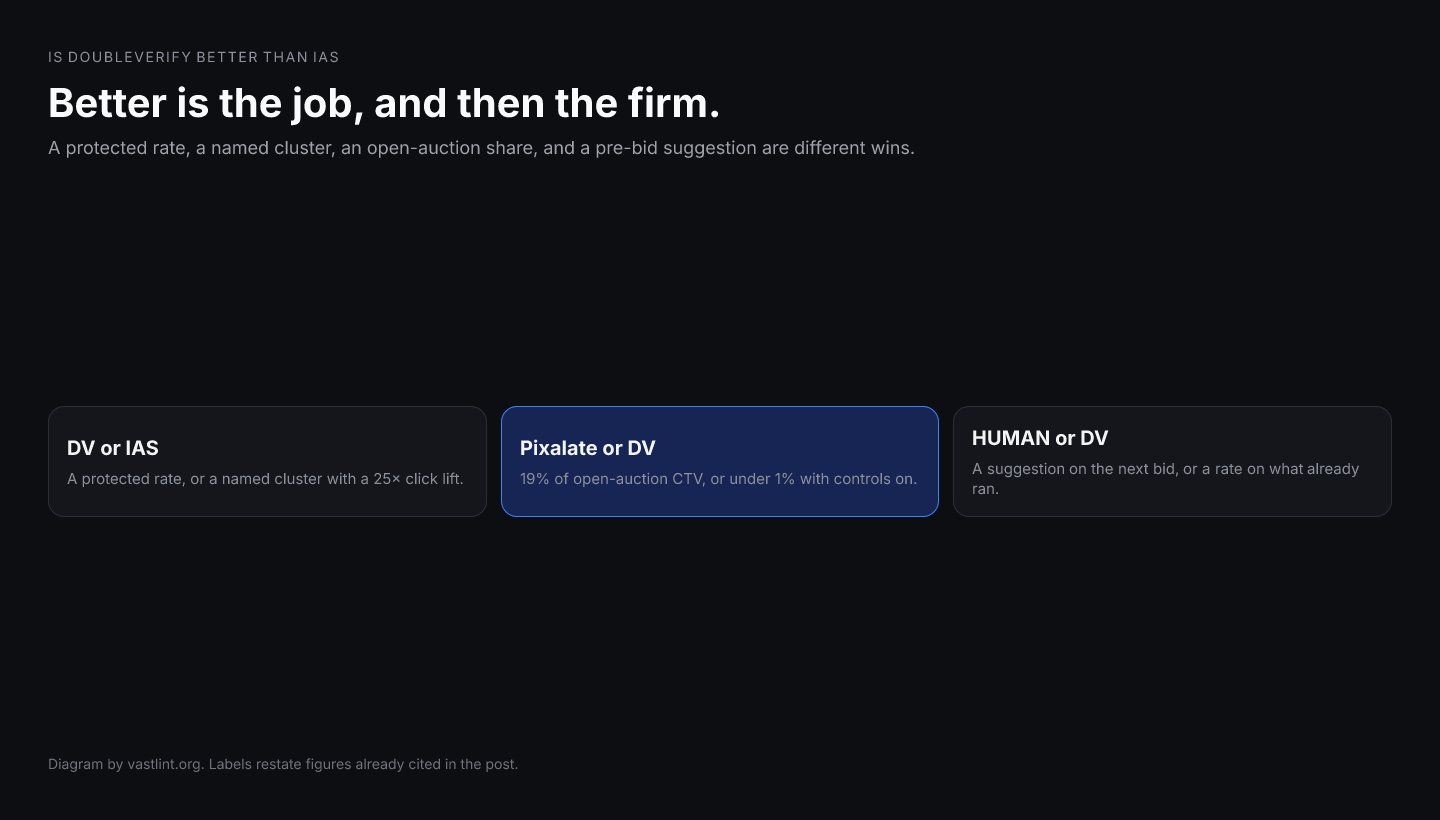
Is DoubleVerify better than IAS is the question form of a shortlist the pair notes already separate. People also type which is better, DoubleVerify or IAS, should I switch from IAS to DoubleVerify, and IAS or DoubleVerify for CTV. The same shape shows up as is Pixalate better than DoubleVerify, is HUMAN better than DoubleVerify, and is Pixalate better than Integral Ad Science. Each one asks for a winner. The public figures ask for a job.
IAS's traveling number is Papyrus, August 6, 2026: a named mobile cluster with nearly 25 times the click success rate, roughly 4 times the eCPM, and about 13 percent higher attention than other traffic IAS had already separated. DoubleVerify's traveling number is May 7, 2026: CTV fraud under 1 percent with its controls on, nearly 9 percent with them off, and 140 percent more schemes year over year, which is a count. Pixalate's is March 9, 2026: 19 percent of US CTV impressions invalid in a predominantly open-auction set. HUMAN's is a suggestion on the OpenRTB request, and the MRC's April 11, 2025 memorandum says the platform decides whether that suggestion becomes a drop.
A firm can be the right hire for one of those sentences and a mismatch for the next. vastlint does not pick the winner. It checks whether the VAST 2.0–4.4 tag still contains the verification node the hire would have to read.
Is DoubleVerify better than IAS
Only if the job is the protected CTV cell, and only as a description of that cell. Under 1 percent is what remained after DV controls. It is not a statement that DV would have produced a smaller Papyrus, because Papyrus is a mobile cluster IAS had already split out of its own observation, scored on clicks, price, and attention. IAS's follow-on is a list of apps, domains, and hostnames filtered after identification. That list is a different artifact from a pre-bid segment DV supplies to DSPs and, through them, to advertisers.
The reverse question, is IAS better than DoubleVerify, has the same shape. Papyrus is evidence about a scheme that was found. It is not a CTV impression share, and it is not the rate on a campaign with controls off. IAS's verification page also describes suitability controls, pre-bid filtering and post-bid blocking for content outside brand guidelines. If the contract is suitability, Papyrus is the wrong scoreboard, and so is the May 2026 fraud rate. The pair note keeps the figures. This paragraph only says which question they can answer.
Is Pixalate better than DoubleVerify for CTV
People type this when 19 percent and something under 10 percent are sitting in one slide. Pixalate's 19 percent is a classification of predominantly open-auction US CTV. DoubleVerify's under 1 percent is a protected campaign, and the nearly 9 percent is the test with controls off. A lower rate after a control is the control. Calling Pixalate better because 19 is closer to an unfiltered market, or DoubleVerify better because 1 is smaller, ranks the filter, not the firm.
Device rows inside Pixalate make the same point without a second logo. Fire TV at 14 percent and Samsung Smart TV at 28 percent are one quarter. A method that moves fourteen points when the device changes does not become a vendor ranking when the next number comes from a different firm and a different filter. For a protected buy, the open-auction share is the wrong target. For a picture of the open auction, the protected rate is the wrong target.
Is HUMAN better than DoubleVerify, and is Pixalate better than Integral Ad Science
Is HUMAN better than DoubleVerify compares a pre-bid suggestion with a campaign rate. MediaGuard returns an IVT prediction on the request, before the impression exists. FraudSensor is required beside it. The MRC says HUMAN's suggestion goes to DSPs and SSPs, not to advertisers, and that HUMAN does not itself drop the request. DV's segments, on the same memorandum, can reach advertisers through DSPs, and DV's under-1-percent figure is a later measurement of campaigns that ran. Better at blocking the next bid and better at labeling a served campaign are both real procurements. They are not one ranking.
Is Pixalate better than Integral Ad Science, which is also typed Pixalate vs IAS, compares the 19 percent open-auction share with Papyrus's click multiple. A quarterly impression benchmark does not say whether the reading-app cluster was in the set. The cluster's lift does not say what share of US CTV Pixalate would have called invalid. The full figures are on the pair pages. The decision is to stop averaging them.
Get VAST spec updates, platform guides, and release notes in your inbox.
What to do with the question
Write the job in the cell where the winner was going to go. Protected CTV rate, named-scheme study, open-auction benchmark, pre-bid suggestion, suitability, attention. Is DoubleVerify better than IAS becomes answerable inside one of those rows, and it stays unanswered across them. If you need both a pre-bid seat and a post-bid label, the next note is whether to run the firms together, which is a tag question, not a winner.
Keep the pair pages for the numbers. This page is the map of the question. vastlint still does not classify invalid traffic. After the job is chosen, the tag either carries that firm's verification node or the measurement is a claim about a document that omitted it.
Answers that stay inside one job
- Is DoubleVerify better than IAS: only for the job you named. Papyrus is a 25-times click lift on a named mobile cluster. The under-1-percent figure is protected CTV.
- Is Pixalate better than DoubleVerify for CTV: 19 percent is an open-auction share. Under 1 percent is a protected rate. Nearly 9 percent is the control turned off.
- Is HUMAN better than DoubleVerify: a suggestion on the bid, acted on by the platform, is a different hop from a rate on impressions that already ran.
- Is Pixalate better than Integral Ad Science: a quarterly impression share and a cluster study do not order each other.
- Which verification vendor should I use: the one whose public artifact matches the job. The tag still has to carry the node.
A winner exists inside one job, and a shortlist that asks which firm is better has usually skipped the job.
Check the tag after the job is chosen
Run VAST 2.0–4.4 tags against specification-derived rules so the verification node is present. Nothing is stored. This does not choose a vendor.
Open the VAST validatorSources
The figures behind is DoubleVerify better than IAS.
The figures behind the CTV version of the question.
The figures behind is HUMAN better than DoubleVerify.
What changes when the answer is both, rather than a winner.