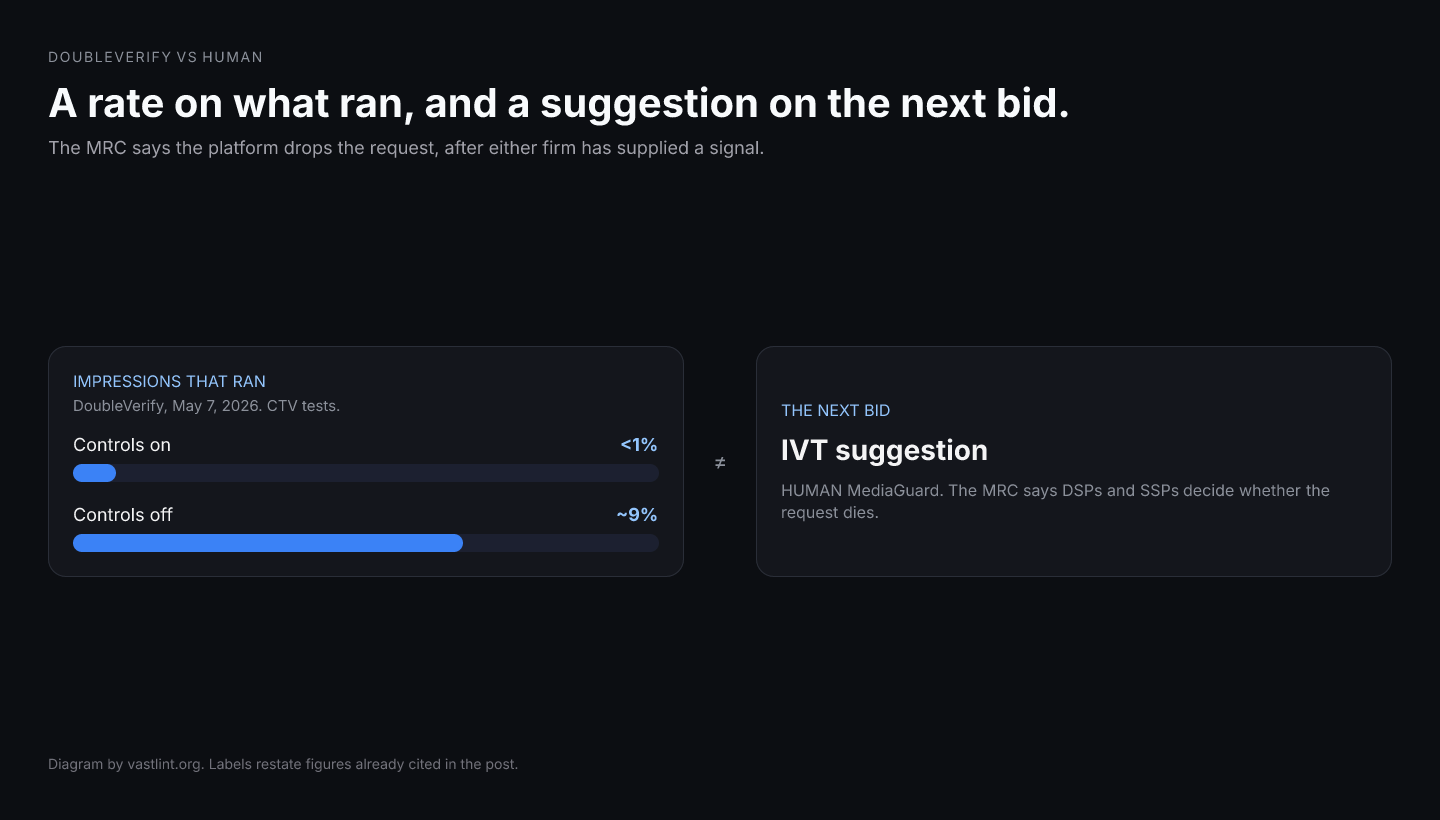
DoubleVerify vs HUMAN, and the reverse search HUMAN vs DoubleVerify, is the shortlist for two firms buyers call when they want invalid traffic kept off a campaign. The public artifacts are not the same artifact. On May 7, 2026, DoubleVerify said fraud rates on DV-protected CTV campaigns were under 1 percent, and nearly 9 percent where protection controls were not applied. HUMAN's MediaGuard documentation describes a prediction, made from the OpenRTB bid, of whether that opportunity is likely invalid, returned before the impression exists. On April 11, 2025, the Media Rating Council described both firms and then said the same structural thing about each: the firm supplies a signal, and the platform decides whether to act.
One sentence is about impressions that were bought and then measured, split by whether a control was on. The other is about a request that has not been bought. A buyer who treats the under-1-percent rate as HUMAN's block rate, or treats a MediaGuard flag as a statement about a CTV campaign, has changed the hop and the unit in one move.
Both firms will take a fee to reduce invalid traffic. The research release and the integration docs do not say they are reducing the same thing at the same moment. Remove the names and a protected-campaign rate still does not rank a suggestion on a bid request.
What the DoubleVerify figures measure
The May 7 release is explicit about two CTV populations. Protected campaigns, verification controls applied, showed fraud under 1 percent. Unprotected campaigns, controlled tests where those controls were not applied, showed nearly 9 percent. The measurement spans billions of impressions. The unprotected cell is the cell where DV says the controls were off. It is not a census of CTV.
Other lines in that release do not belong in the same cell. One hundred forty percent more CTV fraud schemes and variants, first quarter of 2026 versus first quarter of 2025, is a count of operations. About $1.8 million per billion impressions is an estimated cost on unprotected campaigns. Direct deals have their own rows: 34 percent of impressions to bots in one healthcare campaign, 25 percent in a CPG campaign. North America violations were 82 percent bot fraud. APAC violations were 98 percent data-center traffic.
The pre-bid product is a further object, described by the MRC rather than by the CTV release. The April 11, 2025 memorandum says DV provides pre-bid segments and IVT classifications to DSPs, SSPs, and advertisers and agencies through DSPs, by API or by flat file, built from back-end detection. It says DV does not directly filter requests or prevent ad serving. It says DV can enable blocking after the serve, only where the client configured it, and that this configuration is part of what an audit looks at. A trader querying a segment, and a campaign whose post-bid rate came in under 1 percent, are both DoubleVerify. They are not one number.
What the HUMAN figures measure
MediaGuard sits between bid requests received and bids made. The caller sends fields from the bid, or the OpenRTB BidRequest. MediaGuard returns a prediction, including an IVT flag the caller can use to drop the request, and it sorts flagged requests into categories. HUMAN's docs call it a predictive model based on reputation data, and they say FraudSensor, the post-bid tag, is required so those predictions can be checked and the model updated.
The pass-through is a valve, not a market rate. HUMAN's closing-the-loop note says MediaGuard lets 0.5 percent of traffic it has flagged as sophisticated invalid traffic through, so FraudSensor can rescan it, and lets 0.05 percent of general invalid traffic through for the same reason. A brochure claim of 20 trillion transactions a week, and of more than 85 percent of global programmatic impressions running through MediaGuard, is a coverage claim. Coverage is how often the model is asked. It is not how often anyone says no.
The MRC memorandum draws the institutional line. HUMAN provides suggestions on whether a request is IVT, based on back-end detection, through an API. Those suggestions go to DSPs and SSPs, not to advertisers or agencies. HUMAN does not directly filter requests, prevent ad serving, or enable blocking. The decision to bid sits at the platform, outside the audit of HUMAN's suggestion. HUMAN's package page still says pre-bid filtration, and it says analysis of each bid request is built to return in 12 milliseconds or less. Read next to the memorandum, filtration on that page is the product's description of the signal. The drop, if it happens, is the platform's act.
Why a campaign rate and a bid suggestion do not rank each other
The moment differs. DoubleVerify's under-1-percent figure is computed on campaigns that ran with controls applied. MediaGuard's flag is computed before the impression, from what the bid contains. A scheme that hides in the creative, or in a stitched stream the bid fields do not describe, can be invisible to the request and visible to the post-bid tag. A request the platform drops never becomes the impression the CTV rate is about.
The seat differs. DV's segments, on the MRC's account, can reach advertisers through their DSPs. HUMAN's suggestions, on the same account, stop at the DSP and the SSP. An advertiser comparing the two names in an RFP may be comparing a tool their traders can query with a tool their supply platform queries. Those are both pre-bid. They are not the same contract.
The unit differs. A fraud rate on a protected cell, a count of schemes, a boolean flag, a 0.5 percent sampling valve, and an 85 percent coverage claim cannot be averaged. You can buy both. The pre-bid model can refuse requests that already match a reputation, and the post-bid label can describe what got through. Using one document to answer the other question is how a millisecond flag becomes a pretend CTV fraud rate, or a protected-campaign rate becomes a pretend block rate on the next bid.
The MRC's shared sentence is the part the shortlist skips. Neither firm, in that memorandum, is the party that filters the request. A comparison of whose filter is stricter is a comparison of parties the standard says are not holding the filter. The stricter question is what signal arrived, who was allowed to see it, and whether the impression that served still carried a verification node.
Get VAST spec updates, platform guides, and release notes in your inbox.
What to do with the shortlist
Put the hop in the column header. Pre-bid suggestion, platform decision, post-serve block the client configured, protected campaign rate, unprotected test, scheme count. DoubleVerify versus HUMAN is legible once those are separate. It is a ranking if you leave them in one cell.
If the risk you care about is bidding on requests that already look invalid, read the integration: who receives the flag, and who is allowed to drop the request. If the risk you care about is the fraud rate on CTV you already bought, read the population: controls on, controls off, or a single direct deal. A campaign can need both documents.
The VAST tag is downstream of the bid. A request the platform allowed can still carry a wrapper that drops verification, and a request it blocked never produces a tag to lint. vastlint is independent of DoubleVerify and of HUMAN. It checks the tag that remains, for VAST 2.0–4.4 structure. It does not predict IVT on the bid, and it does not reproduce a campaign fraud rate.
Hops the shortlist collapses
- DoubleVerify, controls on, May 7, 2026: CTV fraud under 1 percent of impressions.
- DoubleVerify, controls off, same release: CTV fraud near 9 percent.
- DoubleVerify, same release: 140 percent more schemes and variants, which is not an impression share.
- HUMAN MediaGuard: an IVT prediction on one OpenRTB request, before the impression exists.
- HUMAN, training valve: 0.5 percent of flagged sophisticated traffic and 0.05 percent of general invalid traffic let through for a rescan.
- MRC, April 11, 2025: HUMAN suggests to DSPs and SSPs. DV also supplies segments toward advertisers. Neither firm drops the request itself.
A suggestion on the next bid and a fraud rate on campaigns that already ran are two moments, and the platform, not the logo, decides whether the request dies.
Validate the tag that survives the bid
Run VAST 2.0–4.4 tags against specification-derived rules so verification companions and impression events are present. Nothing is stored.
Open the VAST validatorSources
How the MRC describes DoubleVerify's segments and HUMAN's suggestions, and who decides to filter.
DoubleVerify, May 7, 2026. Protected and unprotected CTV fraud rates.
HUMAN's description of pre-bid prediction on the OpenRTB bid, paired with FraudSensor.
The 0.5 percent SIVT and 0.05 percent GIVT pass-through used to retrain the pre-bid model.
HUMAN's own use of the word filtration, and the 12 millisecond claim on bid-request analysis.
Why this pair is one row in a replacement, not the whole replacement.
The same pair under the company name HUMAN stopped using in 2021.