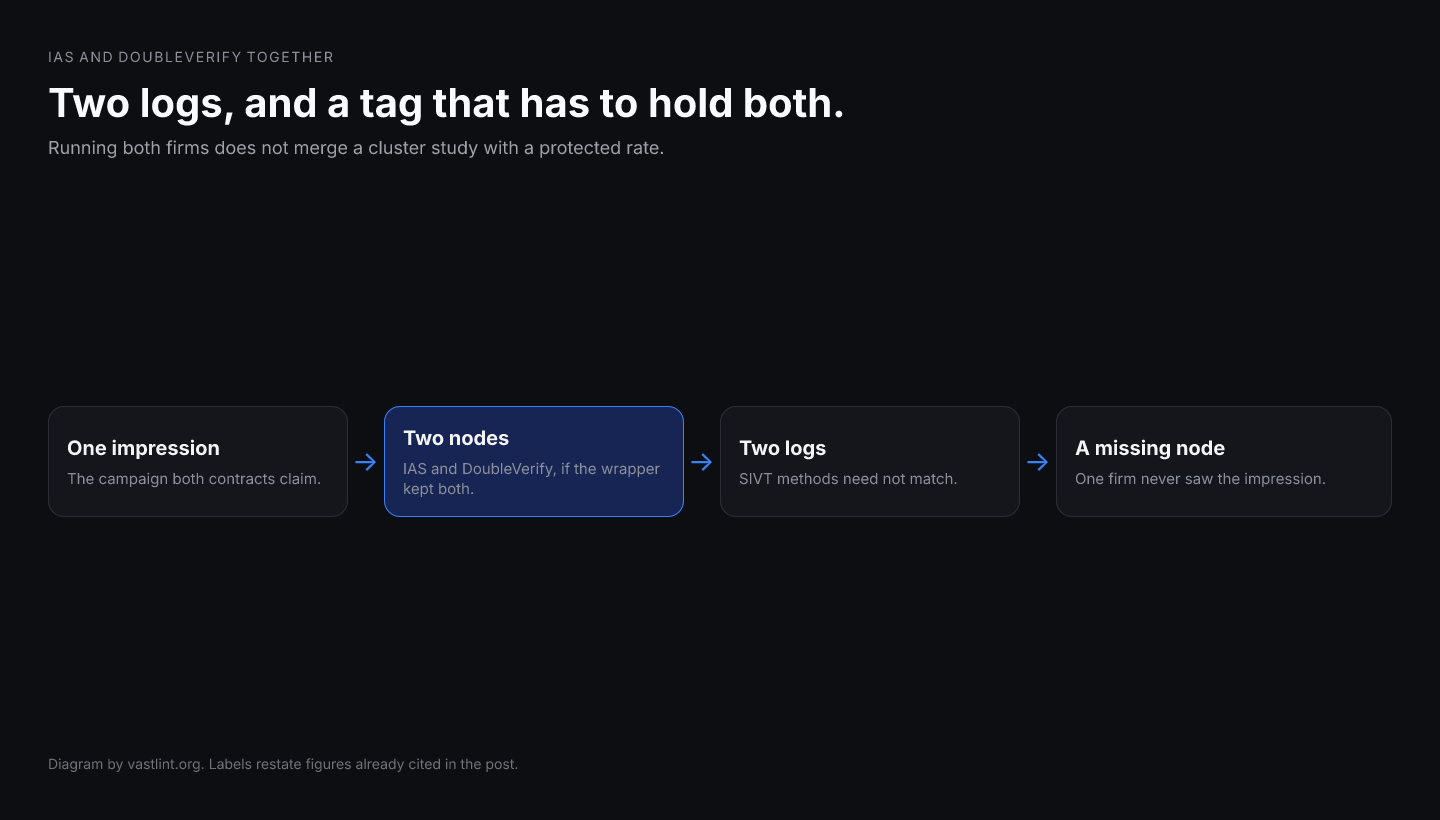
IAS and DoubleVerify together is the search that shows up when the versus question will not settle. People also type use both IAS and DoubleVerify, DoubleVerify and IAS overlap, two verification vendors, and whether a second firm is wasted spend. The versus notes compare published studies. This one is about one impression that both firms are asked to label.
The studies still do not merge. IAS's Papyrus note, August 6, 2026, is a lift on a named mobile cluster: nearly 25 times the clicks against other traffic IAS had separated. DoubleVerify's May 7, 2026 CTV release is fraud under 1 percent with controls on and nearly 9 percent with them off. Putting both contracts on one campaign does not average those into a shared rate. It buys two instruments. If they disagree, the MRC's June 2020 addendum already said they might. General invalid traffic is a shared list and is required. Sophisticated invalid traffic is encouraged, and the methods differ by vendor, so two accredited firms can agree on the general slice and disagree on the sophisticated one.
vastlint does not reconcile the disagreement. It checks whether a VAST 2.0–4.4 tag structurally contains the verification nodes you think you bought, including a duplicate vendor identifier if the same vendor is declared twice. Two different vendors can both be present. A missing node means one of the two logs was never going to exist.
What you actually double
You can double the pre-bid seat, the post-bid label, or both. The MRC's April 11, 2025 memorandum says DoubleVerify supplies pre-bid segments to DSPs, SSPs, and advertisers through DSPs, and does not itself drop the request. IAS's Papyrus note describes a list applied after a scheme is identified. Those can run on the same campaign and still refer to different moments: a segment queried before the bid, and a hostname filtered after someone named the scheme. Overlap in the contract is not overlap in the hop.
You can also double the post-bid tag. Each firm wants a Verification node, or an extension that reaches its host, on the impression that served. VAST allows more than one verification entry. If a wrapper keeps one and drops the other, the campaign is double-covered in the spreadsheet and single-covered in the player. The firm that was dropped will not print a rate for that impression. The firm that remained will. A gap between their reported IVT is then partly a gap in the document, which looks like a methodology fight.
Disagreement on the sophisticated slice is still expected when both nodes survive. The addendum's point in splitting general from sophisticated was to keep the list-based floor comparable and to stop pretending the advanced slice is. A buyer who runs both firms in order to get the truth has bought a second opinion, and the standard does not say the second opinion must match. Use the disagreement as a flag to inspect the impression, not as proof that one logo failed.
What to do with two contracts
Assign each firm a job before you compare their dashboards. If IAS is on the plan for a named-scheme list and suitability, and DoubleVerify is on the plan for a protected CTV rate, the dashboards are allowed to move differently. If both are on the plan for the same post-bid IVT number, read the category. A general-invalid gap is a list problem and should be small. A sophisticated gap can be the product.
Then open the tag. Count verification nodes, hosts, and vendor identifiers against the contracts. A node that still names a discontinued host, such as Moat after September 30, 2024, is not a third opinion. It is a dead URL beside the two living ones. vastlint will tell you the nodes are present and whether a vendor identifier is duplicated. It will not tell you which firm's sophisticated label was right.
Get VAST spec updates, platform guides, and release notes in your inbox.
What running both does not do
- It does not average Papyrus's 25-times click lift with a protected CTV rate under 1 percent.
- It does not force the sophisticated slices to match. The MRC addendum encourages that work and does not make it one shared list.
- It does not put both firms in the same seat. DV's pre-bid segments can reach advertisers through DSPs. A post-identification list is a later object.
- It does not survive a wrapper that keeps one Verification node and drops the other.
- A duplicate of the same vendor identifier is a structural problem. Two different vendors in two nodes can both be legitimate.
Two contracts on one impression buy two logs, and the tag is the only place you can see whether both logs had a node to read.
See whether both verification nodes survived
Run VAST 2.0–4.4 tags against specification-derived rules so each Verification entry is structurally present. Nothing is stored. This does not decide which firm is right.
Open the VAST validatorSources
GIVT is the shared required floor. SIVT methods can differ.
Who receives a pre-bid signal, and who decides to filter.
The question this note answers with both, instead of a winner.
What a missing verification node does to the measurement, whoever the vendor is.