SIMID alternative is the search that appears when a platform will not load the interactive frame. The phrase treats SIMID as a product with substitutes. IAB's SIMID page describes one interactive standard: a layer separated from the media asset, both delivered by VAST 4.x, so the player keeps control of the stream. SIMID 1.2, noted on that page as of January 3, 2024, adds secure session IDs, a signal for unknown size, and explicit squeeze-back guidance. It does not name a second interactive framework to use when SIMID is unavailable.
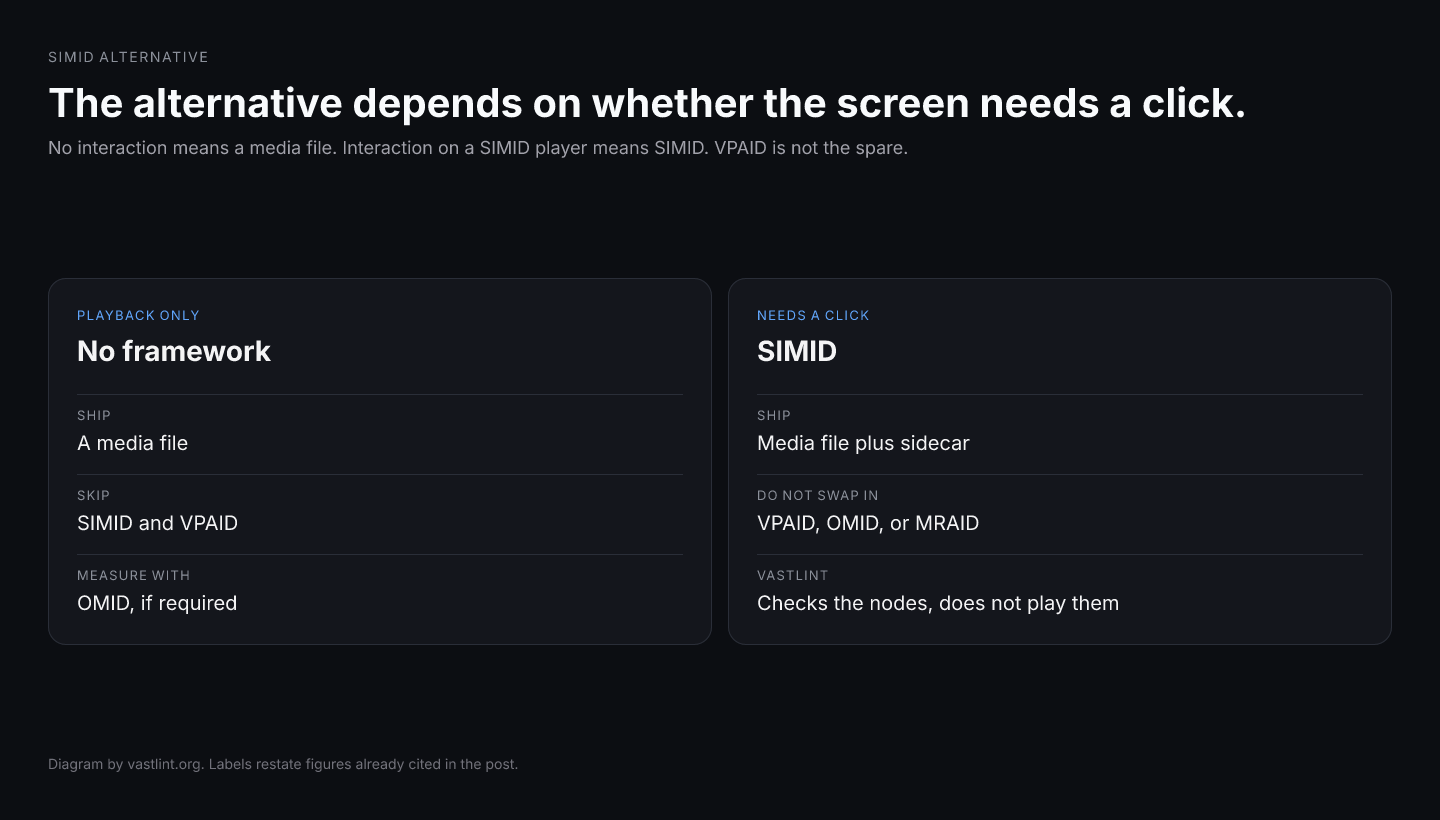
The honest alternative depends on the job. If nobody has to click, do not ship an interactive framework at all. A media file is the ad. If someone has to click and the player implements SIMID, SIMID is the interface, beside that file. VPAID is the deprecated executable, and Google's IMA docs limit VPAID 2 JavaScript to the HTML5 SDK, so it is not a safety net for the television that rejected SIMID. OMID measures. It does not draw the overlay. MRAID talks to an app webview, not to a VAST stitcher. vastlint is not a SIMID runtime and not a substitute creative. It checks whether the VAST 2.0–4.4 tag still has a playable file and a well-formed interactive node. It does not open the session.
What people paste in when they want a spare
The spare is usually VPAID, because old sheets had a fallback row. Devices that implement SIMID already have a media file to play if you gave them one. Devices that implement neither, including most televisions and native players, will not run VPAID either. Offering the executable widens the set of things that can break and narrows the set of screens that can play the ad. IAB's replacement language is specific: OMID for measurement, SIMID for interactivity. A fallback row that reverses that order puts the deprecated object back on the path.
The other spare is a vendor's interactive layer with a private apiFramework. That can be real on a platform that documents it. It is not SIMID, and it is not something vastlint will execute. The structural question stays the same. Is there a media file if the private layer fails, and is measurement still in AdVerifications rather than inside the layer?
A platform that skips SIMID can still take the ad
SSAI and a lot of CTV want the file and will ignore a sidecar they do not implement. That is a successful degradation only when the file exists. A tag whose only creative is the SIMID document has copied the VPAID failure mode into the new element: nothing to play if the interactive part is skipped. IAB's design note for SIMID is that the separation exists so those platforms can keep the stream. Use the separation. Do not delete the file to make the tag look simpler.
Measurement survives the same cut only if OMID is in the document the player or the OM SDK integration actually sees. A SIMID alternative that drops AdVerifications has changed two jobs to solve one. vastlint catches the missing file and the missing verification node. It will not invent an interactive format the platform refused.
A usable answer to the search
- No interaction: media file only. SIMID is optional and should be absent.
- Interaction on a SIMID player: media file plus InteractiveCreativeFile.
- Platform will not load SIMID: keep the media file, drop the sidecar, do not add VPAID.
- Measurement: OMID, independent of whether the sidecar loaded.
- In-app playable: MRAID, as its own delivery, not as a renamed VAST file.
The alternative to an interactive sidecar is often no sidecar, and the file the player already needed.
See whether the tag still plays if the sidecar is ignored
Run VAST 2.0–4.4 tags against specification-derived rules. Nothing is stored. vastlint does not execute VPAID, open a SIMID session, run OMID, or certify an MRAID SDK.
Sources
SIMID page, updated January 3, 2024. SIMID 1.2 separates the interactive layer from the media asset. Both are delivered by VAST 4.x. OMID is named for measurement and SIMID for interactivity, as the replacement for VPAID.
VAST standards hub. VPAID is marked deprecated and replaced with SIMID.
OM SDK page, updated November 4, 2025. Measurement providers collect signals through the OMID API. The current API docs listed there are OMID 1.6.
MRAID is the in-app rich media interface. Version 3.0 adds creative-side viewability and audibility, and selected VPAID events for in-app video reporting.
Only the IMA HTML5 SDK supports VPAID 2 JavaScript creatives.
SIMID support is documented on its own page, including which messages the HTML5 SDK implements.
Why the deprecated executable is not the spare.
Better at the interactive job, and unnecessary when there is no click.
The structural checks on the interactive file and the media beside it.