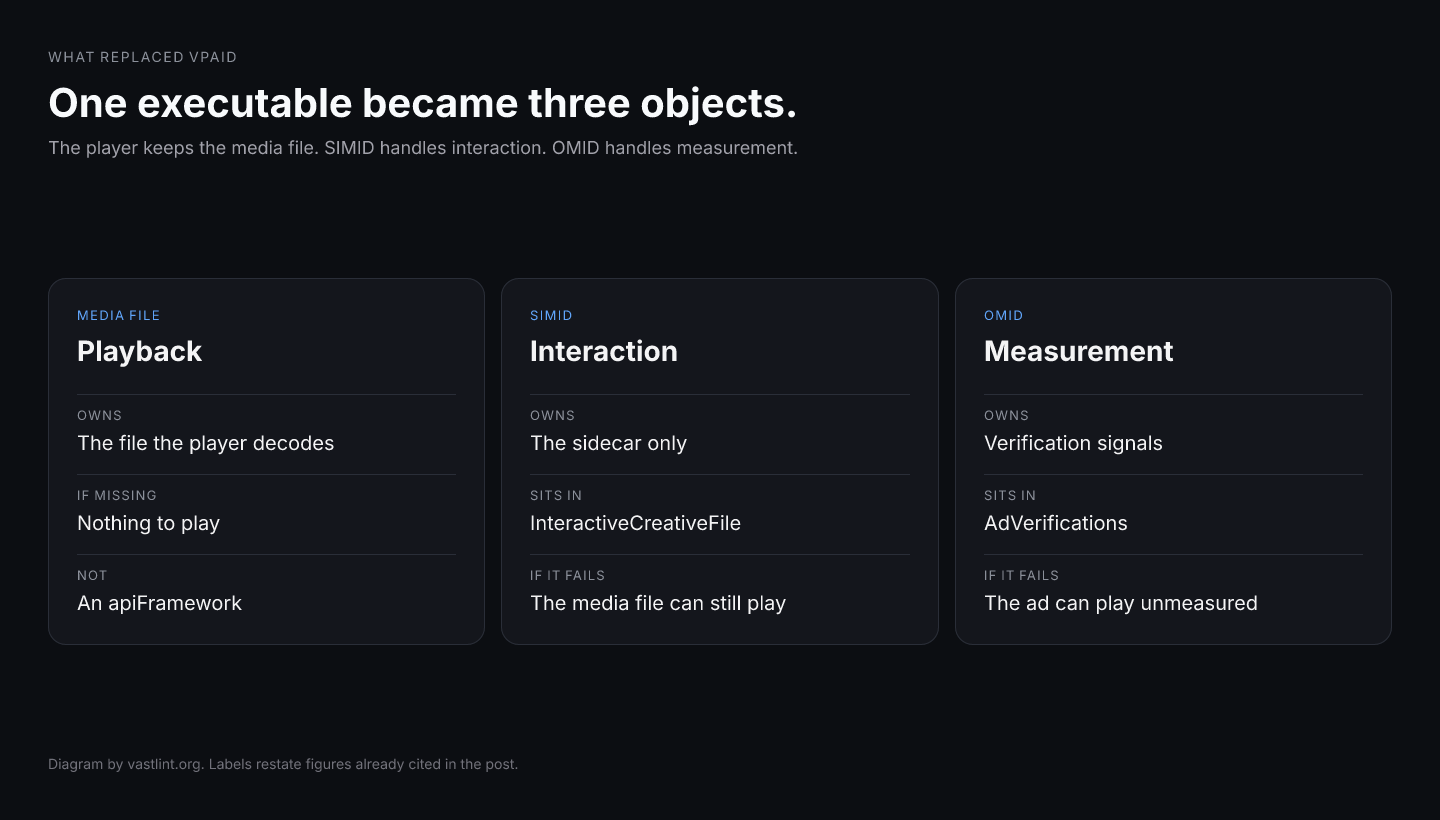
What replaced VPAID is not a new name for the same executable. IAB Tech Lab's SIMID page says the working group is replacing VPAID with two focused standards: OMID for measurement and verification, and SIMID for interactivity. Playback stays a media file. SIMID 1.2, the version described on that page as of January 3, 2024, keeps the interactive layer separate from the media asset, and both are delivered by VAST 4.x. A stitcher can still handle the file. The creative does not become the player.
MRAID did not inherit the video-player job. IAB's MRAID 3.0 note adds creative-side viewability, audibility, and selected VPAID events so in-app video can report more uniformly. That is an event vocabulary inside a mobile webview. It is not the replacement IAB names for a VAST player. vastlint checks whether a VAST 2.0–4.4 tag still has a decodable media file, a SIMID file only where one was declared, and a verification node where measurement was declared. It does not execute VPAID, open a SIMID session, run OM SDK, or certify MRAID.
Why one column on the trafficking sheet keeps the old object alive
A sheet with a single framework cell asks for one string. VPAID used to be a plausible answer because the executable could play the ad, draw the overlay, and emit the quartile. The replacement refuses that compression. If the spot has no interaction, the cell should be empty and the media file should be real. If someone must click, the cell is SIMID, and a media file still has to sit beside it. If a vendor must measure, the cell is not a framework on the media file. It is OMID inside AdVerifications, or, on older documents, an Extension of type AdVerifications.
Google's IMA docs draw the runtime line in public. Only the HTML5 SDK supports VPAID 2 JavaScript creatives. SIMID support is a separate page. A 2026 tag that still prefers VPAID because some web player once needed it keeps an executable on a path that also serves televisions and stitchers. Those runtimes do not gain a creative by receiving a script.
What to do with a tag that still says VPAID
Read the inline, not the wrapper you were handed in QA. Find every MediaFile and InteractiveCreativeFile, and write down the apiFramework. A VPAID media file with no sibling the player can decode is the deprecated shape. A SIMID URL with no sibling media file is that shape wearing the new name. An OMID script placed in the interactive file, or a SIMID URL placed in JavaScriptResource, has swapped the two halves of the split.
Keep the vendor decision off this page. IAS, DoubleVerify, Pixalate, and HUMAN are choices inside measurement, which is the OMID job. They are not substitutes for SIMID, and SIMID is not a verification product. vastlint will not pick a vendor. It will show whether the document still contains the node that vendor would have to read.
The split, written as a check
- A media file the player can decode without loading JavaScript.
- SIMID only as an interactive file beside that media, when interaction is actually required.
- OMID in AdVerifications, not inside the creative.
- Any remaining VPAID media file, treated as legacy web compatibility.
- MRAID left in the in-app rich-media path, not renamed into a VAST apiFramework as a fallback.
The executable became a file the player owns, a sidecar for the click, and a verification script for the measurement, and those three do not collapse back into one cell.
See which of the three the inline actually has
Run VAST 2.0–4.4 tags against specification-derived rules. Nothing is stored. vastlint does not execute VPAID, open a SIMID session, run OMID, or certify an MRAID SDK.
Sources
SIMID page, updated January 3, 2024. SIMID 1.2 separates the interactive layer from the media asset. Both are delivered by VAST 4.x. OMID is named for measurement and SIMID for interactivity, as the replacement for VPAID.
VAST standards hub. VPAID is marked deprecated and replaced with SIMID.
OM SDK page, updated November 4, 2025. Measurement providers collect signals through the OMID API. The current API docs listed there are OMID 1.6.
MRAID is the in-app rich media interface. Version 3.0 adds creative-side viewability and audibility, and selected VPAID events for in-app video reporting.
Only the IMA HTML5 SDK supports VPAID 2 JavaScript creatives.
SIMID support is documented on its own page, including which messages the HTML5 SDK implements.
The pair this index opens from.
Playback, interaction, and measurement, written as a replacement.
How VPAID appears in a VAST tag, and why it is deprecated.