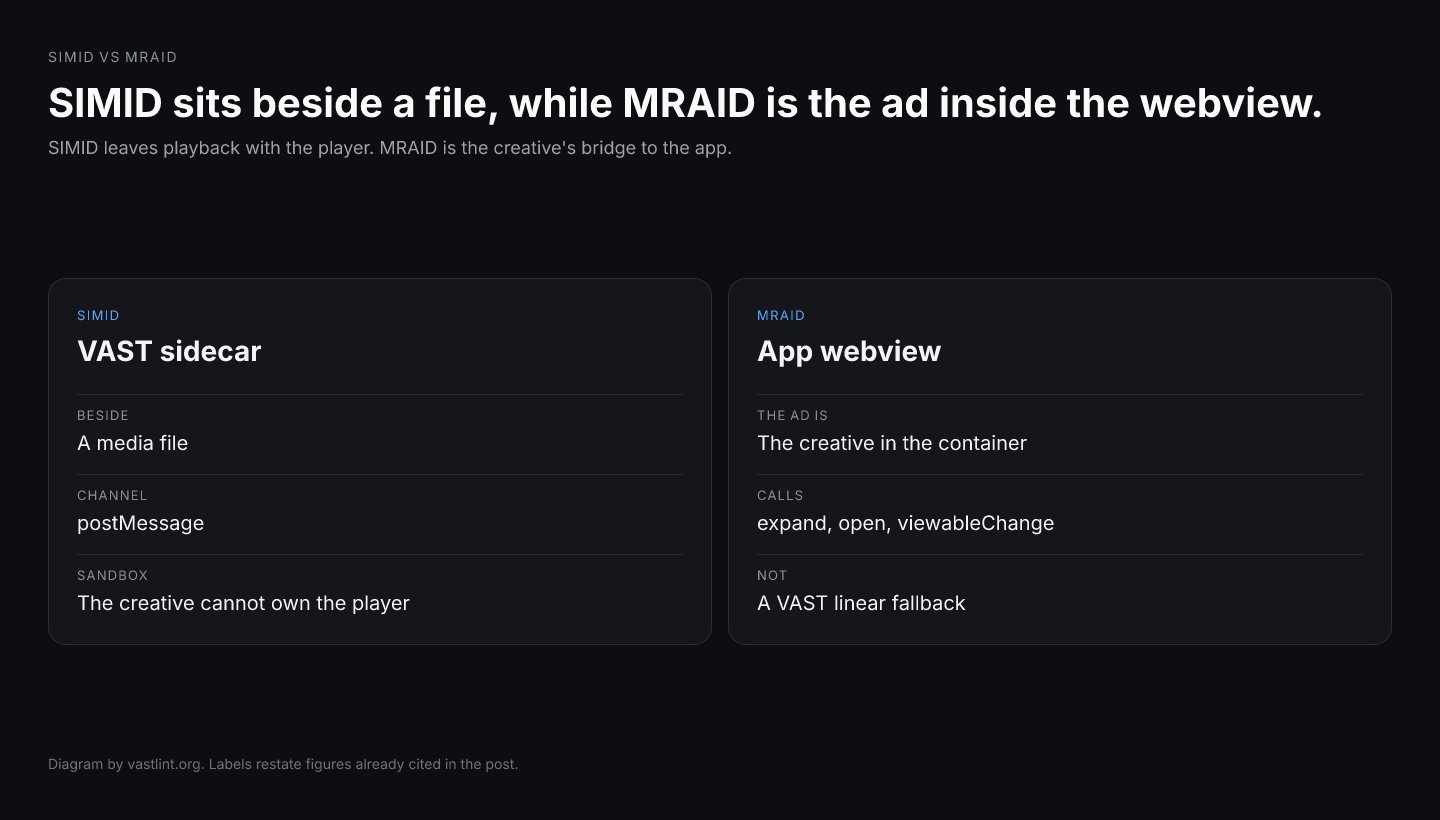
SIMID vs MRAID comes up when a mobile creative and a video creative share a brief. SIMID, Secure Interactive Media Interface Definition, is the interactive layer IAB separated from the media asset. The player plays a file it selected. The interactive document loads in a sandboxed frame and requests player operations over the SIMID channel. If the frame fails, the file can still play. IAB's SIMID page, updated January 3, 2024, describes SIMID 1.2 in those terms, including secure session IDs and explicit notes for squeeze-back layouts, and it names this split as the way to support mobile, SSAI, and OTT without handing the player to ad code.
MRAID is older as an in-app idea and solves a different host. Since 2011 it has been how a rich-media creative talks to an app: expand, resize, interstitials, and, in 3.0, a stricter sense of viewability, audibility, and environment. The creative is the ad. There is no sibling MP4 the television can fall back to, because this path is not a television preroll. vastlint checks the VAST structures SIMID requires: InteractiveCreativeFile, a secure URL, and a media file beside it. It does not call mraid.getState, and it does not certify the SDK.
Why the fallback in either direction fails
A SIMID player that is handed an MRAID creative does not gain an overlay. The SIMID session expects the SIMID protocol. MRAID methods on the other side of that frame are a different bridge, and the player was not offering an app webview. The media file, if you included one, can still play. The interaction will not.
An MRAID SDK that is handed a SIMID URL as if it were the creative HTML may render a document that immediately looks for a player channel that is not there. Playables and expandable banners are authored against MRAID on purpose. They are not a degraded SIMID. VPAID is not the tie-breaker. It is the deprecated video-player executable, and MRAID 3.0's use of selected VPAID events does not make the two creatives interchangeable.
Where measurement sits, so it does not get folded in
SIMID does not measure the impression. OMID does, through AdVerifications, once the player runs OM SDK. MRAID 3.0 lets the creative read viewability itself. That creative-side signal is not a third-party verification. A campaign that needs both an in-app playable and an in-stream spot needs both delivery paths, and the measurement on the in-stream spot still has to be in the VAST document.
vastlint will tell you whether the in-stream document is structurally able to carry SIMID and OMID. It will not preview the playable, and it will not tell you that the playable satisfied MRAID 3.0.
Pick the host before the acronym
- In-stream: a VAST media file, SIMID only for a real interaction, OMID if a vendor must measure.
- In-app rich media or playable: MRAID, in an SDK that implements the calls the creative makes.
- Do not set apiFramework MRAID on a VAST media file and call it a SIMID alternative.
- Do not send a SIMID URL to an MRAID-only container and call it a video ad.
- Do not treat MRAID viewableChange as the OMID integration.
A sidecar beside a file the player owns and a creative that is the ad inside an app webview do not degrade into each other.
Check the VAST side of a SIMID creative
Run VAST 2.0–4.4 tags against specification-derived rules. Nothing is stored. vastlint does not execute VPAID, open a SIMID session, run OMID, or certify an MRAID SDK.
Sources
SIMID page, updated January 3, 2024. SIMID 1.2 separates the interactive layer from the media asset. Both are delivered by VAST 4.x. OMID is named for measurement and SIMID for interactivity, as the replacement for VPAID.
MRAID is the in-app rich media interface. Version 3.0 adds creative-side viewability and audibility, and selected VPAID events for in-app video reporting.
OM SDK page, updated November 4, 2025. Measurement providers collect signals through the OMID API. The current API docs listed there are OMID 1.6.
SIMID support is documented on its own page, including which messages the HTML5 SDK implements.
Why the older video API is not the in-app bridge.
When the right answer is no interactive framework at all.
The element, the sandbox, and the media file that has to remain.