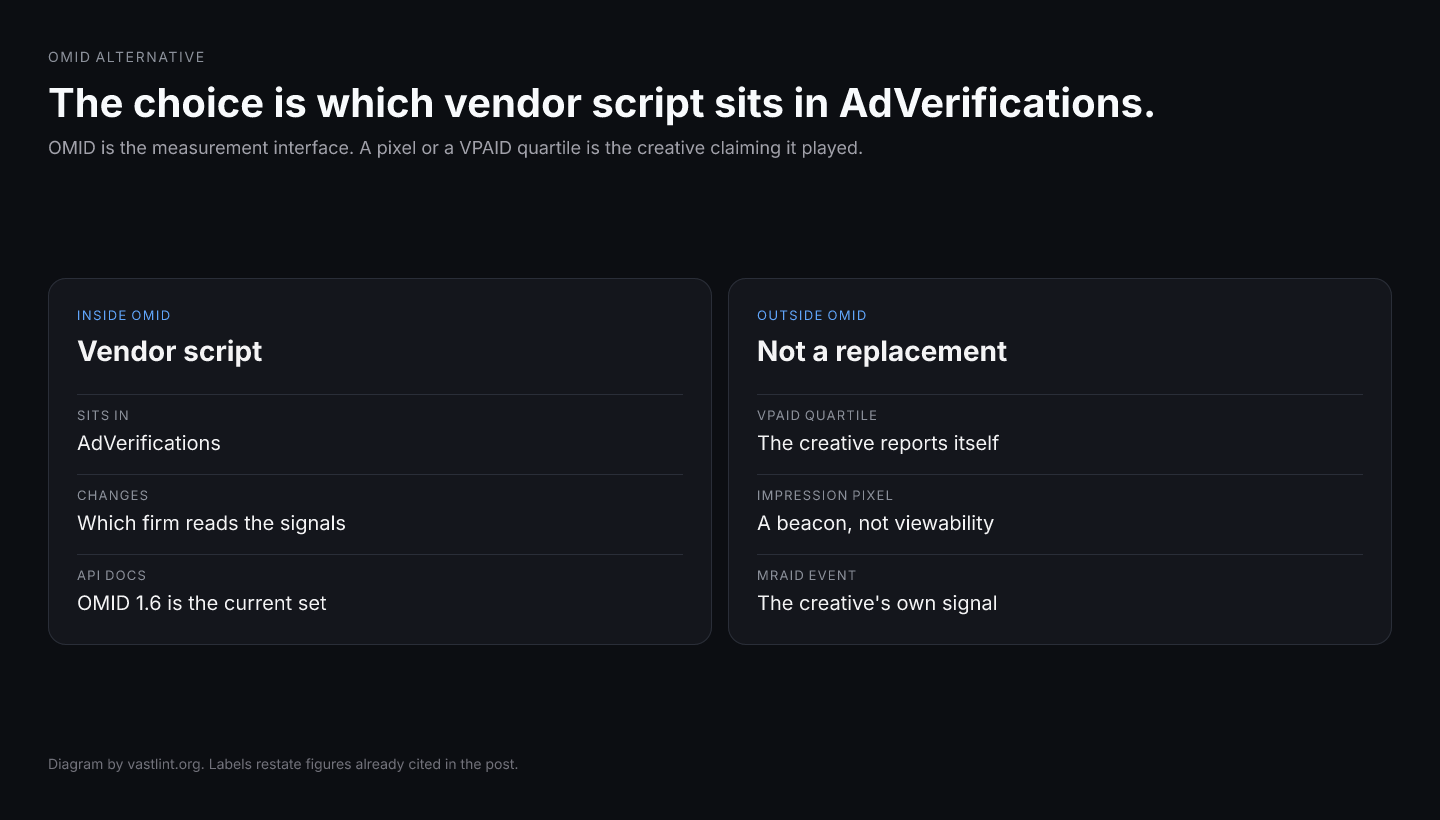
OMID alternative usually means a verification contract is under review. The API is not what is under review. IAB's OM SDK page describes one interface: apps and players expose signals, and measurement providers place tags that collect them through OMID. The page, updated November 4, 2025, lists OMID 1.6 as the current API docs and keeps the earlier versions available. Changing from one accredited provider to another is a different JavaScriptResource in AdVerifications. It is the same apiFramework.
vastlint is not an OMID alternative. It does not integrate OM SDK, collect viewability, or detect invalid traffic. It checks whether a VAST 2.0–4.4 document still contains a verification block a provider script could occupy: vendor, HTTPS resource, apiFramework, and a verificationNotExecuted path that can explain a miss. A player without OM SDK can still ignore a perfect block. The document check comes before that runtime question.
The things that look like measurement and are not the API
An impression pixel says a URL was requested. It does not say what fraction of the pixels were on screen, and it does not let a second vendor listen. A VPAID unit that emits quartiles is the deprecated bundle, creative and meter in one executable, and Google limits VPAID 2 JavaScript to the IMA HTML5 SDK. MRAID 3.0 lets an in-app creative read viewability and audibility itself. The author of that signal is the creative. None of these occupy the OMID slot, and deleting AdVerifications because one of them exists removes the third-party path on purpose.
Pre-4.1 tags sometimes carry the verification block as an Extension with type AdVerifications. That is a compatibility shape, not a different API. A 4.1 or later inline should use the AdVerifications element. vastlint knows both shapes well enough to tell you the node is missing or malformed. It does not know whether the vendor host still answers.
Choosing a firm is a different article
IAS, DoubleVerify, Pixalate, and HUMAN publish different objects: cluster studies, protected-campaign rates, open-auction shares, pre-bid suggestions. Those comparisons do not pick an API. Whichever firm you hire for post-bid video measurement still has to be declared where the player expects a verification resource. Two firms means two Verification nodes, not two flavors of SIMID.
SIMID remains the interactive sidecar, unrelated to which firm measures. Putting the vendor script inside the SIMID file collapses the split VPAID was retired for. Keep the script in AdVerifications even when the interactive file is elaborate.
Before calling something an OMID replacement
- The replacement script still uses apiFramework omid.
- It still sits in AdVerifications, or a legacy Extension of that type on older tags.
- An impression pixel stays a beacon.
- A VPAID quartile stays a creative event.
- An MRAID viewability call stays inside the app creative.
You can change the firm that listens. You cannot replace the listening API with the creative's own report and still be talking about OMID.
Check the node the next verification script would occupy
Run VAST 2.0–4.4 tags against specification-derived rules. Nothing is stored. vastlint does not execute VPAID, open a SIMID session, run OMID, or certify an MRAID SDK.
Sources
OM SDK page, updated November 4, 2025. Measurement providers collect signals through the OMID API. The current API docs listed there are OMID 1.6.
SIMID page, updated January 3, 2024. SIMID 1.2 separates the interactive layer from the media asset. Both are delivered by VAST 4.x. OMID is named for measurement and SIMID for interactivity, as the replacement for VPAID.
MRAID is the in-app rich media interface. Version 3.0 adds creative-side viewability and audibility, and selected VPAID events for in-app video reporting.
Only the IMA HTML5 SDK supports VPAID 2 JavaScript creatives.
Why the creative's own viewability event is not the API.
Why a self-reported quartile is the old shape.
Vendor, resource, and verificationNotExecuted.
The VAST side of the measurement API.