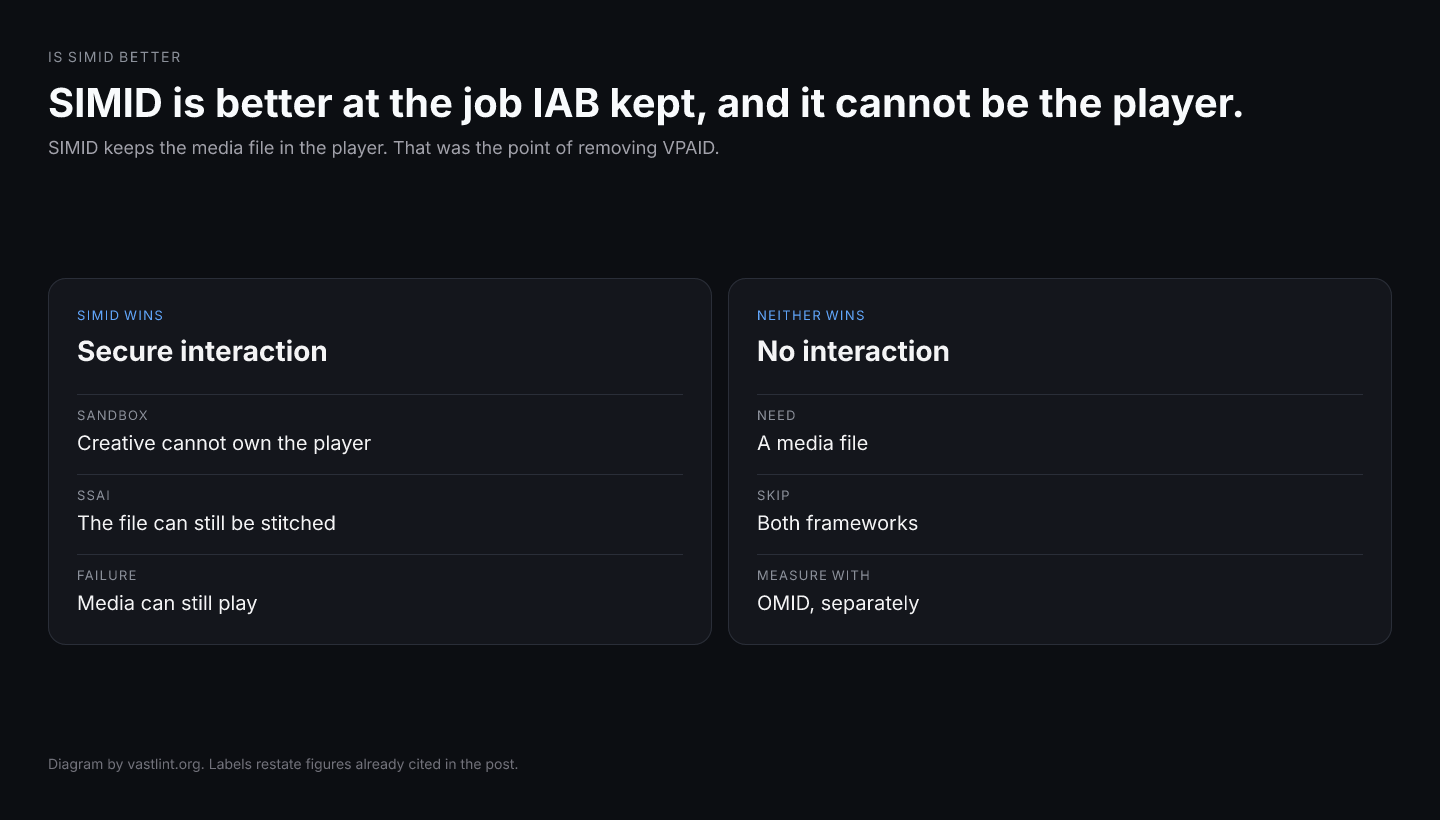
Is SIMID better than VPAID is a ranking question aimed at two interfaces that do not want the same job. IAB's SIMID page says the industry is replacing VPAID with OMID for measurement and SIMID for interactivity, and that the point of SIMID is to separate the interactive layer from the media asset so publishers keep control of the stream, including SSAI and live. On that job, SIMID is the better design: if the sidecar fails, a real media file can still play, and the creative cannot reach into the player. VPAID can be the playback engine. When it fails, there is often no file left. Google's IMA docs add a runtime fact: only the HTML5 SDK supports VPAID 2 JavaScript creatives.
That does not make SIMID the winner on every row of a trafficking sheet. A spot with no interaction needs a media file and no framework. Adding SIMID there adds a session the player must implement, for a click that does not exist. vastlint does not score the two. It checks VAST 2.0–4.4 structure and shows whether a VPAID file is still the only creative, or whether a SIMID file is missing the sibling media file that makes the newer design true. It does not execute either framework.
Where VPAID still looks better on a lab machine
A desktop HTML5 player that already runs VPAID will play a unit that draws its own controls and fires its own events. In that room, the executable looks more capable, because it was allowed to be the player. The capability is the liability everywhere else. A stitcher cannot preserve it. A television player does not offer the JavaScript context. A security review does not want ad code in the player's own context. IAB's deprecation is a statement about that spread, not a claim that old HTML5 sessions suddenly crash.
SIMID 1.2, as described on the IAB page updated January 3, 2024, is explicit about session IDs, unknown creative size, and squeeze-back layouts. It is still a protocol a player must implement. Google documents a subset of SIMID messages for IMA HTML5. A tag that is structurally SIMID can still be outside a given player's subset. Better on the standard is not a promise about one SDK's message list.
How to answer the question on a live tag
Write the job down first. Interaction: SIMID beside a media file. Measurement: OMID, not either framework. Playback alone: the media file. Legacy HTML5 that still requires VPAID: an exception with the runtime named, not a default on the CTV copy. If the sheet asks for a single winner, it is asking to collapse those rows.
Then look at the inline. Both strings can appear. Their presence is not a ranking. A VPAID file as the only media file loses on any player that will not run it. A SIMID file with no media file loses the advantage SIMID was written to have. vastlint is the check for that structure, not a vote.
A direct answer
- For a click beside a video the player controls: SIMID.
- For measurement: neither. Use OMID.
- For a non-interactive spot: neither. Use a media file.
- For being the playback engine: VPAID can, and that is why it was deprecated.
- For a score inside vastlint: there isn't one. The tool shows the structure.
SIMID is better at the job it was given, which was to stop being the player.
See which framework the inline still depends on
Run VAST 2.0–4.4 tags against specification-derived rules. Nothing is stored. vastlint does not execute VPAID, open a SIMID session, run OMID, or certify an MRAID SDK.
Sources
SIMID page, updated January 3, 2024. SIMID 1.2 separates the interactive layer from the media asset. Both are delivered by VAST 4.x. OMID is named for measurement and SIMID for interactivity, as the replacement for VPAID.
VAST standards hub. VPAID is marked deprecated and replaced with SIMID.
Only the IMA HTML5 SDK supports VPAID 2 JavaScript creatives.
SIMID support is documented on its own page, including which messages the HTML5 SDK implements.
The architectural comparison behind the ranking question.
What to ship instead of a winner string.
Why listing both is not a way to get the better one.