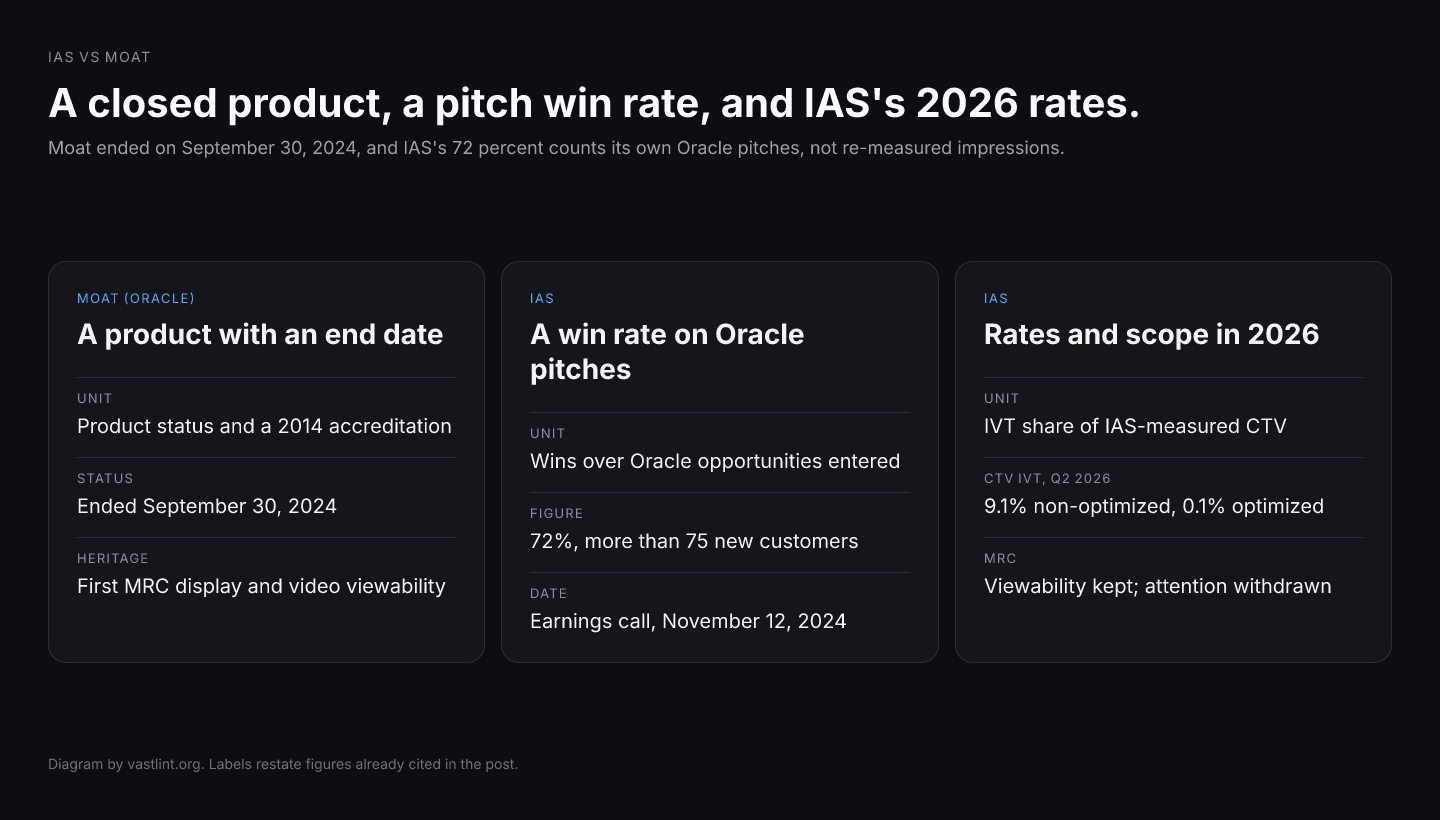
IAS vs Moat is a search that still runs on a 2023 RFP template. One column is a product Oracle switched off: Oracle's end-of-life notice listed Moat Analytics and Moat Reach among the advertising services that stopped on September 30, 2024, with no new agreements and no renewals. The other column is the firm that spent that summer pitching the accounts. On its November 12, 2024 earnings call, IAS said it had won more than 75 new Oracle customers since June, a 72 percent win rate on the Oracle opportunities in which it participated, and that it had hired more than 30 former Oracle employees. Its current numbers come from a different publication entirely. The 21st Media Quality Report, released July 9, 2026, puts 2025 global video viewability at 79.7 percent and IVT at 1.1 percent, and shows CTV IVT in Q2 2026 at 9.1 percent where IAS optimization was off and 0.1 percent where it was on. vastlint does not rank IAS against Moat. It checks whether a VAST 2.0–4.4 tag still carries a verification node and which vendor that node names, and it cannot tell you whether the host behind the node still answers.
Three different objects sit in that paragraph. The September 30, 2024 date is a product status, and a product that ended has no rate to report. The 72 percent is a sales result with IAS's own pitches as the denominator. The 79.7, 1.1, 9.1, and 0.1 percent figures are measurement benchmarks IAS published about its own 2025 and 2026 logs. A shortlist that lists Moat beside IAS and then pastes in any of those numbers is comparing a closed service with a firm's report about itself.
The pair still has a real question underneath it. Moat's name was attached to viewability and attention for a decade, and IAS was one of the two firms that took the contracts. Strip the names off and the claim remains: an end-of-life date, a win rate on pitches entered, and a benchmark from the winner's log cannot be placed on one scale, and none of them says whether the verification tag that used to point at Moat was ever replaced.
What the IAS figures measure
The migration claim is specific about its denominator. IAS described the 72 percent as a win rate on Oracle opportunities in which it participated, and the more than 75 wins as customers that range from brands to platforms to publishers. The named wins on the call were brands such as Peacock, Heineken, and Emirates; platforms such as The Trade Desk, Quantcast, Kargo, and Pandora; and publishers such as Dow Jones, Bloomberg, NASCAR, Condé Nast, and AAA. IAS said Peacock switched from Oracle Moat as part of the deprecation and that Heineken named IAS its exclusive global partner in place of Moat. On the fourth-quarter 2024 call, IAS restated the figure as a win rate north of 70 percent with 75-plus wins, and said there were pricing dynamics during those competitive RFPs. A count that mixes advertisers, ad platforms, and publishers is a count of contracts. It is not a count of Moat impressions moved, and it is not a share of Moat revenue.
The 2026 benchmarks come from IAS's own measurement. The 21st Media Quality Report says it draws on more than 300 billion digital interactions a day. For 2025 it reports global video viewability of 79.7 percent against 67.9 percent for display, IVT broadly stable at 1.1 percent, North America at 1.36 percent, and the United States at 1.40 percent. It also reports that mobile web display carried 45.1 percent of impressions but 71.9 percent of made-for-advertising impressions. The CTV panel is a Q2 2026 split: 9.1 percent IVT where IAS optimization was not applied and 0.1 percent where it was. Each of those is a rate on IAS-measured traffic, cut by format, region, or whether IAS controls were on.
Accreditation is the third kind of IAS figure, and it has a scope. The MRC's July 9, 2026 letter continued accreditation of IAS's Campaign Monitor, Firewall and Viewability Systems platform and its CTV measurement platform for display and video impressions, viewable impressions, and SIVT filtration across desktop, mobile web, and mobile in-app, and for CTV only on certified applications. The same letter continued accreditation for IAS processing of Meta and YouTube data, and granted initial accreditation for IAS pre-bid viewability segments and IVT avoidance segments in display and video. Viewability and IVT are inside that letter, and attention is not.
Attention is where IAS's public record diverges from Moat's reputation. IAS made Quality Attention generally available on January 4, 2024, put a pre-bid Quality Attention Optimization product into beta on December 17, 2024, and has repeated a claim of up to a 130 percent lift in conversion rates when comparing high-attention with low-attention impressions. Its June 4, 2026 Stellantis case study covers more than 13 billion measured impressions in 19 countries and reports a 165 percent increase in engagement on high-attention inventory. The MRC's first-quarter 2026 status update records that in January 2026 IAS Attention Measurement was removed from in-process status due to IAS's lack of intent to engage in third-party audit and the resulting withdrawal from the accreditation process. IAS has been privately held since Novacap closed its take-private on December 23, 2025, and none of the IAS releases cited here updates the 72 percent.
What the Moat figures measure
Moat's public record is mostly dates and scopes. On June 12, 2014, Moat announced it had become the first company accredited by the MRC for measurement of viewable ad impressions in both online display and video. The same release described Moat Analytics as an attention measurement platform. Those are two different claims in one document: the accreditation named viewable impressions, and the attention label was Moat's own description of the product.
Oracle announced on April 18, 2017 that it would acquire Moat and fold it into Oracle Data Cloud. Oracle's release said Moat's attention analytics business had grown by more than 100 percent in the prior year and served more than 600 publisher, brand, and agency clients with viewability, brand safety, non-human traffic, and ad creative insights. That client count is the closest public figure to a Moat population, and it is seven years older than the shutdown. It mixes publishers with brands and agencies, which is also why IAS's post-shutdown wins include publishers and platforms.
The end-of-life notice, as reported by PPC Land on June 19, 2024, listed Moat Analytics Service and Moat Reach Service among the discontinued products, said Oracle would fulfill existing orders until September 30, 2024, would not enter new agreements, and would terminate access to all Oracle Advertising services on that date. After that date there is no Moat viewability rate, no Moat IVT rate, and no Moat attention score being produced. The column has a heritage and a date, and no 2025 or 2026 measurement for any IAS benchmark to be compared with.
Oracle did not publish how many Moat customers went to IAS, to DoubleVerify, or to nobody. The only migration figures in the public record come from the firms that won the business, each reporting against its own pitches.
Why the IAS and Moat figures have no shared scale
The units do not match. A product status is a date. An accreditation is an audited scope for named metrics. A win rate is wins over pitches entered. A viewability benchmark is viewable impressions over measured impressions in one firm's log. None of these converts into another, and the end-of-life date in particular cannot be ranked against anything, because a discontinued service is not producing the metric the comparison assumes.
The populations do not match, and the win rates show it best. IAS reported a 72 percent win rate on the Oracle opportunities it participated in. DoubleVerify told AdExchanger on November 7, 2024 that it had won 70 percent of the Moat advertiser RFPs it participated in. Both can be accurate at once, because each denominator is that firm's own pitches, and IAS's count includes platforms and publishers while DoubleVerify's figure is advertiser RFPs. Adding them, subtracting them, or reading either as a share of the Moat customer base produces a number neither firm published.
The surfaces do not match. Moat's 2014 accreditation was for online display and video viewability. IAS's 2026 benchmarks cover open-web display and video, a CTV IVT panel, and separate social measurement on Meta and YouTube that runs on platform data rather than on a tag the buyer trafficked. A Moat viewability history from the open web and an IAS CTV IVT rate from Q2 2026 are different devices and different metrics.
The attention column is the easiest to misread. Moat called its analytics an attention platform, and the accreditation it advertised was for viewability. IAS publishes attention results from case studies and its own model, and the MRC's 2026 update says IAS withdrew that service from the accreditation process. Moving a buyer from Moat attention to IAS Quality Attention changed the model, the inputs, and the vendor. The win rate records that the contract moved, not that the two scores agree on any impression.
Which question each firm's number answers
Moat answers with history and a date, and IAS answers with its own 2024 sales figures and 2026 logs.
| Question a buyer asks | IAS public answer | Moat public answer |
|---|---|---|
| Can I still contract for it? | Yes; IAS operates privately under Novacap since December 23, 2025 | No; access ended September 30, 2024, with no new agreements |
| How many former Moat accounts moved? | More than 75 Oracle customers at a 72% win rate on pitches IAS entered | Not published by Oracle |
| Is viewability measurement accredited? | Yes, continued July 9, 2026; CTV only for certified applications | First accredited for display and video on June 12, 2014; service ended in 2024 |
| Is attention measurement accredited? | No; removed from MRC in-process status in January 2026 | Not in the sources cited; the 2014 accreditation named viewable impressions |
| What was open-web IVT in 2025? | 1.1% global, 1.36% North America, 1.40% United States | No publication after the shutdown |
| What does CTV IVT look like now? | 9.1% non-optimized, 0.1% optimized, Q2 2026 IAS data | No publication after the shutdown |
Where the Moat migration shows up in the VAST tag
In VAST 4.1 and later, third-party measurement for video sits in an AdVerifications element. Each Verification child carries a vendor attribute, a JavaScriptResource whose apiFramework is omid, optional VerificationParameters, and a TrackingEvents block where a verificationNotExecuted tracker tells the vendor its script did not run. VAST 4.1 allows AdVerifications in a Wrapper as well as in the InLine ad, so each hop in a wrapper chain is a place where a verification node can be added, duplicated, or lost. VAST 3.0 and 2.0 have no native AdVerifications element; the OM guidance places the same block inside an Extension with type AdVerifications, and only players that look for it will read it.
The vendor attribute is where the Moat shutdown is visible. Google Ad Manager's Open Measurement help still uses moat.com-omid as an example vendor key, next to integralads.com-omid and doubleverify.com-omid. A tag that kept a moat.com-omid Verification after September 30, 2024 is well formed and points at a service that ended. A migration that changed the contract but not the trafficking leaves that node in place, and the player may fetch a script that no longer measures anything. A migration that did change trafficking often changed the wrapper chain too: IAS has described its video integration as receiving the advertiser's original VAST and returning an IAS-wrapped VAST URL for trafficking. That adds a hop, and the InLine at the end of the chain still has to carry, or the wrappers still have to contribute, the IAS node.
Two parts of IAS's measurement do not pass through the buyer's tag at all. IAS's accredited Meta and YouTube reporting is processing of platform data, through integrations such as Google's Ads Data Hub, so a buyer cannot open a VAST document to confirm it. On CTV, the MRC letter limits IAS's accredited CTV metrics to certified applications, and on a CTV player that does not run the OM SDK, a correct Verification node may still produce a verificationNotExecuted call instead of a measurement. The tag can show whether the IAS node is present and whether a Moat node is still there. It cannot show which IAS benchmark the impression will end up in.
What to do with the shortlist
Retire Moat as a live column. If a template still says IAS vs Moat, rename the second column to whatever the account used Moat for: open-web viewability, attention, brand safety, or publisher analytics. Then ask IAS for the current answer to that job, with its unit and scope written beside it. Viewability and IVT have an MRC letter dated July 9, 2026. Attention has case studies and no accreditation. Those are different levels of assurance for different metrics from the same firm.
Treat the 72 percent as history. It tells you IAS was competitive on Oracle pitches in the summer of 2024 and, by IAS's own account, that price was part of how those RFPs were won. It does not tell you how IAS's viewable rate compares with what Moat would have reported on the same impressions, because no one published that side-by-side. If continuity matters, ask for a period of parallel measurement on your own traffic rather than relying on a sales figure.
Audit the tags separately from the contract. Search trafficked VAST for moat.com-omid vendor keys and Moat script hosts, and remove or replace them. vastlint is independent of IAS and has no relationship to Oracle or Moat. It checks VAST 2.0–4.4 structure, including whether AdVerifications or the Extension equivalent is present and whether each Verification has a vendor, a resource, and the expected attributes. It does not know which vendors are still in business, it does not score viewability or attention, and it does not classify invalid traffic.
What to separate before using this comparison
- Moat's end of service is a date, September 30, 2024, and a service that ended has no current rate to compare.
- IAS's 72 percent is a win rate on the Oracle opportunities IAS entered, and its more than 75 wins include platforms and publishers as well as brands.
- DoubleVerify's 70 percent of Moat advertiser RFPs and IAS's 72 percent use different denominators, so they neither add up nor contradict each other.
- IAS's 2025 benchmarks of 79.7 percent video viewability and 1.1 percent IVT are rates on IAS-measured open-web traffic, not a reconstruction of Moat data.
- The Q2 2026 CTV split of 9.1 percent non-optimized against 0.1 percent optimized is a with-and-without on IAS's own controls.
- IAS viewability and IVT measurement is MRC-accredited as of July 9, 2026, while IAS attention measurement left the MRC process in January 2026.
- A Verification node with a moat.com-omid vendor key is a leftover host, not a measurement.
Questions buyers ask about IAS and Moat
- Is Moat still available? No. Oracle's end-of-life notice ended access to Moat Analytics and Moat Reach on September 30, 2024, and Oracle stopped entering new agreements.
- How many Moat customers went to IAS? IAS said it won more than 75 new Oracle customers at a 72 percent win rate on the Oracle opportunities it participated in, as of its November 12, 2024 call; Oracle did not publish a total.
- Did more Moat clients go to IAS or to DoubleVerify? The public record does not say. IAS reported 72 percent of its own Oracle pitches and DoubleVerify reported 70 percent of the Moat advertiser RFPs it entered, which are different denominators.
- Is IAS attention measurement MRC-accredited the way Moat viewability was? No. The MRC's first-quarter 2026 update says IAS Attention Measurement was removed from in-process status in January 2026, while IAS viewability and IVT measurement were continued on July 9, 2026.
- What should happen to old Moat tags? Remove or replace any Verification that still names moat.com-omid or a Moat script host, because the service behind it ended in 2024 and the node only looks like measurement.
Check whether a Moat verification node is still in the tag
Run VAST 2.0–4.4 tags against specification-derived rules so AdVerifications, vendor attributes, and impression events are present and consistent. The check does not know whether a vendor host is still in business. Nothing is stored.
Sources
End-of-life list including Moat Analytics and Moat Reach, the September 30, 2024 date, and the terms for existing orders and new agreements.
Moat, June 12, 2014. The accreditation scope and Moat's description of Moat Analytics as an attention measurement platform.
Oracle, April 18, 2017. More than 600 publisher, brand, and agency clients and the growth claim for attention analytics.
November 12, 2024 call. The 72 percent win rate on Oracle opportunities IAS participated in, more than 75 new Oracle customers, more than 30 former Oracle hires, and the named wins.
The restated win rate north of 70 percent with 75-plus wins, and the pricing dynamics IAS described in those RFPs.
AdExchanger, November 13, 2024. Trade reporting of the Moat logos IAS named on the call.
AdExchanger, November 7, 2024. DoubleVerify's 70 percent of the Moat advertiser RFPs it participated in, used here only for the denominator contrast.
IAS, July 9, 2026. Video and display viewability, the mobile web shares, and the 300 billion daily interactions base.
Full report. The 1.1 percent global IVT, regional IVT rates, and the Q2 2026 CTV IVT split of 9.1 percent non-optimized and 0.1 percent optimized.
Continued accreditation for viewability, SIVT, CTV on certified applications, Meta, and YouTube, and initial accreditation for pre-bid viewability and IVT segments.
January 2026 removal of IAS Attention Measurement from in-process status.
IAS, January 4, 2024. Quality Attention general availability and the up to 130 percent conversion lift claim.
IAS, December 17, 2024. The pre-bid Quality Attention Optimization beta.
IAS, June 4, 2026. More than 13 billion measured impressions in 19 countries and the 165 percent engagement figure.
IAS, December 23, 2025. The take-private and delisting from Nasdaq.
IAS, August 15, 2019. IAS receives the original VAST and returns an IAS-wrapped VAST URL for trafficking.
Vendor key examples moat.com-omid, integralads.com-omid, and doubleverify.com-omid, and the link between URL parameters and VAST 4.1 VerificationParameters.
The same shutdown seen from the other firm that took the contracts.
The replacement question, sorted by the job the old contract did.
Where the verification node belongs in each VAST version, and how wrappers lose it.