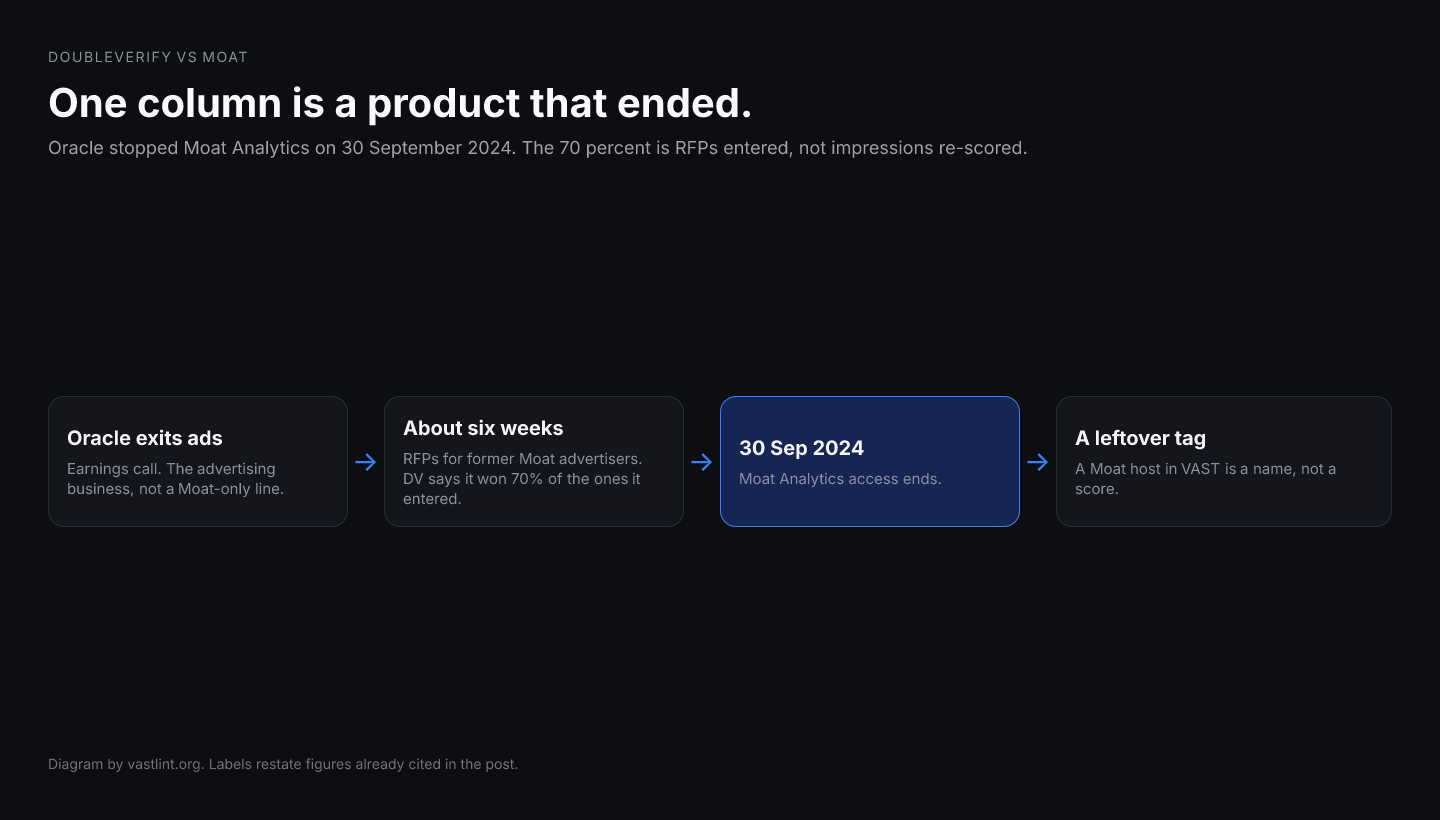
DoubleVerify vs Moat is a comparison query that outlived the product on one side of it. Oracle told clients it would stop supporting its advertising products on September 30, 2024, and the list of what ended includes Moat Analytics. AdExchanger reported that DoubleVerify won 70 percent of the former Moat advertiser RFPs it participated in, in a window of roughly six weeks between Oracle's announcement and the shutdown. The query still reads like a feature bake-off between two current vendors.
The shelf is not current. One name is a measurement and verification product Oracle discontinued with the rest of that advertising business. The other is a company that spent the shutdown pitching the accounts. A win rate on RFPs DoubleVerify chose to enter is a sales result. It is not a measurement of whose viewability or fraud model was more accurate on the same impressions.
Strip the names off and the claim remains. A discontinued product and a live suite do not share a scoreboard, and a share of RFPs entered is not a share of impressions re-measured.
What Moat was, and what ended
Moat's public job was measurement: viewability, attention, and verification sitting on the ad. Oracle had bought it as part of a larger advertising business that also included audience data and contextual tools. When Oracle exited, the client notice covered that business, not a single dashboard. Trade reporting of the earnings call put the advertising business at about $300 million of revenue in fiscal 2024, down from a much larger ad operation in prior years. That figure is the business, not a Moat-only line.
September 30, 2024 is the date access ended. Existing orders ran to that end-of-life date. New agreements were not the path Oracle described. After that date, a tag still labeled Moat in an old trafficking sheet is a name, not a service that is scoring the impression. Teams that kept the pixel in a VAST verification block past the shutdown were calling a host that no longer operated the product.
Moat's reputation in the comparison query is attention and viewability, the metrics buyers had learned to put next to DoubleVerify and IAS. AdExchanger reported DoubleVerify's CEO saying Moat did not do social and did not have a robust dynamic pre-bid suitability product, and that the nearer-term goal was to be more than a like-for-like replacement. That is a product-scope claim from the firm that won the RFPs, made after the shutdown. It is not a side-by-side audit of historical Moat and DV logs.
What the 70 percent actually counts
The 70 percent is a share of advertiser RFPs DoubleVerify participated in, as DoubleVerify described it to AdExchanger. The named wins in that report include P&G, BlackRock, Dish Network, Charter, Inspire Brands, Kellogg's, and Google. A denominator of "RFPs we entered" is smaller than "every former Moat advertiser," and it excludes pitches DoubleVerify did not join. IAS was in the same market for the same accounts. The 70 percent does not say IAS won the rest, and it does not say 70 percent of Moat spend moved.
The clock was short. AdExchanger described roughly six weeks between Oracle's announcement and the date the products were pulled. An RFP in that window is a migration under a deadline. Win rate under a deadline measures who could contract in time. It does not measure whose post-bid viewability methodology matched Moat's on a held-out set of impressions, because that study is not what the figure is.
Attention, which buyers associated with Moat, did not transfer as a unit. DoubleVerify has its own attention and performance products, and it has said expanding past verification is a priority. A buyer who replaces a Moat attention score with a DV attention score has changed instruments. The RFP win records that a contract moved. It does not record that the new score is the old score under a new logo.
Why the query still misleads
Search still pairs the names because years of RFP templates did. The templates assumed two living verification vendors with overlapping tags. After September 30, 2024, one of those tags is a legacy string. Comparing feature lists from a 2023 Moat sheet with a 2026 DoubleVerify sheet compares a product that cannot be bought with one that can.
The measurement question that survives is which events the replacement actually emits. Viewability under the MRC definition is a pixel-and-time threshold. An attention score is a model on top of interaction, duration, and sometimes sound. Moat was known for the second. DoubleVerify's CTV research in 2026, including fraud rates under 1 percent on protected campaigns, is a different publication from an attention methodology. Putting a 2026 fraud rate next to a memory of Moat attention repeats the unit error.
Legacy verification nodes in VAST are where this shows up in the tag. A Verification or Extension that still names Moat, or a vendor identifier that was only ever a Moat host, will not start scoring again because the rest of the tag is valid. The player may fetch a URL that does not answer. The impression can still count. The attention number the trafficking sheet promised does not.
The accounts that moved are also not a sample of the measurement. AdExchanger's list of RFP wins is a list of advertisers who had a deadline, not a panel of impressions re-scored under both methodologies. P&G signing a new verification contract does not tell you whether a 2023 Moat viewability decision and a 2026 DoubleVerify decision would have agreed on one CTV impression. That agreement was never the figure.
Get VAST spec updates, platform guides, and release notes in your inbox.
What to do with the shortlist
Treat Moat as an end-of-life name, not as a column in a 2026 vendor matrix. If a template still says DoubleVerify vs Moat, replace the second column with the vendor that actually holds the contract, and say what that vendor measures this quarter: viewability, IVT, attention, pre-bid, or some mix. The RFP statistic from 2024 is a history of who signed. It is not this quarter's methodology.
Audit tags for dead verification hosts. A Moat URL, a Moat vendor key, or an OMID vendor string that pointed at Oracle's stack should be removed or replaced before the tag is treated as measured. Leaving it in produces a verification block that looks populated and does not return a score.
vastlint is independent of DoubleVerify and has no relationship to the discontinued Moat service. It checks whether AdVerifications and related nodes are present and structurally consistent in VAST 2.0–4.4. It does not know whether a vendor host is still in business, and it does not score attention or invalid traffic. A present node with a dead host is a trafficking problem the structural check will not invent a replacement for. The check tells you the node is there. The end-of-life date tells you the host is not.
What to separate before using this comparison
- End of service: Oracle advertising products, including Moat Analytics, stopped on September 30, 2024.
- RFP win rate: 70 percent of former Moat advertiser RFPs DoubleVerify participated in, not 70 percent of all Moat spend.
- Product scope: viewability, attention, pre-bid suitability, and social were not one Moat feature.
- A 2026 fraud rate from a living vendor is a different publication from a discontinued attention product.
- A Verification node that still names Moat is a host, not a score.
A share of RFPs entered during a shutdown is a sales result, and a discontinued measurement product has no current rate to lose by.
Check whether verification nodes are still in the tag
Run VAST 2.0–4.4 tags against specification-derived rules so AdVerifications and impression events are present and consistent. Nothing is stored.
Open the VAST validatorSources
Client-notice reporting that Moat Analytics Service was on the September 30, 2024 end-of-life list.
AdExchanger on the RFP win rate, the six-week window, and what DoubleVerify said Moat did not cover.
AdExchanger on the earnings-call figure for the advertising business and the decision to exit.
The metric distinction buyers still attach to the Moat name.