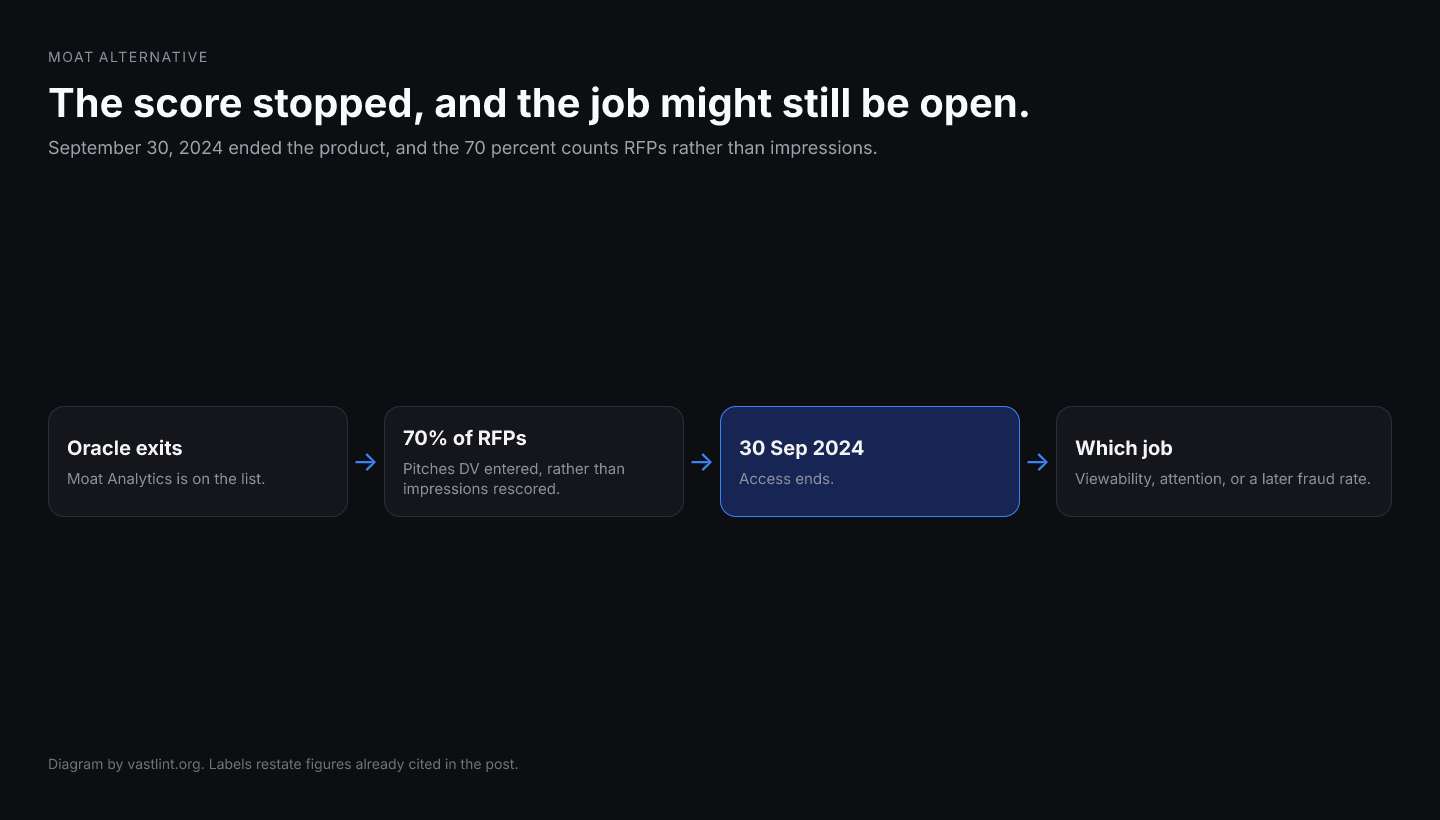
Moat alternative, and the twin search Moat replacement, outlived the product. Oracle stopped supporting its advertising products on September 30, 2024, and Moat Analytics was on that list. After that date there is no current Moat score to beat, match, or migrate pixel for pixel. What remains is a job the old contract was doing, and a tag that may still name the host.
The number that filled the vacuum is a sales result. AdExchanger reported that DoubleVerify won 70 percent of the former Moat advertiser RFPs it participated in, across roughly six weeks between the announcement and the shutdown. The denominator is pitches DoubleVerify entered. It is not every former Moat advertiser, it is not 70 percent of Moat spend, and it is not a count of impressions rescored under two methodologies. IAS was in the same market for the same accounts. The 70 percent does not say IAS won the rest.
vastlint is not a Moat alternative. It has no measurement history to continue, and it does not score viewability or attention. It can tell you whether a VAST 2.0–4.4 verification node is present. It cannot tell you whether the host inside that node still answers, which is the question a leftover Moat URL is asking.
Which job the template still means
Viewability, in the MRC sense the industry argued about for years, is a pixel-and-time threshold: for video, 50 percent of pixels in view for two continuous seconds. That definition did not leave the market when Moat did. A replacement for a viewability seat is another measurer applying that threshold, or a measurer you have audited against it. The RFP win records who signed. It does not record that the new vendor's viewable decision would have matched Moat's on a held-out impression, because that study is not what the 70 percent is.
Attention is the metric buyers attached to the Moat name, and it is a model on top of interaction, duration, and sometimes sound. AdExchanger reported DoubleVerify's CEO saying Moat did not do social and did not have a robust dynamic pre-bid suitability product, and that the nearer goal was to be more than a like-for-like replacement. That is a scope claim from the firm that won the RFPs, made after the shutdown. DoubleVerify has its own attention products, including the pre-bid segments it announced in May 2023 from Authentic Attention. A buyer who points a Moat attention history at a DV attention score has changed instruments. The contract moved. The unit did not automatically follow.
A fraud rate is a third instrument, and it is the one 2026 press is full of. DoubleVerify's May 7, 2026 CTV release, fraud under 1 percent with controls on, is a real measurement of a named population. It is not a Moat viewability series and it is not a Moat attention series. Putting it in the Moat replacement column because the same company won the RFPs repeats the unit error the DoubleVerify vs Moat note is about. IAS's Papyrus figures, nearly 25 times the clicks on a named mobile cluster, are a 2026 scheme study. They are not a reconstructed Moat score either.
What the shutdown did to the tag
Existing orders ran to the end-of-life date. New agreements were not the path Oracle described. A Verification or Extension that still names Moat, or an OMID vendor string that pointed at that stack, calls a host that no longer operates the product. The player may request a URL that does not answer. The impression can still count. The attention number the trafficking sheet promised does not come back.
Leaving the node in place makes the tag look measured. A structural check sees a verification element and can call the document well formed. It will not invent a living vendor behind a dead host. Removing the node, or pointing it at the firm that actually holds the 2026 contract, is a trafficking change. Which firm that should be depends on the job in the previous section, not on who won the most RFPs in a six-week window.
The accounts that moved are a list of advertisers with a deadline. AdExchanger named P&G, BlackRock, Dish Network, Charter, Inspire Brands, Kellogg's, and Google among the wins DoubleVerify described. A list of logos is not a panel of impressions. One of those advertisers signing a new verification contract does not tell you whether a 2023 Moat decision and a 2026 decision would have agreed on one CTV impression.
Get VAST spec updates, platform guides, and release notes in your inbox.
What to do with the shortlist
Retire Moat as a column in a 2026 matrix. If the template says Moat alternative, replace the word Moat with the job: viewability under the pixel threshold, an attention model, pre-bid suitability, or a fraud label. Then pick the firm that publishes that job this quarter. The 70 percent is history of who could contract before September 30, 2024.
Audit tags for the dead host separately from the commercial decision. A Moat URL in a VAST verification block is a defect whether or not you have chosen the replacement, because it reports a measurement that is not happening.
vastlint will flag structure, not the business status of a vendor. Pair the structural pass with an end-of-life list your trafficking team actually maintains. The check tells you the node is there. The date tells you the host is not.
Moat replacement sentences that stay in separate columns
- End of service: Oracle advertising products, including Moat Analytics, stopped on September 30, 2024.
- RFP win rate: 70 percent of former Moat advertiser RFPs DoubleVerify entered, not 70 percent of spend and not a rescored log.
- Viewability: a pixel-and-time threshold another measurer can still apply. The win rate does not prove the decisions match.
- Attention: a model. DoubleVerify's own attention product is a different instrument from the one Moat published.
- A 2026 CTV fraud rate, under 1 percent with controls on, is not a reconstructed Moat score.
- A verification node that still names Moat is a host, not a measurement.
The product ended, so the alternative is whichever living instrument matches the job the template still names, and an RFP win rate is not that instrument.
Check whether a dead verification host is still in the tag
Run VAST 2.0–4.4 tags against specification-derived rules so AdVerifications are present and consistent. The check will not know if the host is out of business. Nothing is stored.
Open the VAST validatorSources
Client-notice reporting that Moat Analytics was on the September 30, 2024 end-of-life list.
AdExchanger on the RFP win rate, the six-week window, and what DoubleVerify said Moat did not cover.
The pair note. This page is the replacement question that pair leaves open.
The metric split buyers still attach to the Moat name.