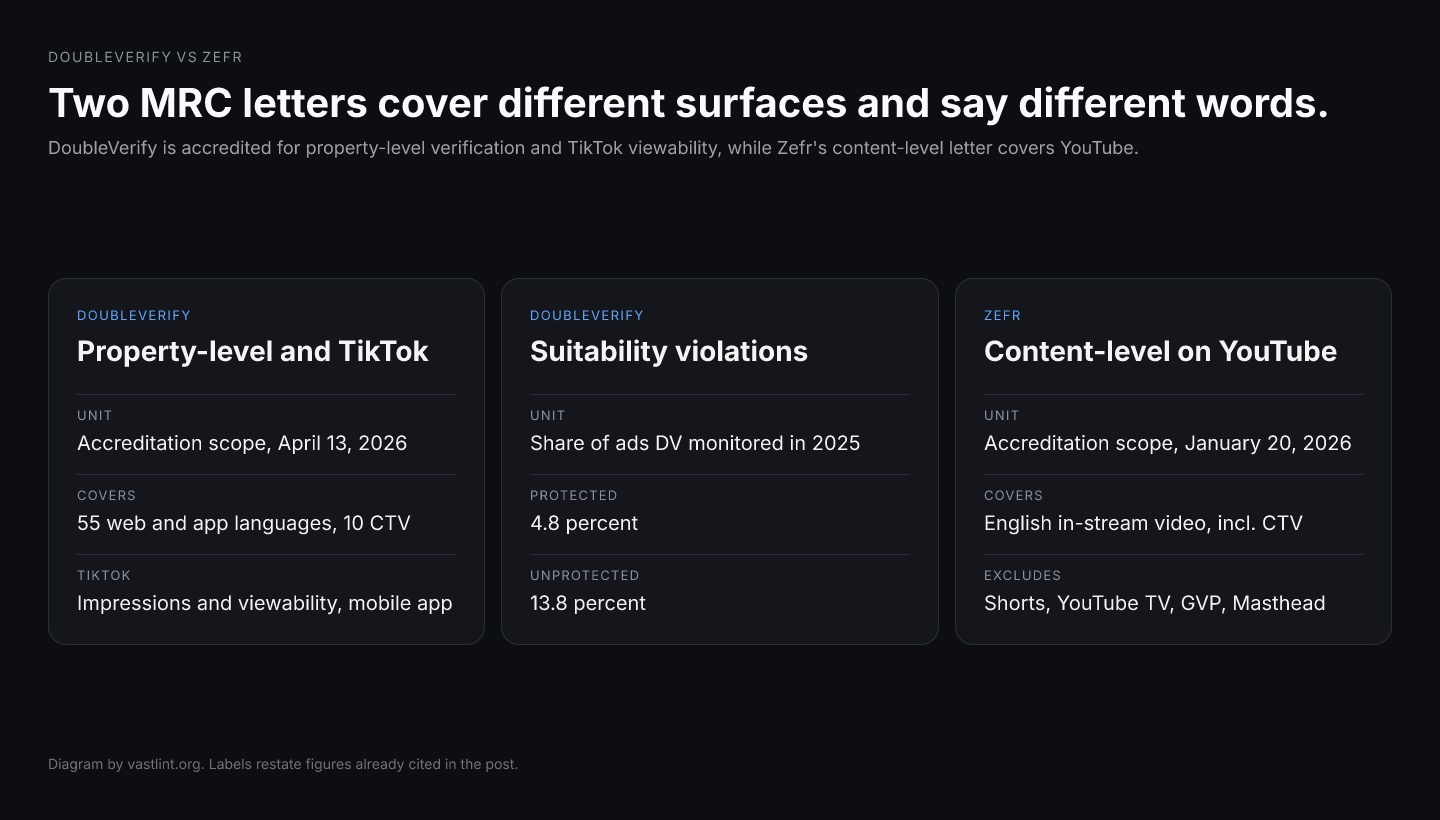
DoubleVerify vs Zefr is the search a buyer runs when a social budget and an open-web budget land on the same verification line. The figures that travel with the two names come from different documents. On April 13, 2026, the Media Rating Council continued accreditation of DoubleVerify's Pinnacle platform for property-level ad verification metrics across desktop, mobile web, mobile in-app, and CTV, added five domain and app languages and French for CTV, and granted initial accreditation for impressions and viewable impressions on video ads served to TikTok. DoubleVerify's April 23 release put the language count at 55 for domain and mobile app environments and 10 for CTV applications. On January 20, 2026, the MRC granted Zefr initial accreditation for content-level brand safety and suitability labeling and reporting of English-language in-stream YouTube video and music video, with Shorts, YouTube TV, Google TV, Masthead, Google Video Partner videos, and volumetric data excluded. vastlint does not rank DoubleVerify against Zefr. It checks whether a VAST 2.0–4.4 tag still carries a verification node, and it does not score suitability.
Rates sit beside those letters and are a different kind of object. DoubleVerify's 2026 Global Insights report, built from post-bid data on campaigns it monitored during 2025, puts the global brand suitability violation rate at 4.8 percent on protected campaigns and 13.8 percent on unprotected ones. Zefr's most quoted rate is older and narrower: in an April 2024 release it said that since launching on TikTok in 2022 it had measured a brand safety rate above 99 percent against the GARM floor definitions across global campaigns. One is a violation share on a vendor's own monitored ads against each advertiser's settings, and the other is a pass share against a shared floor whose sponsor, the World Federation of Advertisers, discontinued GARM on August 9, 2024.
The two firms overlap in fewer places than the query implies. Most of DoubleVerify's accreditation concerns tags it runs on the open web, in apps, and on CTV, with integrations for YouTube, Meta, and TikTok listed as separate lines in the same letter. Both of Zefr's MRC letters are for YouTube. A buyer can only check the VAST document on the first of those surfaces, because the walled gardens in Zefr's letters do not take a buyer's VAST tag with a verification node in it.
What the DoubleVerify figures measure
The April 13, 2026 letter names the service as DoubleVerify's Pinnacle platform, its Quality and Performance dashboards. The continued scope includes display and video impressions with SIVT filtration in desktop, mobile web, mobile in-app, and CTV; property-level ad verification metrics, including video filtering, in the same four environments; CTV video viewability where only traffic from certified apps counts toward viewable impressions; Authentic Attention metrics on desktop and mobile; and pre-bid signals for several products. Meta reporting is limited to Facebook and Instagram feed placements that Meta itself measures and has accredited, reported net of GIVT. YouTube reporting runs through Google's Ads Data Hub for in-stream and bumper placements, covering impressions and viewability net of GIVT, with In-Feed, Masthead, YouTube TV, YouTube Kids, and Shorts out of scope. The word that governs most of the letter is property level, which the MRC's October 18, 2025 policy defines as classification of a domain, site, or app from text, keywords, and language, separate from content-level brand safety that adds images, video, and audio.
The TikTok grant is a viewability accreditation. It covers impressions, viewable impressions, and related metrics for video ads served to TikTok, filtered for GIVT and SIVT, within mobile in-app. The MRC attached two notes: the submission does not represent consideration of incremental or unique metrics, and TikTok traffic is segregated in reporting from DV's tag-based measurement in a separate area of the Pinnacle interface. The MRC's Digital Platforms chart dated July 9, 2026 places DoubleVerify in TikTok's third-party viewability column and shows no accredited third-party content-level brand safety for TikTok at all. DoubleVerify did not claim otherwise; its release calls this TikTok video viewability.
The product story is wider than the letter, which is normal and worth keeping straight. DoubleVerify says its Universal Content Intelligence engine classifies video, image, audio, speech, and text, and it used that description when it extended post-bid suitability measurement to Threads feed on October 16, 2025. On May 18, 2026 it launched pre-screen content-level controls on Threads, refreshed hourly, with 30 additional avoidance categories. On June 22, 2026 it said DV Authentic AdVantage tests on TikTok reduced brand suitability incidents by 59 percent. None of those statements is in the April 13 letter. A content-level product and an accredited content-level metric are two different claims, and the second is the one the MRC audits.
The rates come from a third document. DoubleVerify's 2026 Global Insights report, covered by PPC Land on July 30, 2026, defines a brand suitability violation as a monitored ad that serves, or is blocked from serving, within content that fails the advertiser's own suitability settings. North America fell to 4.1 percent in 2025, from 5.4 percent in 2023 and 4.6 percent in 2024; EMEA was 6.9 percent; the global protected figure was 4.8 percent against 13.8 percent unprotected. The report's own note says the figures are DV post-bid data and may not represent the full scope of protection, because violations stopped before the bid never become measured impressions. DoubleVerify's Q1 2026 Quarterly Benchmarks put the global rate at 4.3 percent, down 9 percent year over year, in a document that leaves CTV out of its video section. The denominator in each case is ads DV monitored, scored against settings that differ by advertiser.
What the Zefr figures measure
Zefr's January 20, 2026 letter is narrow by design. It accredits content-level brand safety and suitability content labeling and reporting of Google YouTube English-language in-stream YouTube video and in-stream YouTube music video, within desktop, mobile web, mobile in-app, and CTV. It cites compliance with the MRC's Minimum Standards, the MRC's Enhanced Content Level Context and Brand Safety Guidelines, and the IAB Ad Verification Guidelines. The MRC's July 9, 2026 chart describes the same line as Zefr's independent URL classification, with volumetric data unaccredited. The unit is a label on a YouTube video. Zefr announced it in March 2026 as the first accreditation of a third-party platform integration for this category on YouTube; Google's own content-level controls for YouTube are a separate accreditation, continued for in-stream and extended to Shorts in a May 28, 2026 letter.
The second Zefr letter, dated November 6, 2025, accredits third-party processing and reporting of Ads Data Hub YouTube traffic from Google Ads and DV360 for video impressions and viewable impressions, GIVT-filtered, on desktop, mobile web, and mobile in-app. It includes skippable in-stream, non-skippable in-stream, and bumper formats and excludes video in-feed, Masthead, Shorts, and Demand Gen non-YouTube inventory. That is the same category DoubleVerify holds for YouTube. Adotat's August 12, 2026 piece on accreditation scope quotes the MRC saying it accredits reported metrics for specific environments, devices, media, formats, and geographies, not companies or whole services. Adotat noted that Zefr's homepage describes YouTube, TikTok, Meta, and Snap while both of its accreditations are on YouTube, and it also said Zefr's own announcement named the metric and the platform correctly.
The 99 percent figure belongs to a different period and a different yardstick. Zefr's April 2024 TikTok release said it had measured a 99 percent plus brand safety rate based on the GARM floor definitions across global campaigns since launching in 2022. The GARM Brand Safety Floor described illegal or harmful content that no advertising should support, which is a narrower set than any single brand's suitability settings. A pass rate against that floor is not the inverse of DoubleVerify's violation rate, which scores each advertiser's own suitability tiers. GARM itself ended on August 9, 2024, although TikTok's brand safety page still describes DoubleVerify, IAS, and Zefr as post-campaign partners whose rates align to the GARM Brand Safety Floor and Suitability Framework. No denominator, impression count, or year-by-year series accompanies the 99 percent.
Zefr's role inside the platforms is also part of what the number means. Adotat reports Rich Raddon's account that TikTok asked Zefr for post-campaign brand safety and suitability measurement rather than targeting, that Zefr's data arrives from the platforms by API, and that Zefr sends its classifications back so platforms can tune their first-party filters. Zefr's April 20, 2026 release extended its brand safety, suitability, viewability, and IVT measurement to TikTok Search, the upgraded Brand and Smart+ campaign flow, TikTok Lite in the US, and GMV Max in the US, excluding LIVE and Shop Tab placements. On September 30, 2026 it announced a Reddit partnership; MediaPost noted Reddit already works with IAS and DoubleVerify, and listed Zefr's other partnerships as YouTube, TikTok, Meta, and Snapchat. Each surface in that list is a platform partnership, and none of them is a tag the buyer traffics.
Why a property-level letter and a content-level letter have no shared scale
The units do not match. An accreditation letter is a scope statement: which metrics, which environments, which languages, which exclusions. It is not a quality rate and it does not say how many ads were unsuitable. DoubleVerify's 4.8 percent is a violation share against advertiser-defined settings. Zefr's 99 percent plus is a pass share against a shared floor. Subtracting one from 100 does not produce the other, because the two numerators count different kinds of content.
The populations do not match. DoubleVerify's rates come from ads it monitored in 2025 across its tag-based measurement and integrations, split by whether its protection was applied. Zefr's TikTok figure covers global TikTok campaigns it measured from its 2022 launch to the April 2024 release, with no published count. Zefr's accreditation covers English-language in-stream YouTube video only; DoubleVerify's property-level accreditation covers 55 domain and app languages and 10 CTV languages. A buyer running Spanish-language YouTube in-stream, or YouTube Shorts, is outside Zefr's accredited scope, and a buyer running open-web CTV is outside both of Zefr's letters.
The surfaces do not match, and the MRC made that explicit. Its October 18, 2025 policy says vendors accredited for property-level ad verification based on text, keywords, or language may not position those services as brand safety or represent them as content-level without content-level capabilities for the specific environment. After a six-month grace period the MRC said it would stop continuing accreditation for vendors that kept doing so, while suitability language stays allowed with disclosures about excluded images, video, and audio, roll-ups to domain level, crawl rates, and sampling error. DoubleVerify's open-web line is property-level. Zefr's YouTube line is content-level. The different vocabulary in the two letters is deliberate.
The dates do not match. The 99 percent plus figure is from April 2024 and rests on a framework discontinued four months later. DoubleVerify's violation rates were published in July 2026 on 2025 data, and the two letters are from January and April 2026. Any of those records can change at the next audit cycle without the others moving.
Which question each firm's number answers
Cells restate public letters and releases. Not published means the cited material does not contain it, not that the capability is absent.
| Question a buyer asks | DoubleVerify public answer | Zefr public answer |
|---|---|---|
| Is third-party content-level brand safety on YouTube accredited? | Not in the April 13, 2026 letter; DV's YouTube line is Ads Data Hub viewability | Yes, English in-stream video and music video, including CTV, January 20, 2026 |
| Is TikTok measurement accredited? | Yes, impressions and viewability in the mobile app, April 13, 2026 | Not in Zefr's MRC letters; Zefr measures TikTok as a platform partner |
| What share of ads failed suitability? | 4.8% protected and 13.8% unprotected on 2025 post-bid data | Not published as a violation rate; above 99% brand safety on TikTok against the GARM floor, April 2024 |
| Is open-web and CTV verification accredited? | Yes, property-level across desktop, mobile web, app, and CTV | Not published; releases describe YouTube, TikTok, Meta, Snap, and Reddit |
| Which languages are accredited? | 55 domain and app languages, 10 CTV languages | English only for YouTube content-level labeling |
| Does the measurement depend on a VAST tag the buyer traffics? | Tag-based measurement does; TikTok and Ads Data Hub reporting do not | Not on the surfaces named in its letters |
Where the VAST tag carries DoubleVerify and where Zefr never touches it
On open-web video and CTV, DoubleVerify's tag-based measurement reaches the player through the VAST document. In VAST 4.1 and later, AdVerifications is a direct child of InLine or Wrapper and holds one Verification element per vendor, identified by the vendor attribute. Each Verification points at a JavaScriptResource with apiFramework="omid" or an ExecutableResource, can pass VerificationParameters to the vendor script, and can carry TrackingEvents with a Tracking event="verificationNotExecuted" URL that reports a [REASON] code when the script did not run. VAST 3.0 and 2.0 tags carry the same data, when they carry it at all, inside Extension type="AdVerifications". That node is where a viewability or property-level measurement starts on the device. A wrapper hop or an SSAI stitcher that drops it leaves a creative that plays and fires its Impression and quartile pixels while the verification vendor sees nothing. DoubleVerify's own CTV accreditation already narrows viewable impressions to certified apps; a missing node narrows it further, silently.
Zefr's accredited surfaces have no such node from the buyer. On YouTube, Zefr's content-level label attaches to the video by URL classification, and its viewability numbers come through Ads Data Hub; neither MRC letter mentions a buyer's VAST tag. On TikTok, Meta, Snap, and Reddit, Zefr reads what the platform sends it. DoubleVerify's TikTok accreditation shows the same split from the other side: the MRC notes that TikTok traffic is kept apart from DV's tag-based measurement in reporting. On those surfaces the buyer's checkable artifacts are the accreditation letter, its exclusions, and the platform's reporting export. A VAST validator has nothing to read there.
A split plan therefore needs two different checks. For a YouTube leg bought through DV360 with Zefr reporting, read the January 20 exclusions against the line items: Shorts, YouTube TV, Google TV, Masthead, and Google Video Partner videos are outside the accredited content-level scope, and so is any non-English in-stream content. For an open-web or CTV leg measured by DoubleVerify, paste or fetch the resolved InLine the device receives, after every wrapper and after stitching, and confirm the Verification entry for DoubleVerify is still present, its JavaScriptResource is a non-empty HTTPS URL with apiFramework="omid", and verificationNotExecuted carries the [REASON] macro. The first check means reading a PDF, and the second means reading XML.
What to do with the shortlist
Write the unit and scope beside every number before it enters a vendor matrix. Property-level accreditation, content-level accreditation, platform viewability accreditation, protected and unprotected violation rates, and a pass rate against a retired floor are separate columns. After that split the comparison is readable, and it still compares letters and published studies rather than a head-to-head test on the same impressions.
Ask each vendor for the letter that matches the line item, not the general badge. For YouTube content-level suitability, the January 20, 2026 Zefr letter is the accredited reference and DoubleVerify's April 13 letter does not contain that category. For TikTok viewability, DoubleVerify's April 13 letter is the accredited reference and neither Zefr letter contains it. For open-web and CTV property-level verification, DoubleVerify's letter lists the languages and environments; Zefr's public material does not describe that service. Where a platform chart says a category is not accredited for anyone, as it does for third-party content-level brand safety on TikTok as of July 9, 2026, the vendor's rate is a product report and should be labeled that way in the deck.
vastlint is independent of DoubleVerify and of Zefr. It checks structural consistency for VAST 2.0–4.4, including whether AdVerifications or the Extension compatibility block is present, whether each Verification has a vendor and a resource, and whether tracking URLs are well formed. It only helps on surfaces that use a VAST tag the buyer can see, which in this pair means the open-web and CTV side. It does not classify content, score suitability or brand safety, read YouTube or TikTok reporting, rank these firms, or know whether a vendor's host is answering.
What to separate before using this comparison
- An accreditation letter is a scope statement about named metrics in named environments, and it carries no quality rate.
- DoubleVerify's open-web accreditation is property-level, which the MRC's October 18, 2025 policy keeps separate from content-level brand safety.
- DoubleVerify's TikTok accreditation is for impressions and viewability, and the MRC chart dated July 9, 2026 shows no accredited third-party content-level brand safety on TikTok.
- Zefr's content-level accreditation covers English-language in-stream YouTube video and music video, and it excludes Shorts, YouTube TV, Google TV, Masthead, Google Video Partner videos, and volumetric data.
- DoubleVerify's 4.8 and 13.8 percent are 2025 violation shares against each advertiser's settings, split by whether DV protection was on.
- Zefr's 99 percent plus is a 2022 to 2024 pass share on TikTok against the GARM floor, a framework discontinued on August 9, 2024.
- A VAST verification node exists only on the open-web and CTV legs, so the tag check applies to DoubleVerify's tag-based measurement and not to Zefr's platform integrations.
Questions buyers ask about DoubleVerify and Zefr
- Is Zefr MRC accredited for brand safety on TikTok or Meta? Not in its MRC letters; both cover YouTube only, and the MRC chart dated July 9, 2026 shows no accredited third-party content-level brand safety on TikTok.
- Is DoubleVerify accredited for content-level brand safety on YouTube? The April 13, 2026 letter's YouTube line is Ads Data Hub impressions and viewability, and the MRC's July 9, 2026 chart lists only Zefr as accredited for third-party content-level YouTube labeling.
- Does DoubleVerify classify social content at the content level? DoubleVerify says its Universal Content Intelligence engine classifies video, image, audio, speech, and text, and it launched pre-screen content-level controls on Threads on May 18, 2026; those are product claims rather than lines in its accreditation letter.
- Can I compare DoubleVerify's 4.8 percent with Zefr's 99 percent? No; one is a 2025 violation share against advertiser-defined settings and the other is an April 2024 pass share against the GARM floor, with different populations and no shared denominator.
- Can vastlint check Zefr's YouTube measurement? No; Zefr's accredited YouTube reporting runs through URL classification and Ads Data Hub, not a buyer's VAST tag, so there is no verification node for vastlint to read.
- What can vastlint check for DoubleVerify? On open-web video and CTV, whether the resolved VAST 2.0–4.4 tag still carries a Verification entry with a vendor, a resource, and verificationNotExecuted tracking, which DoubleVerify's tag-based measurement depends on.
Check the verification node on the legs that use a VAST tag
Run VAST 2.0–4.4 tags against specification-derived rules so AdVerifications, vendor resources, and verificationNotExecuted tracking are present after the wrapper chain. Nothing is stored, and the check does not score suitability.
Sources
MRC, January 20, 2026. Content-level brand safety and suitability scope for English-language in-stream YouTube video and music video, with exclusions.
MRC, November 6, 2025. Ads Data Hub impressions and viewability for YouTube in-stream and bumper formats, with exclusions.
MRC, April 13, 2026. Continued property-level, viewability, SIVT, attention, Meta, and YouTube ADH scope, plus the initial TikTok grant and its notes.
DoubleVerify, April 23, 2026. TikTok viewability and SIVT scope, and 55 domain and app languages and 10 CTV languages.
MRC, October 18, 2025. The property-level versus content-level distinction and the six-month grace period on brand safety wording.
MRC chart updated July 9, 2026. Third-party content-level and viewability status by platform, including YouTube and TikTok rows.
Adotat, August 12, 2026. MRC on accrediting metrics rather than companies, Zefr's two YouTube accreditations, and Zefr's platform role.
PPC Land, July 30, 2026. 2026 Global Insights brand suitability violation rates on 2025 data, definitions, and methodology caveats.
PPC Land, July 2026. Q1 2026 Quarterly Benchmarks, including the 4.3 percent suitability violation rate and the CTV exclusion.
DoubleVerify, October 16, 2025. Universal Content Intelligence and post-bid suitability on Threads.
DoubleVerify, May 18, 2026. Pre-screen controls, hourly refresh, and 30 additional avoidance categories.
DoubleVerify, June 22, 2026. TikTok test campaigns with 59 percent fewer brand suitability incidents.
Zefr's announcement of the January 2026 accreditation and its property-level versus content-level framing.
TV Tech, March 9, 2026. Trade report of the announcement and its content-level scope.
MRC, May 28, 2026. Google's first-party YouTube content-level controls, continued for in-stream and granted for Shorts.
Zefr, April 2024. The 99 percent plus TikTok brand safety rate against GARM floor definitions since 2022.
Zefr, April 20, 2026. Search, Smart+, TikTok Lite, and GMV Max coverage, with GMV Max exclusions.
MediaPost, September 30, 2026. Zefr's Reddit partnership alongside Reddit's existing DoubleVerify and IAS partnerships.
World Federation of Advertisers, August 9, 2024. End of GARM activities, including the Brand Safety Floor.
TikTok's page naming DoubleVerify, IAS, and Zefr as post-campaign brand safety and suitability partners.
Why a suitability violation rate and an invalid-traffic rate are different subtractions.
The envelope check for Verification, vendor, resources, and verificationNotExecuted.
The same shortlist problem with DoubleVerify's CTV fraud figures.