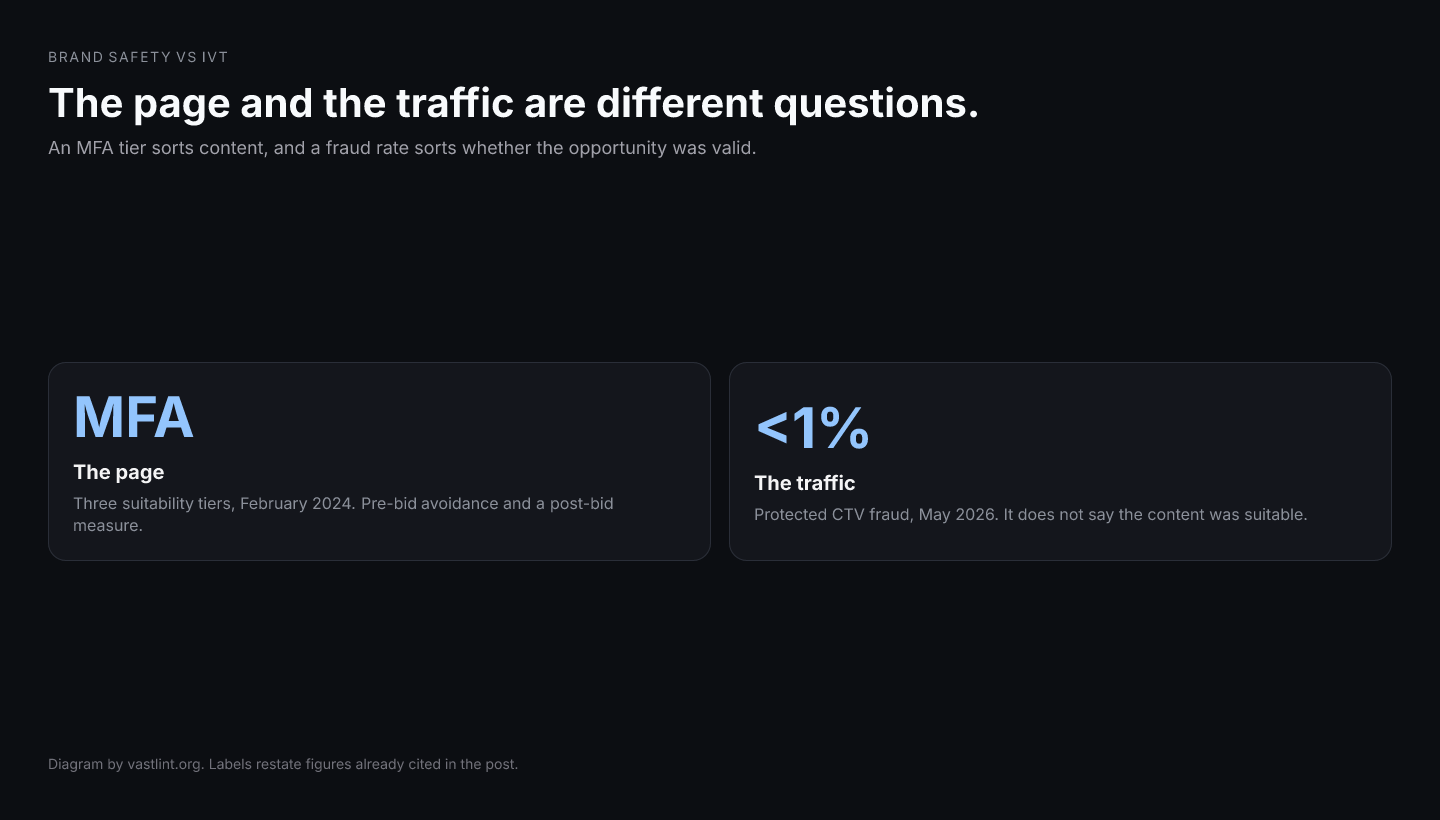
Brand safety versus IVT is the search that treats two products as one badge. People also type brand safety versus ad fraud, MFA versus invalid traffic, made-for-advertising DoubleVerify, and brand suitability versus fraud. On February 27, 2024, DoubleVerify announced tiered made-for-advertising categories for pre-bid avoidance inside Authentic Brand Suitability, next to a post-bid measure of the same issue, and it described sites landing in one of three suitability tiers. IAS's verification page describes a different suitability control: contextual segments for content avoidance, with pre-bid filtering and post-bid blocking when the content falls outside brand guidelines. Neither announcement is an invalid-traffic rate.
The IVT figures live in other sentences. DoubleVerify's May 7, 2026 CTV release puts fraud under 1 percent where its controls were on. Pixalate's March 9, 2026 benchmark puts US CTV at 19 percent in a predominantly open-auction set. The MRC's IVT addendum is about whether the opportunity was valid: lists for general invalid traffic, and an encouraged investigation for sophisticated invalid traffic. It does not score whether the article next to the ad matched a brand's content rules. A human on a made-for-advertising page can be valid traffic in an unsuitable place. A bot on a prestige publisher can be invalid traffic in a suitable place.
vastlint does not classify either one. It checks whether a VAST 2.0–4.4 tag carries the verification node a suitability vendor or an IVT vendor would read. The node does not say which job the vendor was hired for.
What a suitability tier actually sorts
DoubleVerify's February 2024 release is about content-creation practices on sites, sorted into tiers so a buyer can avoid made-for-advertising inventory before the bid and measure it after. That is adjacency and page quality, in the firm's framing. It is not a statement that the impression was served to a person. Turning the MFA control on can shrink a campaign's suitable scale without changing the IVT rate of what remains, and it can leave the IVT rate untouched while the suitability report moves.
IAS's public verification page puts the same job in its own words: context control, segments for avoidance, pre-bid filtering and post-bid blocking for content outside the brand's guidelines. Papyrus, the August 6, 2026 mobile scheme, is not that product. Papyrus is a fraud study about hidden webviews and inflated clicks. Using a Papyrus headline to answer an MFA question, or an MFA tier to answer a Papyrus question, swaps the contract.
Attention is a third column, already separated from viewability in another note. A pixel-and-time viewability threshold, an attention model, a suitability tier, and an IVT rate can all be sold by one company. They remain four instruments. DoubleVerify described Authentic Attention as MRC-accredited when it announced pre-bid attention segments on May 4, 2023. That accreditation sentence is about attention measurement as DV described it then. It is not an accreditation of the 2026 CTV fraud rate, and it is not an accreditation of the MFA tiers.
What an IVT rate refuses to say about the page
Under 1 percent fraud on a protected CTV campaign means the invalid-traffic cell, with controls on, came back under 1 percent. It does not mean the content was suitable, the attention score was high, or the ad was viewable under the pixel threshold. A buyer who reports one green number to cover brand safety and fraud has collapsed the February 2024 product into the May 2026 product.
The reverse collapse is as common. A site blocked for made-for-advertising can be full of real people. Blocking it is a suitability decision. Calling the blocked impressions IVT misstates the MRC category. General invalid traffic is data centers, crawlers, prefetch, and placements that were never a legitimate opportunity. A low-quality article farm is a content judgment unless and until a measurer shows the traffic itself was invalid. The words in the dashboard often say brand safety and IVT in one module. The standard keeps them apart so a content block is not laundered into a fraud rate, and a fraud rate is not laundered into a content approval.
Pre-bid makes the mix worse if the segment file combines both. A trader avoiding a segment may be avoiding MFA, IVT, or both, and the block rate will not say which rule fired unless the log splits them. The MRC's April 2025 memorandum already says the platform decides whether to drop a request flagged for IVT. A suitability avoid is a further rule in the same seat. Two avoids in one bid log are two policies.
Jobs that a single green rate cannot cover
- Invalid traffic: was this a valid opportunity. GIVT is the required list. SIVT is the further investigation.
- Brand suitability: was the content inside the brand's rules. DoubleVerify's MFA tiers, February 27, 2024, are this job, with pre-bid avoidance and post-bid measurement.
- IAS context control: pre-bid filtering and post-bid blocking for content outside brand guidelines, which is suitability, not Papyrus.
- A protected CTV fraud rate under 1 percent, May 7, 2026, does not certify suitability.
- A blocked MFA site is not automatically invalid traffic. A bot on a suitable publisher is not automatically a brand-safety pass.
- Attention and viewability are further instruments. They are not this comparison.
A fraud rate says what kind of traffic arrived, and a suitability tier says what kind of page it arrived on, and a campaign can fail one while passing the other.
Check that the tag can carry whichever job you bought
Run VAST 2.0–4.4 tags against specification-derived rules so the verification node is present. Nothing is stored. The check does not know whether the node was hired for IVT or for suitability.
Sources
DoubleVerify, February 27, 2024. Three suitability tiers, pre-bid avoidance and post-bid measurement.
IAS's description of contextual avoidance, separate from an IVT study.
The third and fourth instruments people fold into the same badge.
Why suitability, attention, and a fraud rate do not swap as one replacement.