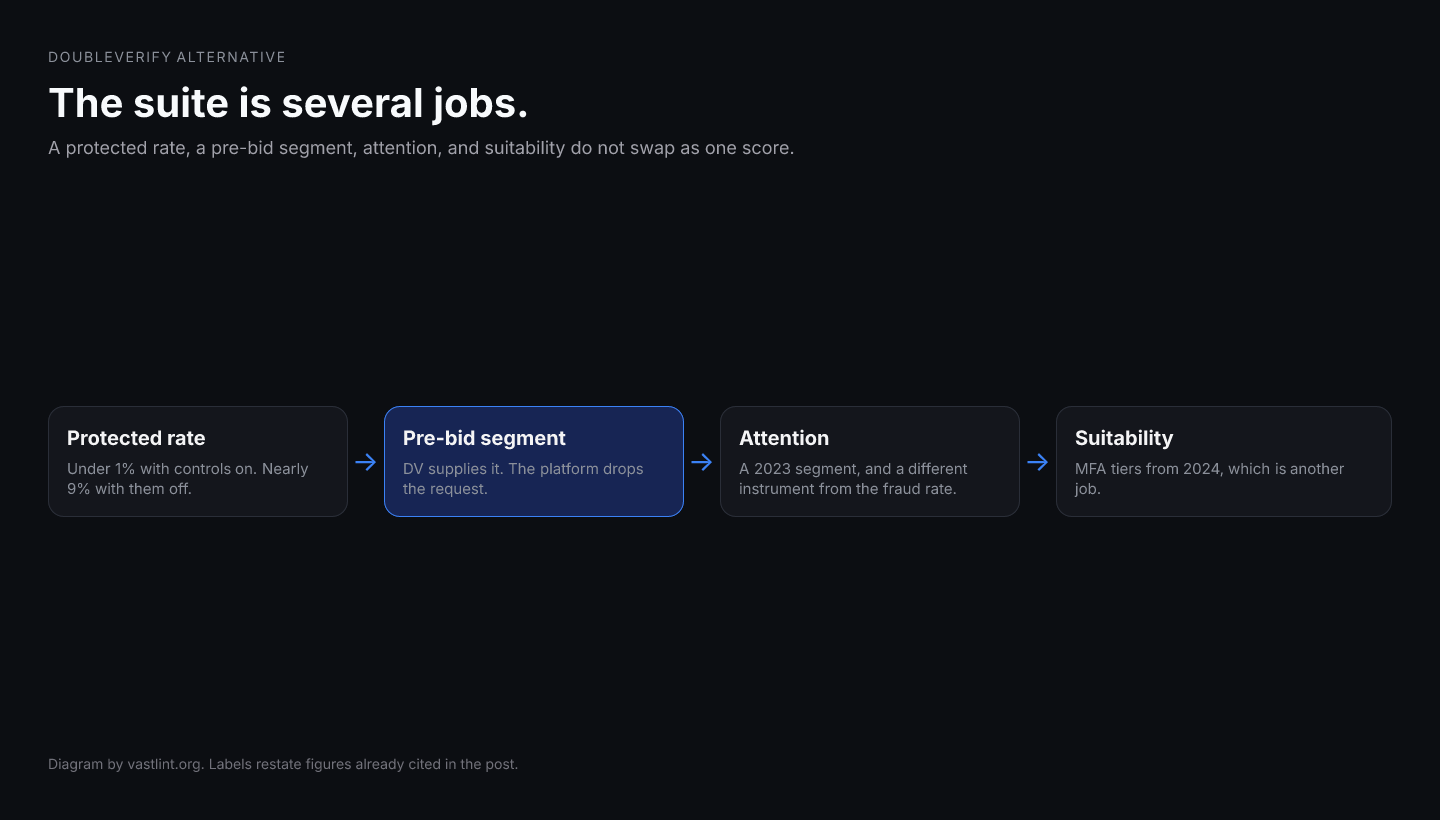
DoubleVerify alternative is the search that shows up when a verification contract is up for review. The phrase treats the company as one product with one score, and the public record does not. On May 7, 2026, DoubleVerify said fraud on DV-protected CTV campaigns was under 1 percent, and nearly 9 percent in controlled tests where those controls were off. On April 11, 2025, the Media Rating Council described a different object: DV supplies pre-bid segments and IVT classifications, and DV does not itself drop the bid request. On March 9, 2026, Pixalate published a third object, 19 percent of US CTV impressions invalid inside a predominantly open-auction set. Oracle had already ended Moat Analytics on September 30, 2024.
A buyer can hire another firm. The hire only replaces the job that firm actually publishes. A protected-campaign rate, a suggestion on the OpenRTB request, a quarterly open-auction share, an attention segment, and a brand-suitability category are five decisions. Search collapses them into one column labeled alternative.
vastlint is not that alternative. It is independent of DoubleVerify, IAS, Pixalate, and HUMAN. It checks whether a VAST 2.0–4.4 tag still carries the verification node and the impression events a measurement firm would have to read. It does not classify invalid traffic, and it does not score attention.
What sits inside the DoubleVerify name
The May 7, 2026 CTV release is the number people paste into a spreadsheet. Protected campaigns, controls on, fraud under 1 percent. Unprotected tests, controls off, nearly 9 percent. The same release counts 140 percent more CTV fraud schemes and variants in the first quarter of 2026 than in the first quarter of 2025. A scheme count and an impression share are different units, and both are DoubleVerify's. About $1.8 million per billion impressions is an estimated cost on unprotected campaigns, not a rate. Two direct deals, 34 percent of impressions to bots in one healthcare buy and 25 percent in a CPG buy, are single campaigns.
Pre-bid is a second job, and the MRC's April 11, 2025 memorandum is specific about who acts. DV provides pre-bid segments and IVT classifications to DSPs, SSPs, and advertisers through DSPs, by API or by flat file. The memorandum says DV does not directly filter requests or prevent ad serving. It says DV enables blocking after the impression only where the client has configured that block. A segment the buyer can query, and a block the buyer turned on, are both real. Neither one is the under-1-percent campaign rate, which is what remained in a measured cell after controls were on.
Attention and brand suitability are further jobs, with their own dates. On May 4, 2023, DoubleVerify announced pre-bid attention segments built from Authentic Attention, and it described that measurement product as MRC-accredited at the time of the announcement. On February 27, 2024, it announced tiered made-for-advertising categories for pre-bid avoidance inside Authentic Brand Suitability, next to a post-bid measure of the same issue. An RFP that says replace DoubleVerify has to say which of these the contract actually uses. A fraud rate will not stand in for an attention segment, and an attention segment will not stand in for a suitability category.
Which public artifact can stand in for which job
IAS is the name that usually shares the RFP. The public research that travels with the name is Papyrus, published August 6, 2026: a named mobile cluster in novel-reading apps, nearly 25 times the click success rate, roughly 4 times the eCPM, and about 13 percent higher attention than other traffic IAS had already separated. IAS says clients on IVT avoidance are filtered against the apps, domains, and hostnames once that scheme is identified. That is a list after identification. IAS's verification page also describes pre-bid filtering and post-bid blocking for content that falls outside brand guidelines, which is a suitability control. Papyrus does not say what fraction of a CTV campaign would have remained after an IAS control, and the suitability page does not publish the May 2026 CTV rates.
HUMAN is the name that shares the pre-bid conversation. MediaGuard, in HUMAN's own docs, returns an IVT prediction on the OpenRTB bid in time to decide whether to bid, and FraudSensor is required alongside it so the post-bid tag can check the prediction. The MRC memorandum says HUMAN provides that suggestion to DSPs and SSPs, not to advertisers or agencies, and that HUMAN does not directly filter the request, prevent serving, or enable the block. The decision sits at the platform. HUMAN's package page uses the word filtration and says the analysis of a bid request is built to return in 12 milliseconds or less. The package sentence and the MRC sentence can both be true: one describes the product's speed and intent, and the other says who is allowed to drop the request. A buyer who wanted DV segments inside an advertiser seat is not looking at the same distribution.
Pixalate is the name that shares the CTV benchmark conversation. The March 9, 2026 table puts US CTV invalid traffic at 19 percent and global CTV at 21 percent, from more than 103 billion programmatic impressions that are predominantly buy-side open auction. Pixalate's product page names three products: pre-bid blocking, post-bid analytics, and a Media Ratings Terminal. Its metrics note says designations in those products, including the blocking lists, reflect Pixalate's opinions and are neither facts nor guarantees. A 19 percent open-auction share is a classification of a log. It is not the rate left after DoubleVerify's controls, and a blocking list sold as an opinion is not a protected-campaign study.
Moat is the name that still appears in old templates. Oracle ended Moat Analytics with the rest of that advertising business on September 30, 2024. AdExchanger reported that DoubleVerify won 70 percent of the former Moat advertiser RFPs it entered, in a window of about six weeks. That figure is a share of pitches, not a re-measurement of impressions, and it is not evidence that a 2026 fraud rate replaced a Moat attention score. A tag that still names Moat is a host, not a living alternative.
Get VAST spec updates, platform guides, and release notes in your inbox.
What to do with the shortlist
Write the job before you write the vendor. Protected CTV impression rate, scheme count, pre-bid segment, post-serve block, attention segment, brand suitability, open-auction benchmark, post-identification list. A DoubleVerify alternative is legitimate inside one of those rows. It is a category error across the row.
Ask who is allowed to act. The MRC's point, for both DV and HUMAN, is that the measurement firm is not the party that drops the bid. If the contract you are replacing is a segment your traders query, the replacement has to show up in that seat. If the contract is a post-bid label on served CTV, the replacement has to read the impression, which means the VAST tag still has to carry the verification node.
Keep the tag check separate from the vendor decision. Server-side stitching can fire beacons without the device context a fraud model expects, and a wrapper can omit AdVerifications while the impression still counts. vastlint checks that structure for VAST 2.0–4.4. It will not tell you whether IAS, HUMAN, or Pixalate should hold the contract.
Jobs a single alternative cannot cover
- DoubleVerify, DV-protected CTV campaigns, May 7, 2026: fraud under 1 percent.
- DoubleVerify, controls not applied, same release: fraud near 9 percent.
- DoubleVerify, Q1 2026 versus Q1 2025: 140 percent more CTV schemes and variants, which is a count, not an impression share.
- MRC, April 11, 2025: DV supplies pre-bid segments and does not itself filter the bid request. Post-serve blocking is the client's configuration.
- MRC, same memorandum: HUMAN suggests IVT to DSPs and SSPs and does not itself filter the request.
- Pixalate, Q4 2025, US CTV, predominantly open auction: 19 percent of impressions.
- Moat Analytics: access ended September 30, 2024. A leftover verification host is not a score.
A replacement is real inside one job, and a shortlist that swaps the whole suite for one rival rate has changed the question.
Check the tag the next vendor would have to read
Run VAST 2.0–4.4 tags against specification-derived rules so AdVerifications and impression events are present. Nothing is stored. This does not choose a verification vendor.
Open the VAST validatorSources
Who supplies a pre-bid signal, and who actually decides to filter the request, for DoubleVerify and for HUMAN.
DoubleVerify, May 7, 2026. Protected and unprotected CTV rates, and the scheme count.
DoubleVerify, February 27, 2024. Brand suitability as its own pre-bid and post-bid job.
Pixalate, March 9, 2026. US CTV at 19 percent in a predominantly open-auction set.
The pair the alternative search usually collapses.
Why a filtered campaign rate and an open-auction share are different subtractions.