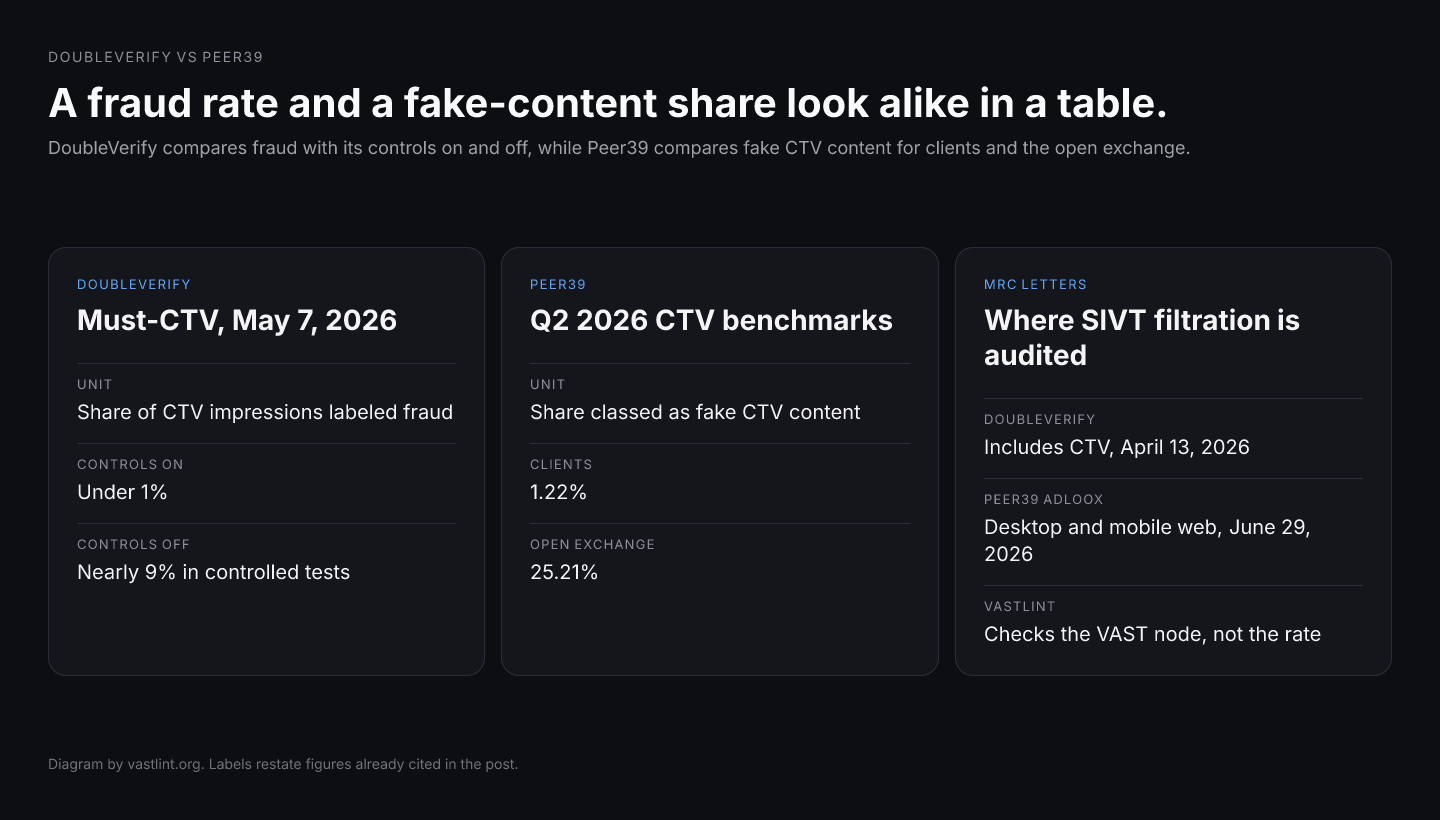
DoubleVerify vs Peer39 is a search that became a verification shortlist in June 2026, when Peer39, a contextual data platform, bought the ad verification company Adloox from Scope3. The headline numbers the two firms publish still describe different objects. On May 7, 2026, DoubleVerify released its CTV report, Must-CTV, and said fraud rates on DV-protected CTV campaigns were less than 1 percent, against nearly 9 percent in controlled tests where its protection controls were not applied. In its Q2 2026 CTV benchmarks, last updated in July 2026, Peer39 said fake CTV content was 1.22 percent for its clients and 25.21 percent on the open exchange, and its Q1 2026 research said about 60 percent of CTV bid requests contain no usable program-level signal. vastlint does not rank DoubleVerify against Peer39. It checks whether a VAST 2.0–4.4 tag still carries the verification node a post-bid script would have to read, and it does not classify invalid traffic, score suitability, or judge what program an ad ran in.
The two with-and-without pairs look like the same experiment. Under 1 and nearly 9 against 1.22 and 25.21 invites a reader to line them up and conclude that one firm's controls cut more. The numerators differ before any ranking starts. DoubleVerify counts fraud, a share of impressions that its classifier labeled invalid. Peer39's pair counts fake CTV content, which it defines as non-television environments such as wallpapers, screensavers, and idle apps misrepresented as CTV inventory. A screensaver app can serve a real person in a real living room and still be fake CTV content in Peer39's taxonomy, and a premium streaming app can carry bot traffic and still be authentic content. The two pairs measure different failures.
Both firms now sell pre-bid controls in DSPs and post-bid measurement, and a buyer can hire either or both. The public figures do not say which hire would have removed more of a given campaign's waste. Strip the names off and the claim remains: a protected-versus-unprotected fraud rate, a client-versus-open-exchange content share, and a share of bid requests missing program data do not order one another.
What the DoubleVerify figures measure
DoubleVerify's May 7, 2026 release describes its base in one sentence: proprietary DV measurement data spanning billions of impressions from DV-protected campaigns, plus controlled tests where protection controls were not applied. Surveys of more than 2,000 marketers and 22,000 consumers in more than 20 markets sit in the same report as a separate instrument. The fraud rates come from the measurement data. The same release says DV detected 140 percent more CTV fraud schemes and variants in Q1 2026 than in Q1 2025, and estimates that fraud in unprotected campaigns can cost about $1.8 million per billion CTV impressions served. The under-1-percent cell exists because DV's controls were on, and the nearly-9-percent cell exists because a test turned them off. Neither is a census of CTV.
DoubleVerify's quality benchmarks add violation rates across measured media rather than CTV alone. PPC Land's July 7, 2026 summary of the Q1 2026 Quarterly Benchmarks report gives a global fraud and SIVT violation rate of 0.5 percent, a brand suitability violation rate of 4.3 percent, a block rate of 3.5 percent, and a video filter rate of 4.6 percent, and notes that the report's video benchmark section excludes connected TV. PPC Land's July 30, 2026 summary of the 2026 Global Insights report, Media Quality in the Age of AI, uses 2025 post-bid data: unprotected campaigns recorded a 13.8 percent brand suitability violation rate against 4.8 percent for protected campaigns, and a 2.8 percent fraud violation rate against 0.6 percent. The same summary quotes DoubleVerify's caution that post-bid figures may not represent the full scope of its protection, because some violations are prevented before an impression is bought.
A brand suitability violation, as DoubleVerify defines it in that report, is a monitored ad that serves, or is blocked from serving, in content that fails the advertiser's own suitability settings. The denominator is therefore set by each advertiser's profile. A stricter profile produces more violations on the same media, and a looser one produces fewer. A 4.3 percent violation rate is a statement about media measured against thousands of different rulebooks, not about how much of the market is unsafe under one rulebook.
Accreditation sits beside the research. The MRC's April 13, 2026 letter continues accreditation of DoubleVerify's Pinnacle platform for display and video impressions in desktop, mobile web, mobile in-app, and CTV, inclusive of SIVT filtration. In CTV, video viewable impressions, completion, and quartile metrics are accredited with SIVT filtration, with the condition that only traffic from certified apps is included in video viewable impressions and fully on-screen metrics. Property-level ad verification is accredited in CTV, and the language table marks 10 languages for CTV classification, with French newly granted in this letter. The pre-bid table lists Fraud/IVT segments for desktop, mobile web, mobile app, and CTV. The letter also covers Meta feed placements net of GIVT, YouTube through Google's Ads Data Hub for listed in-stream formats, and grants initial accreditation for TikTok viewability in mobile in-app. None of those lines is a fraud rate. They describe where DoubleVerify's methods passed audit.
What the Peer39 figures measure
Peer39's CTV figures classify what sits behind a bid request. The Q2 2026 benchmarks page says the data comes from aggregated bid requests observed by Peer39 and anonymized CTV campaign data from active clients, counting only campaigns with at least 100,000 impressions, and that the benchmarks are a directional guide. Fake CTV content was 1.22 percent for Peer39 clients against 25.21 percent on the open exchange. Sensitive content exposure, which covers news, kids, legal, and other sensitive environments, was 7.11 percent against 20.73 percent. User-generated content was 0.01 percent against 4.94 percent. Completion was 97.51 percent for Peer39 tag users, over more than 322 million starts, with TV screens at 84.85 percent of starts and known channel transparency at 25.53 percent.
The open-exchange side of that pair is framed in two ways. Peer39's Q1 2026 report, CTV Truths, says 25.2 percent of open-exchange CTV bid requests are classified as fake content and that approximately 60 percent of CTV bid requests contain no usable program-level signal. MediaPost's March 11, 2026 coverage adds that around a third of the remaining requests carry data Peer39 calls shallow or inaccurate, and that 98 percent of fake CTV comes from mobile app inventory presenting itself as big-screen inventory. The Q2 page's FAQ phrases the client figure as 1.22 percent of impressions. A share of bid requests and a share of delivered impressions are different denominators, because most bid requests are never bought.
Peer39's September 29, 2026 report, The Brand Safety Illusion, adds two CTV findings with their own bases. Comparing bid requests for the film Man of Steel with authenticated information about it, Peer39 found that none of the observed requests carried the complete set of genre and mood descriptors, that 58 percent supplied only one genre, Fantasy, and that roughly 11 percent had no content object at all. In a separate 45-day analysis of CTV placements, 3.8 percent of impressions showed direct evidence of invalid traffic, and another 10.7 percent could not be confirmed as either valid or invalid with the available signals. That is a three-way split. Adding 3.8 and 10.7 does not produce an IVT rate, because the second number is the share Peer39 says it could not decide.
Peer39's MRC accreditation arrived with Adloox. The June 29, 2026 letter continues accreditation of the Peer39 Adloox viewability and fraud prevention service, formerly Scope3 France Adloox, for desktop, mobile app, and mobile web display and video, with SIVT filtration in desktop and mobile web. CTV does not appear in that letter, and neither does contextual classification. Peer39's June 3, 2026 announcement says Adloox adds MRC-accredited viewability and IVT measurement, and describes its CTV offer as program-level contextual authentication plus OM SDK-based placement verification. The CTV benchmarks are Peer39's own research, and the material read does not describe them as accredited.
Why a protected fraud rate and a fake-content share have no shared scale
The numerators differ. DoubleVerify's under-1-percent and nearly-9-percent cells are fraud. Peer39's 1.22-percent and 25.21-percent cells are fake content, an environment class. Peer39 does publish an IVT finding, 3.8 percent with direct evidence, but from a 45-day placement analysis with an undetermined 10.7 percent beside it, not from the benchmark pair. Putting DV's 9 percent next to Peer39's 25.21 percent compares an invalid-traffic test with a content taxonomy, and the gap between them is the difference in definitions.
The populations differ on both sides of each pair. DoubleVerify's with side is campaigns with DV controls applied, and its without side is controlled tests with those controls off. Peer39's with side is client campaigns of at least 100,000 impressions, and its without side is the open exchange as Peer39 observes it in bid requests. A controlled test and an open-exchange bid stream are not the same unprotected population, and a DV-protected campaign and a Peer39 client campaign may be the same campaign, since a buyer can activate Peer39 segments in a DSP and carry a DV tag on the same line.
Suitability splits the same way. DoubleVerify's 4.3 percent global violation rate is measured against each advertiser's settings, and PPC Land's summary does not break it out for CTV. Peer39's 7.11 percent sensitive content exposure is measured against Peer39's own categories, in CTV. Both can be called brand suitability in a deck. One is a mismatch with a buyer's rulebook across measured media, and the other is exposure to a vendor-defined set of program types on television screens.
The dates and accreditations do not line up either. DoubleVerify's fraud rates are from a May 2026 report, its violation rates from Q1 2026 and from 2025 data, and its accreditation letter from April 13, 2026. Peer39's figures are from Q1 2026, Q2 2026, and a September 29, 2026 report, and its accreditation letter from June 29, 2026 covers a service it had owned for less than a month. DoubleVerify's letter includes CTV impressions with SIVT filtration. The Peer39 Adloox letter does not include CTV. That is a difference in audited scope, and it says nothing about whose CTV classifier is more accurate on the same impressions.
Which question each firm's number answers
Not published means the material read does not contain the figure, not that the firm lacks the capability.
| Question a buyer asks | DoubleVerify public answer | Peer39 public answer |
|---|---|---|
| How much CTV fraud remains with the vendor's controls on? | Under 1% on DV-protected CTV campaigns, May 7, 2026 | Not published as fraud; fake CTV content was 1.22% for clients in Q2 2026 |
| What does CTV look like without controls? | Nearly 9% fraud in controlled tests with controls off | 25.21% fake CTV content on the open exchange; about 60% of CTV bid requests lack program-level signal |
| How often do ads meet unsuitable content? | 4.3% suitability violations globally in Q1 2026; 4.8% protected vs 13.8% unprotected in 2025 | 7.11% sensitive content exposure for clients vs 20.73% on the open exchange, Q2 2026 CTV |
| How much CTV traffic is invalid in a sample? | Not published as a market share; the nearly 9% is a controlled test | 3.8% with direct IVT evidence and 10.7% undetermined in a 45-day CTV analysis |
| Is CTV IVT measurement MRC-accredited? | Yes, CTV impressions with SIVT filtration, April 13, 2026 letter | Not in the June 29, 2026 Peer39 Adloox letter, which applies SIVT filtration in desktop and mobile web |
| Is CTV content classification MRC-accredited? | Yes, property-level ad verification in CTV, with 10 CTV languages | Not in the letter read |
| Does it cover YouTube and Meta? | YouTube via Ads Data Hub for listed formats; Facebook and Instagram feeds; TikTok newly accredited | Meta (Facebook, Instagram Feed and Reels, Threads) and DV360 through Adloox, per Peer39 |
Where each firm shows up in the VAST tag, and where it does not
DoubleVerify's post-bid video measurement is the part that lives in the tag. In VAST 4.1 and later, an OM SDK verification script is declared in AdVerifications as a Verification element with a vendor attribute, a JavaScriptResource with apiFramework set to omid, optional VerificationParameters, and a verificationNotExecuted tracking event the player fires when it cannot run the script. In VAST 3 and earlier the same structure travels inside an Extension of type AdVerifications. Google Ad Manager's Open Measurement help page gives doubleverify.com-omid as an example vendor key, next to integralads.com-omid, and describes the parameters as the same VerificationParameters defined in VAST 4.1. On CTV, DoubleVerify's accredited video viewability counts only traffic from certified apps. Separately, a CTV player without an OM SDK integration cannot run the script, and when it fires verificationNotExecuted it is telling the buyer that this impression was not measured by the tag.
Most of Peer39's evidence never touches the VAST document. The Man of Steel finding is about the content object in the OpenRTB bid request, the fields that carry title, genre, and rating. A VAST response does not carry the program title, and a wrapper chain cannot repair a bid request that arrived with one genre or none. Peer39's pre-bid categories, such as Safe from Fake Content and Verified Valid Channel, act in the DSP before any VAST is fetched, and so do DoubleVerify's pre-bid segments. For post-bid, Peer39 describes OM SDK-based placement verification through Adloox, which in a VAST tag would take the same AdVerifications shape, though the material read does not publish a vendor key. The Adloox video module in Prebid.js still documents a VAST wrapper hosted at j.adlooxtracking.com, so a Peer39 verification line may load from a host that carries neither the Peer39 name nor the Scope3 name.
Some surfaces in this comparison have no buyer VAST tag at all. DoubleVerify's YouTube accreditation is independent processing of Ads Data Hub data, and its Meta line is integrated reporting on Facebook and Instagram feeds. Peer39's Meta coverage comes through the Adloox integration. In those environments there is nothing for a buyer to paste into a validator, and the buyer relies on the platform integration and the accreditation letter. In server-side ad insertion, the stitcher fetches the VAST, so an OMID script runs on the device only if the stitcher passes the verification node through to the player. vastlint checks the documents a buyer can see: it flags a Verification with no vendor or resource, a vendor value not in a company.com-omid form, missing VerificationParameters, an apiFramework other than omid, a verificationNotExecuted URL without the REASON macro, and an InLine or Wrapper with no Impression.
What to do with the shortlist
Map each number to the decision it informs. DoubleVerify's protected and unprotected rates answer whether a fraud control reduced invalid traffic on CTV campaigns in DoubleVerify's own measurement. Peer39's fake-content and program-signal shares answer whether a buyer knows what kind of environment and program a CTV bid represents. Those are different decisions, and they can sit on one line item, which is why a single winner column misreads both firms.
Ask for denominators before the numbers enter a deck: impressions or bid requests, client campaigns over 100,000 impressions or controlled tests, the advertiser's suitability profile or the vendor's category list, and the period. For CTV, ask each firm for its current accreditation letter and read the environment column: DoubleVerify's April 2026 letter includes CTV with a certified-app condition on viewability, and the Peer39 Adloox letter of June 2026 stops SIVT filtration at desktop and mobile web. If Adloox controls in DV360 still carry Scope3 names, which Peer39's FAQ says they will until renamed, record the mapping so reconciliation finds them.
vastlint is independent of DoubleVerify, Peer39, Adloox, and Scope3. It checks VAST 2.0–4.4 structure, including Impression presence and the shape of AdVerifications and Verification nodes, in the document you paste. It does not read OpenRTB content objects, it does not classify invalid traffic or fake content, it does not score suitability, and it does not know whether a vendor host is alive. A clean result means the node a post-bid script needs is present and well formed. Whether that script ran, and what it found, is in the vendor's report.
What to separate before using this comparison
- DoubleVerify's under 1 percent and nearly 9 percent are CTV fraud rates with its controls on and in controlled tests with them off, from the May 7, 2026 report.
- Peer39's 1.22 percent and 25.21 percent are shares of fake CTV content, an environment class, for clients and for the open exchange in Q2 2026.
- Peer39's roughly 60 percent is a share of CTV bid requests with no usable program-level signal, not a share of delivered impressions.
- Peer39's 3.8 percent with direct IVT evidence sits beside 10.7 percent it could not confirm either way, and the two do not add up to a rate.
- DoubleVerify's 4.3 percent suitability violation rate is measured against each advertiser's settings, while Peer39's 7.11 percent sensitive exposure is measured against its own categories in CTV.
- DoubleVerify's April 13, 2026 MRC letter includes CTV impressions with SIVT filtration, and the Peer39 Adloox letter of June 29, 2026 does not include CTV.
- Pre-bid controls from either firm act on the bid request, so only the post-bid verification node can be checked in the VAST tag.
Questions buyers ask about DoubleVerify and Peer39
- Is Peer39 a verification company now? It acquired Adloox from Scope3 on June 2, 2026, and the MRC continued accreditation of the Peer39 Adloox viewability and fraud prevention service on June 29, 2026, while Peer39's CTV benchmarks remain content classification research.
- Is Peer39's 25.21 percent the same kind of number as DoubleVerify's nearly 9 percent? No. Peer39's figure is fake CTV content on the open exchange, and DoubleVerify's is fraud in controlled tests where its own controls were off.
- Is DoubleVerify MRC-accredited in CTV? Yes. The April 13, 2026 letter covers CTV impressions with SIVT filtration and CTV video viewability, with viewable impressions counted only from certified apps.
- Does Peer39 publish a CTV invalid-traffic figure? Its September 29, 2026 report found 3.8 percent of impressions with direct IVT evidence and 10.7 percent undetermined in a 45-day CTV analysis, and its accredited SIVT filtration covers desktop and mobile web.
- Can a VAST validator tell me which firm is right? No. vastlint checks whether the verification and impression nodes are present and well formed, and the classifications themselves happen in each firm's systems.
Check the verification node the post-bid script needs
Paste a VAST 2.0–4.4 tag to check AdVerifications, Verification vendor keys, and Impression presence against specification-derived rules. Nothing is stored. This does not score fraud, suitability, or program context.
Sources
DoubleVerify, May 7, 2026. Protected and unprotected CTV fraud rates, scheme counts, and the per-billion cost estimate.
Pinnacle platform scope, CTV certified-app condition, CTV languages, pre-bid table, Meta, YouTube ADH, and TikTok.
July 7, 2026 summary of the Q1 2026 Quarterly Benchmarks: 0.5 percent fraud and SIVT, 4.3 percent suitability violations.
Summary of the 2026 Global Insights report: 4.8 versus 13.8 percent suitability violations, the violation definition, and the post-bid caveat.
Peer39, Q2 2026, last updated July 2026. Fake CTV, sensitive, and UGC exposure, completion, and methodology.
Peer39 Q1 2026. About 60 percent of CTV bid requests without usable program-level signal, 25.2 percent fake content.
March 11, 2026 coverage of the Peer39 research, including the 98 percent mobile-app share of fake CTV.
September 29, 2026 release on The Brand Safety Illusion: Man of Steel bid requests and the 45-day IVT split.
Trade coverage of the same Peer39 report.
June 3, 2026. Capabilities by platform, accredited metrics, and the FAQ on Scope3 segment names.
Trade coverage describing Peer39 as a contextual data platform moving into verification.
SIVT filtration in desktop and mobile web; no CTV line.
Vendor key format with doubleverify.com-omid as an example, and the link to VAST 4.1 VerificationParameters.
The VAST wrapper hosted at j.adlooxtracking.com.
Why a content classification and an invalid-traffic label are separate measurements.
The same DoubleVerify protected and unprotected rates beside an open-auction IVT share.
The Verification, vendor, and verificationNotExecuted checks referenced above.