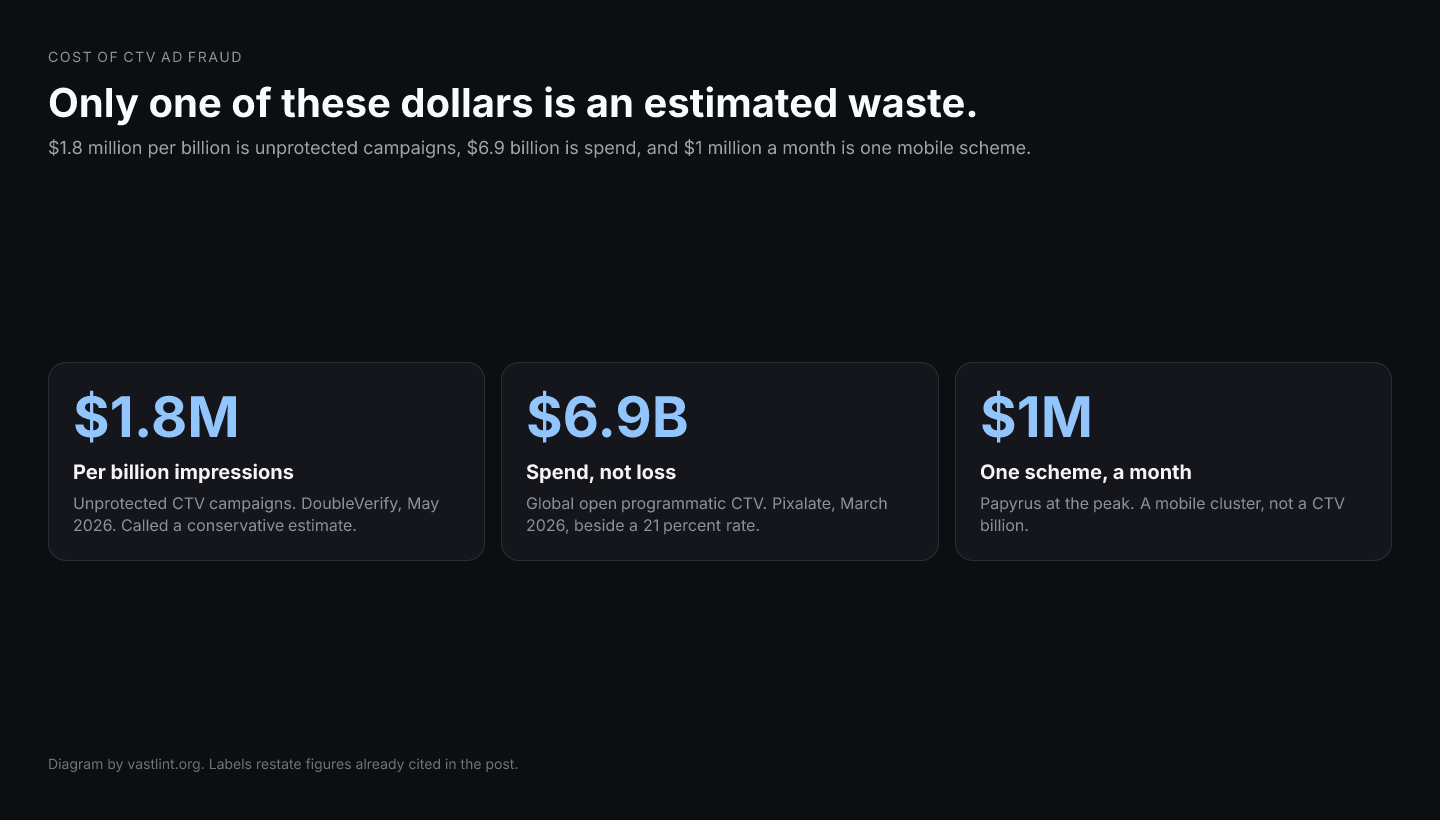
Cost of CTV ad fraud is the search that wants a single invoice. People also type how much invalid traffic costs, CTV fraud cost per billion impressions, and what unprotected campaigns waste. The figure that matches the per-billion shape is in DoubleVerify's May 7, 2026 release: fraud in unprotected campaigns can cost about $1.8 million per billion CTV impressions served, and DoubleVerify calls that a conservative estimate. The cell next to it is the nearly 9 percent fraud rate where protection controls were not applied. The under-1-percent rate is the other cell, controls on, and the estimate is not written for that cell.
Two other dollars travel in the same conversation and are not this estimate. Pixalate's March 26, 2026 supply-chain note puts $6.9 billion next to global open programmatic CTV ad spend, and 21 percent invalid on more than 7 billion transactions. Spend beside a rate is not the product of the rate and the spend. IAS's Papyrus note, August 6, 2026, puts monetization near $1 million a month at the peak for one mobile scheme, by applying an observed eCPM to a broader impression footprint. A month of one cluster is not a billion CTV impressions.
vastlint does not price invalid traffic. It checks whether a VAST 2.0–4.4 tag can carry the verification and the impression events a cost model would have to read. A tag that drops the node is unmeasured, which is not the same as a computed $1.8 million.
What the $1.8 million is allowed to say
It is an estimate, on unprotected campaigns, per billion impressions served, from the firm whose controls define unprotected in that release. Conservative, in DoubleVerify's wording, means the firm thinks the number is not high. It does not mean the number is a census of CTV, and it does not mean a buyer with controls on should book $1.8 million of waste. The protected cell is the evidence the control is the thing being priced. Turn the control on, in that study, and the fraud rate they publish is under 1 percent. The dollar is the story of the off switch.
It is also not a CPM you can audit from the outside. An estimate per billion impressions folds price, the fraud share, and whatever they excluded into one product. You cannot back into their 9 percent from $1.8 million without their price assumption, and they did not ask the reader to. Quoting the dollar as if it were 9 percent of a known CPM invents the assumption.
What multiplying the other headlines produces
Pixalate published a spend total and an invalid share. It did not publish 21 percent of $6.9 billion as dollars lost. That multiplication treats every invalid impression as a full-price loss, ignores that open programmatic is not all CTV spend, and ignores that 7 billion transactions and 103 billion impressions are different bases. A slide that prints the product as Pixalate's fraud bill is citing a calculation the benchmark did not make.
IAS's million a month is narrower still. It is Papyrus, a named cluster in reading apps, not connected TV. The method is an eCPM from supply IAS observed, applied to a broader footprint. Using it as the monthly cost of CTV fraud moves a mobile scheme onto a television budget. The direct-deal rows in the DoubleVerify release, 34 percent and 25 percent of impressions to bots on two campaigns, are also not convertible into the $1.8 million without a price and a volume those campaigns did not print.
A scheme count fails the same way. One hundred forty percent more CTV fraud schemes is not 140 percent more dollars. More operations can coincide with a low rate on protected impressions. The cost note and the scheme note are different searches. This page is only the dollar.
Dollars that are not the CTV fraud bill
- DoubleVerify, May 7, 2026: about $1.8 million per billion impressions, unprotected CTV campaigns, called a conservative estimate.
- The paired rate is nearly 9 percent with controls off, and under 1 percent with controls on. The estimate belongs to the off cell.
- Pixalate, March 26, 2026: $6.9 billion in global open programmatic CTV ad spend, beside a 21 percent IVT rate. Spend is not loss.
- IAS Papyrus, August 6, 2026: close to $1 million a month at the peak for one mobile scheme.
- Multiplying 21 percent by $6.9 billion is a calculation neither release published.
A cost per billion impressions is the price of a named cell with the control off, and a spend total beside an invalid share is still a spend total.
Check the tag before you price the impression
Run VAST 2.0–4.4 tags against specification-derived rules so impression events and verification nodes are present. Nothing is stored. This does not estimate fraud cost.
Sources
DoubleVerify, May 7, 2026. The unprotected-campaign cost estimate and the paired fraud rates.
March 26, 2026. $6.9 billion in open programmatic CTV spend beside the 21 percent rate.
The count in the same DoubleVerify release, which is not this dollar.
Why the rates next to these dollars are not one market rate.