What is a normal CTV IVT rate is the search behind the vendor shortlists. People also type it as an average CTV fraud rate, an acceptable IVT percentage, a good invalid-traffic rate, and whether 19 percent is high. The public record does not contain a normal. It contains a set of rates that look like answers because each one is a percent of impressions.
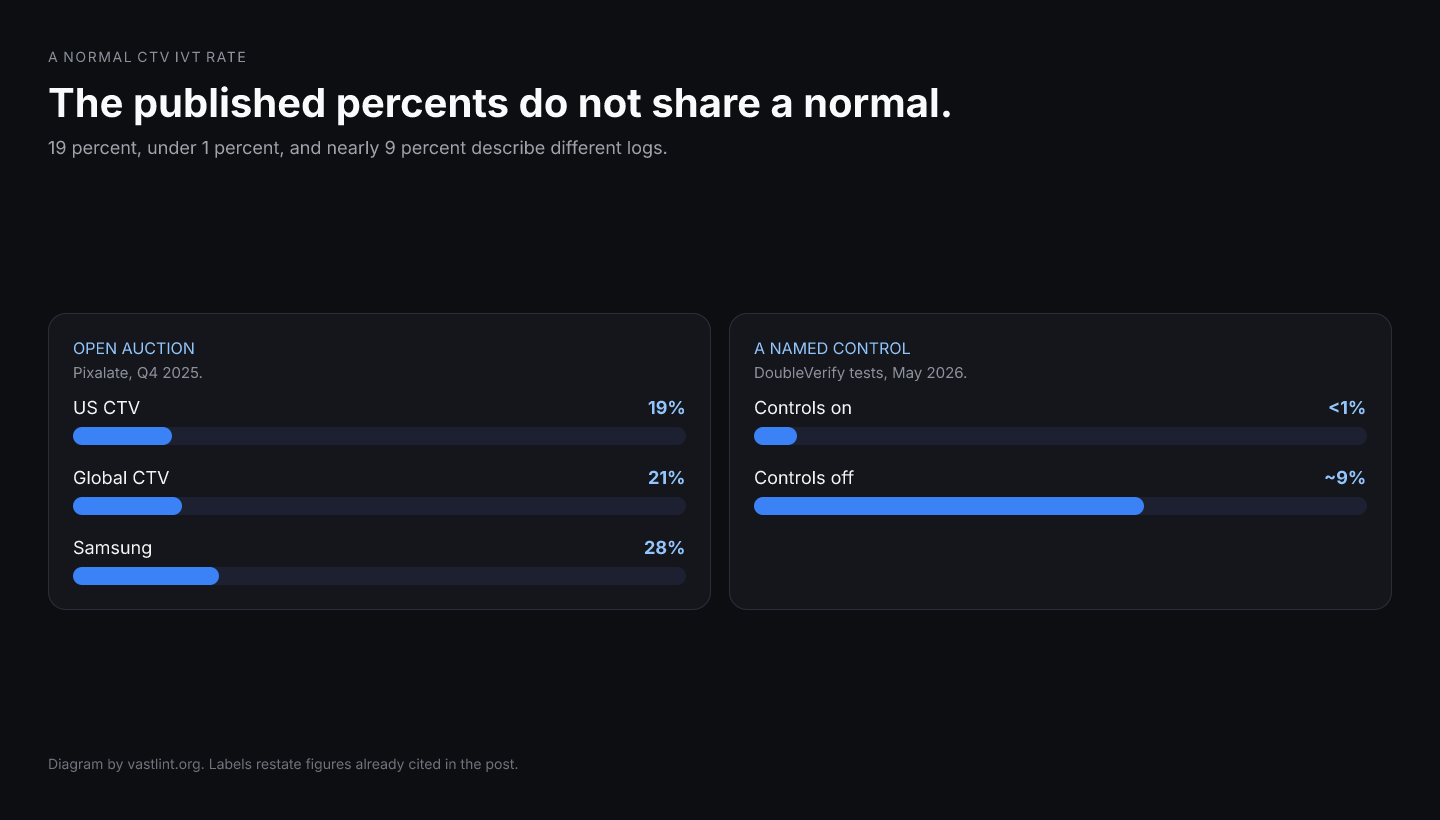
On March 9, 2026, Pixalate put Q4 2025 US CTV invalid traffic at 19 percent and global CTV at 21 percent, from more than 103 billion programmatic impressions that are predominantly buy-side open auction. On March 26, 2026, the same firm put Amazon Fire TV at 14 percent global device IVT and Samsung Smart TV at 28 percent, inside open-programmatic CTV. On May 7, 2026, DoubleVerify said fraud on DV-protected CTV campaigns was under 1 percent, and nearly 9 percent in controlled tests where those controls were off. Two direct deals in that release, 34 percent and 25 percent of impressions to bots, are single campaigns.
An average of those percents is not an average of the market. Nineteen and one do not share a denominator. A buyer who picks the lower number as the acceptable rate has chosen the protected cell, which is the rate after a control. A buyer who picks 19 percent as the benchmark has chosen a predominantly open-auction quarter. Both can be careful measurements. Neither is what CTV does in general.
Why a single acceptable rate keeps failing
Acceptable is a contract word. It means the threshold in the insertion order, or the cell where a control was on. DoubleVerify's under-1-percent figure is that kind of sentence: fraud remained under 1 percent where DV controls were applied. Using it as the industry normal drops the condition. The nearly-9-percent figure is the closer neighbor to an unprotected log, and it is still a test DoubleVerify defined, not a census.
Inside one Pixalate quarter the device rows already refuse a single normal. Fire TV at 14 percent and Samsung Smart TV at 28 percent are both open-programmatic CTV in Q4 2025. Fourteen points of spread from a change of device, inside one firm and one method, is larger than the gap people argue about between vendors once the populations are allowed to differ. A shortlist that cannot tolerate that spread should not treat 19 and 1 as a ranking of companies, or as a target to manage toward.
Scheme counts make a third fake normal. DoubleVerify's 140 percent more CTV fraud schemes and variants, first quarter of 2026 versus first quarter of 2025, is a count of operations. A year in which schemes proliferate and a protected impression rate stays under 1 percent is compatible with the same release. Someone searching for the average fraud rate and landing on 140 percent has changed the unit from impressions to operations.
What to use instead of a normal
Pick the sentence that matches the buy. Open auction, predominantly, is the 19 percent US CTV share and the 21 percent global share. A campaign with a named control on is the under-1-percent cell. A test with that control off is the nearly-9-percent cell. A direct deal is its own row, and the two examples in the May 2026 release are 34 percent and 25 percent, which is a warning that direct is not a rate of zero. A device mix can move the open-auction number without any vendor changing its mind.
If the question is whether your own log is high, the denominator has to be your log. A pre-bid filter already on will push the remainder toward a protected rate. A mostly open-auction buy with no control will sit closer to the quarterly share. Comparing your remainder to 19 percent, after you have already filtered, makes a working control look like a dirty market. Comparing an unfiltered open-auction buy to the under-1-percent cell makes the market look like a failure of the control you did not buy.
The tag is still outside every one of these rates. Server-side stitching can fire beacons without the device context a fraud model expects, and a wrapper can omit the verification node. vastlint does not publish an IVT rate and it does not decide what acceptable means. It checks whether a VAST 2.0–4.4 tag can carry the media, the trackers, and the verification the rate is supposed to describe.
Get VAST spec updates, platform guides, and release notes in your inbox.
Rates people paste in as the normal
- Pixalate, Q4 2025, US CTV, predominantly open auction, March 9, 2026: 19 percent of impressions.
- Pixalate, same release, global CTV: 21 percent. A March 26 cut repeats 21 percent on more than 7 billion CTV transactions.
- Pixalate, same quarter, devices: Fire TV 14 percent global IVT, Samsung Smart TV 28 percent.
- DoubleVerify, controls on, May 7, 2026: CTV fraud under 1 percent.
- DoubleVerify, controls off, same release: CTV fraud near 9 percent.
- DoubleVerify, two named direct deals: 34 percent and 25 percent of impressions to bots.
- DoubleVerify, Q1 2026 versus Q1 2025: 140 percent more schemes, which is a count, not a rate you can call normal.
A normal rate would be one population measured one way, and every famous CTV percent in this market is a different population.
Check the tag those rates never open
Run VAST 2.0–4.4 tags against specification-derived rules so verification nodes and impression events are present. Nothing is stored. This does not produce an IVT rate.
Open the VAST validatorSources
March 9, 2026. US CTV at 19 percent, global CTV at 21 percent, predominantly open auction.
March 26, 2026. Fire TV at 14 percent and Samsung Smart TV at 28 percent.
DoubleVerify, May 7, 2026. Protected, unprotected, and single-deal figures.
The pair that produces the two numbers most often called the normal.