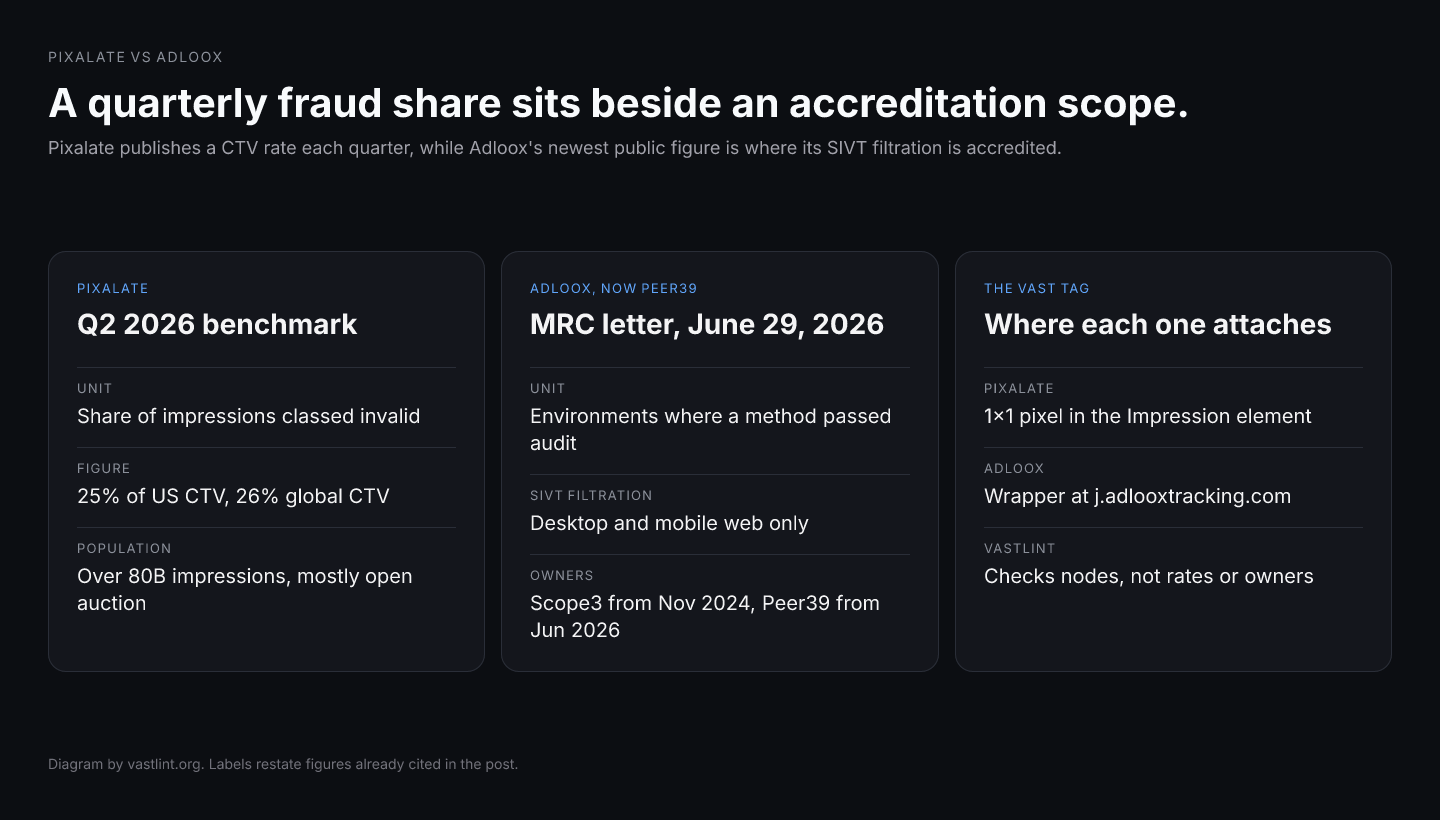
Pixalate vs Adloox is a search that pairs a firm publishing a fresh quarterly fraud rate with a firm whose public record in 2026 is mostly a change of owner and an accreditation letter. On August 12, 2026, Pixalate put Q2 2026 invalid traffic at 25 percent of US connected-TV impressions and 26 percent of global CTV, from more than 80 billion global programmatic impressions that are predominantly buy-side open auction. Adloox has not published a comparable rate under any of its recent owners. Its newest public number is a scope: on June 29, 2026, the Media Rating Council continued accreditation of the Peer39 Adloox service, formerly doing business as Scope3 France Adloox, with sophisticated invalid traffic (SIVT) filtration applied only in desktop and mobile web. vastlint does not rank either firm. It checks whether a VAST 2.0–4.4 tag carries the impression and verification nodes that their measurement depends on, and it does not classify invalid traffic or know which company now operates a tracking host.
Those are two different objects. One is a share of impressions that a firm classified as invalid inside its own quarterly sample. The other is a list of environments in which an auditor confirmed that a second firm's filtration method meets the MRC invalid-traffic standard. The first says how much of a log looked invalid, and the second says where a method is certified to remove it. A percentage of impressions cannot be subtracted from a list of environments, and the shortlist only becomes a ranking if someone treats the missing Adloox rate as a zero or the Pixalate rate as a verdict on Adloox clients.
The name in the second column has also moved twice in less than two years. Scope3 announced on November 4, 2024 that it had acquired Adloox. Peer39 announced on June 2, 2026 that it had acquired Adloox from Scope3, and AdExchanger's roundup the next day called it a sale just 18 months after Scope3 bought it. A buyer comparing Pixalate with Adloox in 2026 is comparing Pixalate with a service that now belongs to Peer39, may still carry Scope3 segment names inside a DSP, and still loads from an adlooxtracking.com host in its published Prebid.js integration.
What the Pixalate figures measure
The August 12, 2026 release is a table of invalid-traffic shares for the second quarter of 2026. United States: desktop and mobile web 25 percent, mobile app 39 percent, CTV 25 percent. Global: web 20 percent, mobile app 41 percent, CTV 26 percent. Pixalate says its data science team analyzed more than 80 billion global programmatic impressions in Q2 2026, and that the datasets consist predominantly of buy-side open-auction traffic sources. The 25 percent is the share of US CTV impressions in that set that Pixalate classified as invalid, including what it calls ad fraud. It is a statement about Pixalate's sample of open auction, not about every CTV impression sold in the quarter.
The series moves, and so does the base. Pixalate's Q4 2025 release on March 9, 2026 put US CTV at 19 percent and global CTV at 21 percent, from more than 103 billion impressions. The Q1 2026 release on April 29, 2026 put US CTV at 24 percent, global CTV at 25 percent, and US mobile app at 32 percent, from more than 82 billion impressions. Q2 2026 then reads 25 percent on more than 80 billion. US CTV rose six points over two quarters while the stated impression base fell by more than 20 billion. The releases do not split that movement into changes in traffic, changes in which sources entered the sample, and changes in detection. The trend line is the trend of Pixalate's sample.
Other Pixalate cuts use other bases even when they print the same percent. The May 25, 2026 CTV supply chain report says 25 percent of global CTV open programmatic ad traffic in Q1 2026 was invalid, from more than 19 billion open programmatic transactions across 210,000 CTV devices, beside more than $6 billion of global open programmatic CTV ad spend. Amazon Fire TV had the lowest rate among measured platforms at 15 percent. Nineteen billion CTV transactions and 82 billion impressions across web, app, and CTV are different denominators that happen to land on the same 25 percent. Pixalate also tracks made-for-advertising apps as a separate object: its Q1 2026 MFA report flagged 1,976 mobile apps as likely MFA, from 19 billion impressions and 232,000 apps. Every one of these releases carries a disclaimer that Pixalate's designations are opinions, not facts or guarantees.
Accreditation sits beside the research, not inside it. The Pixalate letter that the MRC links today is dated April 8, 2025. It covers display and video ad counts and impressions, gross, net of general invalid traffic (GIVT), and total net of SIVT, in desktop, mobile web, mobile in-app, and CTV. It covers server-side ad insertion (SSAI) video metrics in the same four environments. Its viewability line is display only, in desktop, mobile web, and in-app. The letter accredits metrics in Pixalate's Analytics platform. It does not name the quarterly benchmark release, so the 25 percent is research produced by an accredited firm rather than an accredited statistic.
What the Adloox figures measure
The newest Adloox figure is the June 29, 2026 MRC letter, addressed to Peer39's French entity. It continues accreditation of the Peer39 Adloox Viewability and Fraud prevention service for desktop, mobile app, and mobile web display and video: tracked ads (gross), impressions, Decision Rate, viewable impressions, viewability metrics, and exposure metrics, with SIVT filtration applied in desktop and mobile web. The enclosure is precise about the split. Impressions and viewability are accredited total net of SIVT for desktop and mobile web only, while mobile in-app is accredited gross and net of GIVT. Decision Rate is the one line where the SIVT-net figure also lists mobile app. CTV does not appear anywhere in the letter. The scope reads the same as the September 20, 2024 letter the MRC sent to Adloox S.A.S., before either acquisition.
Peer39's June 3, 2026 announcement lists the same accredited metrics and then describes product reach, which is a different kind of statement. It says Adloox brings pre-bid brand suitability, viewability, and fraud avoidance in DV360; IVT detection, viewability, and suitability for Facebook, Instagram Feed and Reels, and Threads on Meta; verification and suitability dimensions in Amazon DSP; and, in CTV, program-level contextual authentication plus OM SDK-based placement verification. Those are capabilities with no rate attached. The CTV verification described there sits outside the accredited list in the June 29 letter.
Under its own name, Adloox published claims rather than benchmarks. An October 4, 2023 Adloox post says the company blocked a daily average of 5,000 fraudulent sites, preventing 15 billion invalid bid requests, that 85 percent of the ads it saw directed toward MFA sites were display, and that its pre-bid measures can reduce MFA impressions from over 50 percent to just 0.5 percent. No campaign set, date range, or impression count is given for the before-and-after. The same post says Adloox had always assessed MRC invalid-traffic guidelines as sufficient to filter MFA sites, so its MFA figures sit inside an IVT frame, while Pixalate counts likely MFA apps in a separate report. A before-and-after on unnamed campaigns is a product claim, not a market share.
The ownership chain is the part a buyer can actually verify. Scope3's own Adloox page says Scope3 is not an ad verification company, that Adloox services were being transitioned to Scope3 products such as Media Quality Reporting and Brand Standards, that the Meta and DV360 integrations had been transferred, that Adloox measurement tags were being transitioned, and that the Adloox dashboard would stay accessible until further notice. Peer39 then bought the business on terms not disclosed. Its FAQ says there would be no immediate changes to categories or reporting, that current Adloox customers do not need to change DV360 or Meta setup, and that DV360 control names will not say Peer39 until they are renamed from the Scope3 segments. The MRC's digital accreditation page still lists the service under the name Adloox, so the same service can appear under three names depending on where the buyer looks.
Why a quarterly share and an accreditation scope have no shared scale
The units do not match. Pixalate's 25 percent is a share of impressions in a sample. The Peer39 Adloox letter is a list of environments and metrics in which a method passed audit. The 2023 Adloox MFA figure is a before-and-after on campaigns the post does not describe. A share, a scope, and a vendor claim can each be correct, and none of them converts into the others. Treating an absent Adloox CTV rate as a low Adloox CTV rate is the most common way this shortlist goes wrong.
The populations do not match. Pixalate names its population: predominantly buy-side open auction, over 80 billion impressions in Q2 2026, over 103 billion two quarters earlier. Adloox's accreditation applies to whatever traffic its clients' tags measure, and no Adloox, Scope3, or Peer39 release in the material read publishes an aggregate IVT rate across that traffic. A Pixalate client's own log is also a third population, distinct from the benchmark, because it reflects that client's buying and any pre-bid filter applied before the impression existed.
The surfaces cross. Pixalate's accredited SIVT filtration reaches CTV and mobile in-app, and its accredited viewability is display only. Adloox's accredited viewability covers display and video in desktop, mobile web, and in-app, and its accredited SIVT filtration stops at desktop and mobile web. A buyer who wants accredited CTV IVT reporting will find it in Pixalate's letter and not in the Peer39 Adloox letter. A buyer who wants accredited video viewability on desktop or mobile will find it in the Peer39 Adloox letter and not in Pixalate's April 2025 letter. Each firm's accredited footprint covers a cell the other's does not, which is a reason to read both letters before reading either headline.
The dates spread across three years. The Adloox MFA claim is from October 4, 2023. Pixalate's linked letter is April 8, 2025. The Peer39 Adloox letter is June 29, 2026. Pixalate's newest benchmark is August 12, 2026. Accreditation is renewed annually, so the letter on the MRC page is a snapshot of the last completed audit, and a quarterly benchmark is a snapshot of one quarter's sample. A comparison table that pastes these into one row is comparing a 2023 sales post with a 2026 audit and a 2026 research release.
Which question each firm's number answers
Not published means the material read does not contain the figure, not that the firm lacks the capability.
| Question a buyer asks | Pixalate public answer | Adloox public answer |
|---|---|---|
| How much of open-auction US CTV looked invalid last quarter? | 25% in Q2 2026, in a predominantly open-auction sample of over 80 billion global impressions | Not published |
| Is SIVT filtration MRC-accredited in CTV? | Yes, for ad counts, impressions, and SSAI video metrics, per the April 8, 2025 letter | Not in the June 29, 2026 letter, which applies SIVT filtration in desktop and mobile web |
| Is video viewability MRC-accredited? | Not in the April 8, 2025 letter, which lists display viewability only | Yes, display and video in desktop, mobile web, and mobile in-app |
| Who operates it, and under what name? | Pixalate, with no ownership change in the material read | Peer39 since June 2, 2026, after Scope3 from November 4, 2024; DV360 controls may still carry Scope3 names |
| How much made-for-advertising supply does it see? | 1,976 mobile apps flagged as likely MFA in Q1 2026 | A 2023 claim that pre-bid cuts MFA impressions from over 50% to 0.5%, with no base stated |
| Does it measure inside Meta or DV360? | Not in the releases read | Yes, per Peer39: Meta (Facebook, Instagram, Threads), DV360, and Amazon DSP |
| How does it attach to a VAST tag? | A 1x1 pixel in the VAST Impression element, per its knowledge base | A wrapper around the VAST URL, per the Adloox Prebid.js video module docs |
Where each vendor shows up in the VAST tag, and what a buyer can check
Pixalate's knowledge base describes its client-side video integration as a 1x1 tracking pixel injected into the third-party impression tag of the VAST XML. The samples show the pixel as an Impression element in a VAST 2.0 Wrapper and in VAST 3.0 InLine responses, including one that carries VPAID. Pixalate says it registers an impression on the client side when the video loads, that the pixel can ingest up to 60 macros of which up to 30 can be custom, and that a supply-type key such as CTV_InApp_Video should be passed so the impression is labeled correctly. Every VAST version requires at least one Impression in both InLine and Wrapper, and a player fires the wrapper's impression URLs alongside the inline ones. A wrapper that drops its Impression when it rewrites the response, or a macro left unexpanded, changes what the pixel reports without changing the creative. Pixalate's integration overview also offers a server-to-server path, and its accreditation includes SSAI video metrics, so a server-fired beacon is supported, but it is a different path from the client-side pixel those samples describe. The same overview says Pixalate's tag QA expects its impression count to match the buyer's platform within plus or minus 10 percent, which is a reconciliation tolerance and not an IVT rate.
The Adloox modules in the Prebid.js repository describe a different attachment. In the default mode, the Adloox Ad Server Video module wraps the winning bid's VAST URL with the Adloox VAST/VPAID wrapper at https://j.adlooxtracking.com/ads/vast/tag.php, VAST tracking is collected by Adloox, and viewability is MRC-accredited for VPAID and OM SDK-enabled inventory. With wrapping turned off, the docs say viewability metrics are not MRC-accredited and VAST tracking is not collected by Adloox. The accredited path therefore adds a hop to the wrapper chain, and the host name is adlooxtracking.com whichever company owns the service. VPAID was deprecated in VAST 4.1, and many CTV players do not execute it. Peer39 describes its CTV verification as OM SDK-based, and in a VAST tag OM SDK verification lives in AdVerifications (VAST 4.1 and later) or in an Extension of type AdVerifications (VAST 3 and earlier), as a Verification element with a vendor attribute, a JavaScriptResource with apiFramework set to omid, VerificationParameters, and a verificationNotExecuted tracking event. The Peer39 and Adloox material read does not publish a vendor key for that element.
What a buyer can check in the tag is structural and narrow. Search the delivered XML for the hosts the contract names, which for this service may still read adlooxtracking.com after two changes of owner. Confirm that each hop in the wrapper chain still carries an Impression and that the verification node survived the rewrite. vastlint reports an InLine or Wrapper with no Impression, duplicate Impression URLs inside one Ad, a Verification with no vendor or no resource, a vendor value that is not in a company.com-omid form, missing VerificationParameters on an OMID resource, an apiFramework other than omid, and a verificationNotExecuted URL without the REASON macro. It validates the document you paste, so each wrapper hop is checked on its own. It does not know whether adlooxtracking.com still answers, who operates it this quarter, or whether Pixalate's pixel registered the impression.
What to do with the shortlist
Decide which question the shortlist is for. If it is a market benchmark of open-auction invalid traffic, Pixalate publishes one every quarter and Adloox does not, so the comparison has only one entry. If it is a verification vendor for your own tags, Pixalate's 25 percent says nothing about how either firm would score your log, and the useful documents are the accreditation letters and a test on your own traffic. Pitting a quarterly benchmark against a vendor without one tells you who publishes research, not whose filtration fits your buy.
Read the letters for the surface you buy. For CTV with accredited SIVT reporting, Pixalate's April 8, 2025 letter lists it and the Peer39 Adloox June 29, 2026 letter does not. For accredited video viewability on desktop and mobile, the Peer39 Adloox letter lists it and Pixalate's April 2025 letter does not. Ask each firm for its current letter, because accreditation is renewed annually. For any Adloox contract, write the operating company, the DSP segment names, and the tag hosts into the insertion order, because the same service has been sold as Adloox, Scope3, and Peer39, and a reconciliation that looks for one name will miss lines filed under another.
vastlint is independent of Pixalate, Adloox, Scope3, and Peer39. It checks VAST 2.0–4.4 structure, including Impression presence in InLine and Wrapper and the shape of AdVerifications and Verification nodes. It does not publish an IVT rate, it does not rank verification vendors, it does not score viewability or MFA, and it does not know whether a vendor host is alive or which company runs it. A clean structural result means the node a vendor needs is present and well formed. Whether the vendor measured anything is a question for the vendor's report.
What to separate before using this comparison
- Pixalate's 25 percent is the Q2 2026 share of US CTV impressions classified invalid in a predominantly open-auction sample of more than 80 billion global impressions.
- Pixalate's US CTV series moved from 19 percent in Q4 2025 to 24 percent in Q1 2026 and 25 percent in Q2 2026 while the stated impression base fell from more than 103 billion to more than 80 billion.
- The June 29, 2026 Peer39 Adloox letter applies SIVT filtration in desktop and mobile web only, and CTV does not appear in it.
- Pixalate's April 8, 2025 letter accredits SIVT filtration in CTV and in-app while listing viewability for display only.
- The 2023 Adloox claim that pre-bid cuts MFA impressions from over 50 percent to 0.5 percent has no stated base and is not a market rate.
- Adloox, Scope3, and Peer39 can all name the same service in a 2026 trafficking sheet, and adlooxtracking.com can remain the host under each.
- A tag that carries the right Impression and Verification nodes is structurally ready to be measured, which is not the same as having been measured.
Questions buyers ask about Pixalate and Adloox
- Is Adloox still operating after Scope3? Yes. Peer39 announced on June 2, 2026 that it acquired Adloox from Scope3, and the MRC continued accreditation of the Peer39 Adloox service on June 29, 2026.
- Does Adloox publish a CTV invalid-traffic rate like Pixalate's? Not in the material read. Its accredited SIVT filtration covers desktop and mobile web, and CTV is not listed in the June 29, 2026 letter.
- What is Pixalate's latest US CTV invalid-traffic rate? 25 percent for Q2 2026, released August 12, 2026, from a predominantly open-auction sample of more than 80 billion global impressions, up from 24 percent in Q1 2026 and 19 percent in Q4 2025.
- Do I need to retag if my Adloox setup dates from the Scope3 period? Peer39's FAQ says current Adloox customers do not need to change their DV360 or Meta setup, and that DV360 controls keep Scope3 names until they are renamed.
- Is Pixalate MRC-accredited for video viewability? The April 8, 2025 letter lists viewability for display only, while video impressions and SSAI video metrics are accredited across desktop, mobile web, in-app, and CTV.
Check the impression and verification nodes in the tag
Paste a VAST 2.0–4.4 tag or a single wrapper hop to check Impression presence and AdVerifications structure against specification-derived rules. Nothing is stored. This does not produce an IVT rate.
Sources
August 12, 2026. US CTV at 25 percent, global CTV at 26 percent, global mobile app at 41 percent, over 80 billion impressions, predominantly open auction.
April 29, 2026. US CTV at 24 percent, global CTV at 25 percent, US mobile app at 32 percent, over 82 billion impressions.
March 9, 2026. US CTV at 19 percent, global CTV at 21 percent, over 103 billion impressions.
May 25, 2026. 25 percent of global CTV open programmatic traffic invalid on over 19 billion transactions, Fire TV lowest at 15 percent.
1,976 mobile apps flagged as likely MFA, from 19 billion impressions and 232,000 apps.
SIVT filtration across desktop, mobile web, in-app, and CTV; SSAI video metrics; display-only viewability.
Continued accreditation of the Peer39 Adloox service, formerly Scope3 France Adloox, with SIVT filtration in desktop and mobile web.
The same scope issued to Adloox S.A.S. before the Scope3 and Peer39 acquisitions.
MRC's listing, which still names the service Adloox and shows SIVT filtration for D and MW.
Scope3's FAQ on the November 4, 2024 acquisition, the product transition, and the Adloox tags and dashboard.
June 3, 2026. Capabilities by platform, accredited metrics, and the FAQ on Scope3 segment names.
June 2, 2026 release. Terms not disclosed.
Trade coverage of the sale and Adloox's MRC accreditation.
June 3, 2026 roundup describing the sale 18 months after Scope3's purchase.
October 4, 2023. Adloox's MFA claims, including over 50 percent to 0.5 percent with pre-bid.
Pixalate's pixel placed in the VAST Impression element, with VAST 2.0 and 3.0 samples.
The kv24 supply-type key, including CTV_InApp_Video.
Tag-based or server-to-server integration, and the plus or minus 10 percent tag QA tolerance.
The VAST/VPAID wrapper at j.adlooxtracking.com and when its viewability is MRC-accredited.
The same Pixalate series beside a protected-campaign rate instead of an accreditation scope.
The other comparison where a vendor name in the tag outlived the arrangement behind it.
The Verification, vendor, and verificationNotExecuted checks referenced above.