Pixalate alternative is the search that follows Pixalate vs DoubleVerify and Pixalate vs Integral Ad Science, once someone decides the benchmark should have a rival. The benchmark people are actually holding is dated. On March 9, 2026, Pixalate put Q4 2025 invalid traffic at 19 percent of US CTV impressions and 21 percent of global CTV, from more than 103 billion programmatic impressions that are predominantly buy-side open auction. A second cut, on March 26, 2026, puts global open-programmatic CTV at 21 percent again, this time on more than 7 billion transactions. Seven billion CTV transactions and 103 billion impressions across web, app, and CTV are different bases.
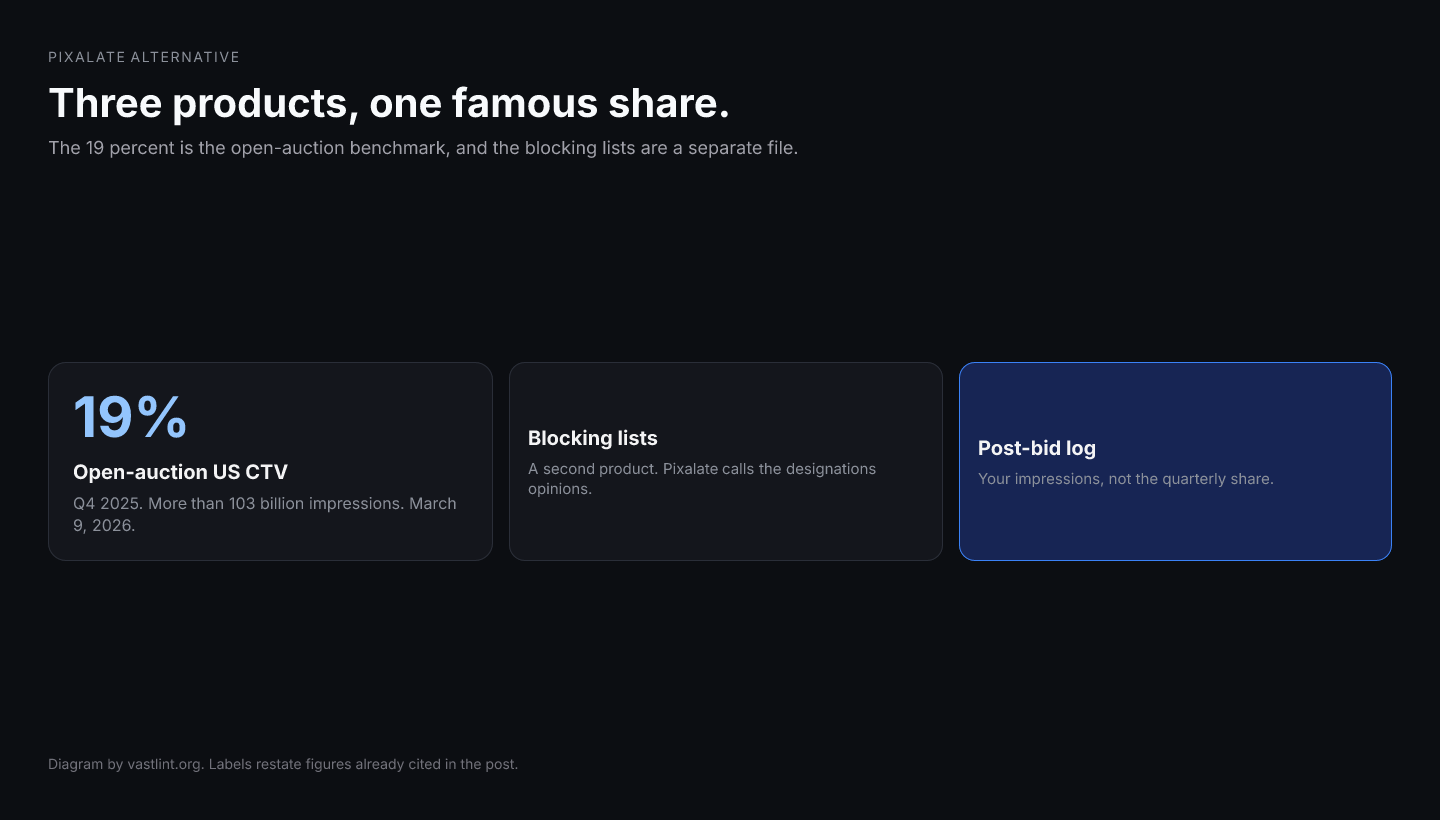
The product page names three products, not one rate: pre-bid blocking, post-bid analytics, and a Media Ratings Terminal. The metrics note says invalid-traffic and viewability designations in those products, including the pre-bid blocking lists, reflect Pixalate's opinions and are neither facts nor guarantees. A buyer who wanted the quarterly share, a buyer who wanted a block list, and a buyer who wanted a post-bid log of their own impressions are not looking for the same replacement.
vastlint is not a Pixalate alternative. It does not classify invalid traffic and it does not sell a block list. It checks whether a VAST 2.0–4.4 tag is structurally able to carry media files, trackers, and verification. A stitched impression can be invalid for reasons the tag's shape will not prove, and a broken tag can be unmeasurable for reasons a fraud model will not see.
What the 19 percent is, and what it is not
The March 9 table is a set of shares for the fourth quarter of 2025. United States: desktop and mobile web 25 percent, mobile app 29 percent, CTV 19 percent. Global: web 23 percent, mobile app 36 percent, CTV 21 percent. Open auction is the source Pixalate names as predominant. A private marketplace, a programmatic guaranteed buy, and a log that already passed someone else's pre-bid filter sit outside the population that sentence describes, or they sit in it only to the extent the set actually contained them. The release does not say it measured DoubleVerify's protected cell.
Inside the March 26 supply-chain note, the device rows move without leaving Pixalate. Amazon Fire TV is at 14 percent global device IVT and Samsung Smart TV is at 28 percent, both in open-programmatic CTV for that quarter. Fourteen points of spread inside one firm, from a change of device, is a warning against treating 19 percent and some other firm's 1 percent as a ranking of companies.
Pixalate says it is MRC-accredited for sophisticated invalid traffic detection and filtration across desktop, mobile web, in-app, and CTV, and its pages have quoted different counts of accredited areas as renewals accumulated. The durable claim is the scope of that accreditation, including SSAI metrics, not a single headcount. Accreditation for detection and filtration is not a promise that a blocking-list designation is a fact. The metrics note says the opposite about those designations.
What people try to swap in
DoubleVerify is the usual swap for the CTV number. The May 7, 2026 release puts fraud under 1 percent on DV-protected campaigns and nearly 9 percent where controls were off, and it counts 140 percent more schemes year over year. The under-1-percent figure is what remained after a control. Pixalate's 19 percent is a classification of a predominantly open-auction log. Hiring DoubleVerify to obtain a lower headline replaces a benchmark with a protected-campaign rate. That can be the right procurement if you wanted the control. It is the wrong procurement if you wanted a quarterly picture of the open auction, because the control is designed to move the rate.
IAS is the usual swap in the Integral Ad Science query. Papyrus, August 6, 2026, is a lift on a named mobile cluster: nearly 25 times the clicks against other traffic IAS had separated. That study does not contain a US CTV impression share. An IAS alternative to Pixalate's benchmark would have to be a benchmark. The cluster note is not one.
HUMAN is the usual swap for the blocking product. MediaGuard returns a prediction on one bid request. Pixalate's blocking product, on its own page, is lists at user, publisher, and network level, and the metrics note calls the designations opinions. A per-request suggestion and a list are both pre-bid inputs. The MRC says HUMAN does not itself drop the request. Pixalate's note says the list is an opinion the client can use. Neither sentence is the 19 percent.
A post-bid analytics seat is the third product, and it is the one that needs the tag. Pixalate's integration overview describes post-bid IVT measurement on the client's impressions, and it points at the blocking feeds as a complement rather than as the same feed. Replacing analytics means replacing a log of what served. Replacing the benchmark means replacing a published quarter. Those files do not have the same rows.
Get VAST spec updates, platform guides, and release notes in your inbox.
What to do with the shortlist
Decide which Pixalate object the contract is. Open-auction benchmark, pre-bid blocking list, post-bid analytics, ratings terminal. A Pixalate alternative is coherent inside one of those. The 19 percent is the wrong success metric for a blocking-list renewal, and a block rate is the wrong success metric for someone who wanted the quarterly share left intact.
If you buy mostly deals, the open-auction denominator is the wrong one for your own log, which is the same caution the Pixalate vs DoubleVerify note already makes. If you buy mostly open auction with a filter already on, your remaining IVT is a third number, closer to a protected rate than to the published 19 percent.
Keep verification placement in the tag if the replacement is post-bid. vastlint checks that placement. It will not tell you whether to keep Pixalate's benchmark as the quarterly reference.
Pixalate objects that do not replace each other
- Pixalate, Q4 2025, US CTV, predominantly open auction, published March 9, 2026: 19 percent of impressions.
- Pixalate, same release, global CTV: 21 percent. A March 26 cut repeats 21 percent on a base of more than 7 billion CTV transactions.
- Pixalate, same quarter, open-programmatic devices: Fire TV at 14 percent global IVT, Samsung Smart TV at 28 percent.
- Pixalate product page: pre-bid blocking, post-bid analytics, and a Media Ratings Terminal. The metrics note calls designations in those products opinions.
- DoubleVerify, controls on: fraud under 1 percent. That is a protected cell, not this benchmark.
- IAS Papyrus: a click multiple on a named mobile cluster, not a CTV impression share.
A quarterly open-auction share, a blocking list the publisher calls an opinion, and a log of your own impressions are three files, and only one of them is the 19 percent.
Check the tag a post-bid log would have to read
Run VAST 2.0–4.4 tags against specification-derived rules so media files, trackers, and verification nodes are present. Nothing is stored.
Open the VAST validatorSources
March 9, 2026. US CTV at 19 percent, global CTV at 21 percent, predominantly buy-side open auction.
Pixalate's three-product description: pre-bid blocking, post-bid analytics, and the Media Ratings Terminal.
Pixalate's note that designations in analytics, blocking lists, and the ratings terminal are opinions.
Why the open-auction share and the protected rate are the pair this alternative search collapses.
Why a lower rate after a control is the control, not a better benchmark.