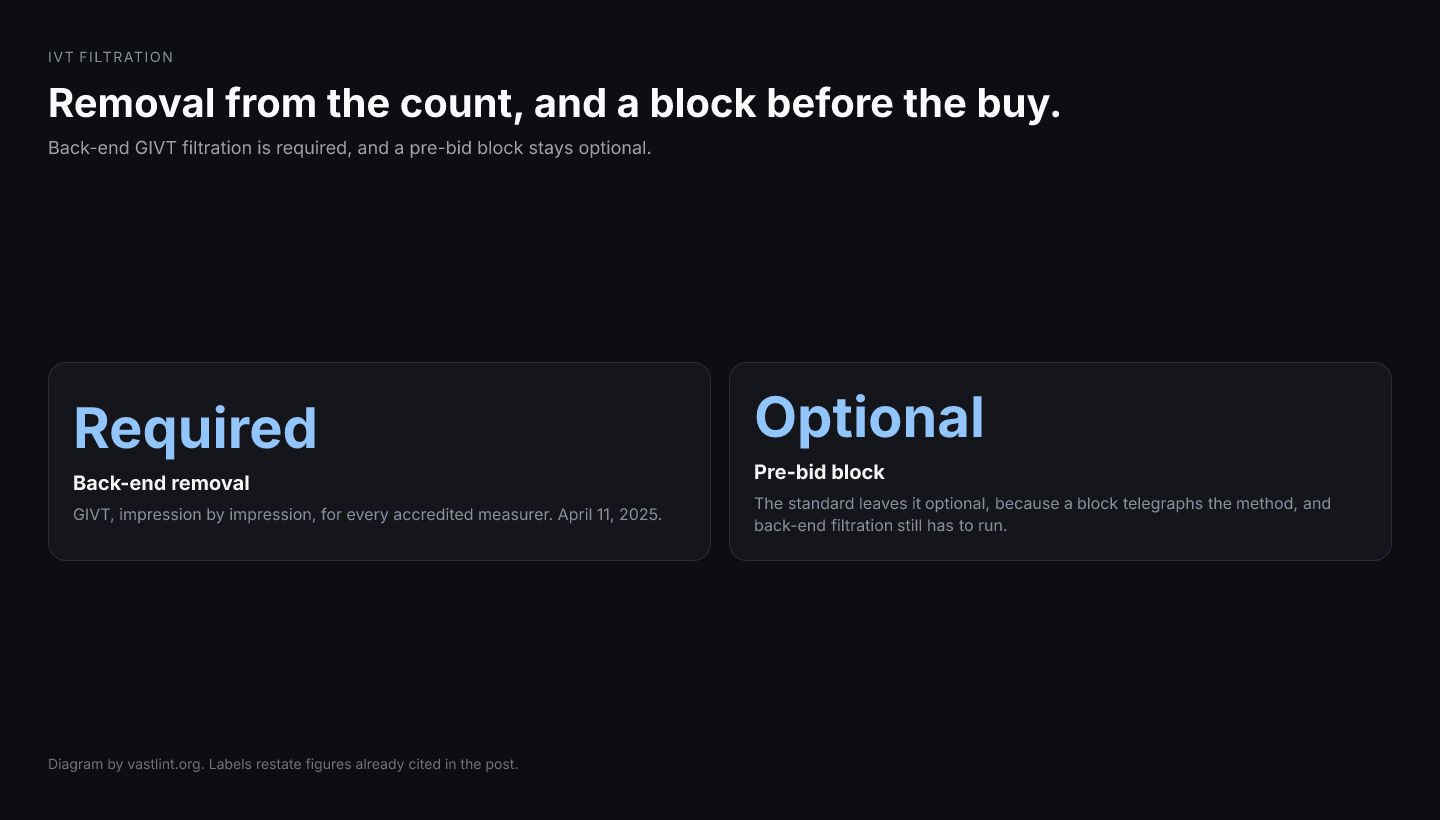
IVT filtration is the phrase buyers use when they want a campaign cleaned. The Media Rating Council uses it for a narrower act. In the April 11, 2025 memorandum on pre-bid requirements, the MRC says accredited digital vendors must apply back-end, post-serve filtration of general invalid traffic, impression by impression, including known spiders and bots and known data-center addresses. The same memorandum says the MRC does not require pre-bid filtration, and that the standards caution against it in several places, because a block is visible to the traffic source and the method gets weaker as that source tests against it.
The June 2020 Invalid Traffic Detection and Filtration Standards Addendum is the taxonomy under that sentence. General invalid traffic is what lists and parameter checks can catch, and accredited measurers must apply it. Sophisticated invalid traffic is the remainder that takes more than a list, and the addendum encourages it without requiring it. Filtration, in both documents, is removal from the metrics that get reported. It is not a synonym for a trader hitting decline on a bid.
That is why two famous rates refuse to rank each other. Pixalate's March 9, 2026 benchmark puts 19 percent of US CTV impressions invalid inside a predominantly open-auction set of more than 103 billion impressions. DoubleVerify's May 7, 2026 release puts fraud under 1 percent on campaigns with its controls on. One figure is a classification of a log. The other is what remained after a control. Calling both of them filtration, and then sorting the companies by the number, sorts the subtraction, not the market.
What the required filtration actually removes
The June 2020 addendum's general category is the shared floor. Known invalid data-center traffic, with a carve-out for routing artifacts of legitimate users. Bots, spiders, and crawlers, except the ones that masquerade as people and therefore sit in the sophisticated category. Non-browser user agents. Pre-fetch and pre-render where the ad was never then accessed. Invalid placements such as 0x0 and 1x1. Sessions whose device information says they cannot render an image, when the counted activity is a rendered impression. The addendum says this floor exists so discrepancies between measurers stay small. If every audited firm strips the same ranges and the same declared crawlers, the residual logs can be compared.
The April 2025 memorandum says the audits test that floor in production. They test application of the IAB spiders and bots list, and of industry data-center lists such as the TAG data-center IP list, on measured and reported impressions. The memorandum says this is not a sample, and it is not dependent on a DSP or SSP passing an IP address, a user agent, or a device identifier to the vendor in order to build the pre-bid file. Back-end filtration has to be able to see the impression the vendor measured.
Sophisticated filtration is the other subtraction, and it is not the floor. Hijacked devices, hidden ads, spoofed apps, falsified measurement events, and server-side ad insertion spoofing are the addendum's examples of traffic that survives a list. Two accredited firms can agree on the general removal and disagree on the sophisticated slice. A report that says IVT filtered, with no category, has collapsed a mandatory list and an optional investigation.
Why a pre-bid block is not the same filtration
The memorandum quotes the standard on up-front techniques. A bid request that is not fulfilled, or is otherwise blocked, because of IVT must be used with caution. The block is apparent to the source. The technique gets less effective unless the detection keeps changing. Application on an up-front basis is not required. Back-end detection is harder for the source to see, and it leaves invalid transactions inside the data until a later stage removes them from the reported metrics. Where a firm does filter up front, the memorandum says back-end filtration is still required, and the back-end observations have to inform the pre-bid files.
The same note says who is allowed to make the block. The decision to present a bid request, or to serve an ad, rests with DSPs and SSPs, and it depends on what those platforms choose to compare against the pre-bid product. HUMAN, the memorandum says, provides suggestions through an API to DSPs and SSPs, not to advertisers, and does not directly filter, prevent serving, or enable blocking. DoubleVerify provides segments and classifications to platforms and, through DSPs, to advertisers, and does not directly filter the request either. DV can enable a post-serve block only where the client configured it. IVT filtration in an RFP often means the vendor stopped the bad impression. On the MRC's account, the vendor removed it from the count, and someone else decided whether it was bought.
HUMAN's package page and DoubleVerify's product language still say filtration and avoidance. Those words describe the commercial product. They do not override the institutional sentence about who drops the request. A 12 millisecond response, which is HUMAN's claim for bid-request analysis, is a latency budget for a suggestion. It is not, by itself, a removal from a reported impression count.
Get VAST spec updates, platform guides, and release notes in your inbox.
What to do with a filtered rate
Label the subtraction before you quote the rate. Back-end GIVT removal, back-end SIVT removal, pre-bid segment the platform applied, post-serve block the client configured, open-auction classification with no control in the sentence. Pixalate's 19 percent and DoubleVerify's under 1 percent can both be careful measurements and still describe different logs. The gap is the control and the population, which is what filtration is doing when it does anything.
Ask the report for the category. General invalid traffic is the required list. Sophisticated invalid traffic is the investigation the addendum does not force. A clean general rate can leave hijacked devices and hidden ads in the log, which is the traffic that moves clicks and attention. IAS's Papyrus note is that pattern on mobile: nearly 25 times the click success rate on a cluster that was not a declared crawler.
On the tag, back-end filtration of a video impression needs something to read. A wrapper that drops AdVerifications, or a stitched stream that fires beacons without the device context the model expects, is a document the post-serve check cannot see. vastlint does not filter IVT. It checks whether impression events and verification nodes are structurally present in VAST 2.0–4.4, so the removal the standard requires has a tag to attach to.
Filtration sentences that do not belong in one column
- MRC, April 11, 2025: back-end GIVT filtration is required, impression by impression, for accredited measurers.
- MRC, same memorandum: pre-bid filtration is not required, and the standards caution that a block telegraphs the method.
- MRC, June 2020 addendum: sophisticated invalid traffic filtration is encouraged, and it is not the required floor.
- Pixalate, Q4 2025, US CTV, predominantly open auction: 19 percent of impressions classified invalid.
- DoubleVerify, controls on, May 7, 2026: CTV fraud under 1 percent, which is a rate after a control.
- MRC, on both HUMAN and DoubleVerify: the firm supplies a signal. The platform, or the client's configuration, decides the block.
Filtration is a removal from the count the buyer is shown, and a block is a decision about whether the impression is bought at all.
Check the tag a back-end filter would have to read
Run VAST 2.0–4.4 tags against specification-derived rules so impression events and verification nodes are present. Nothing is stored.
Open the VAST validatorSources
Back-end GIVT filtration is required. Pre-bid filtration is not. The memorandum also says who decides to block.
GIVT and SIVT definitions, and the requirement that accredited measurers apply general filtration.
The category split inside the word invalid, which filtration then applies.
The two rates people paste together once both have been called filtration.