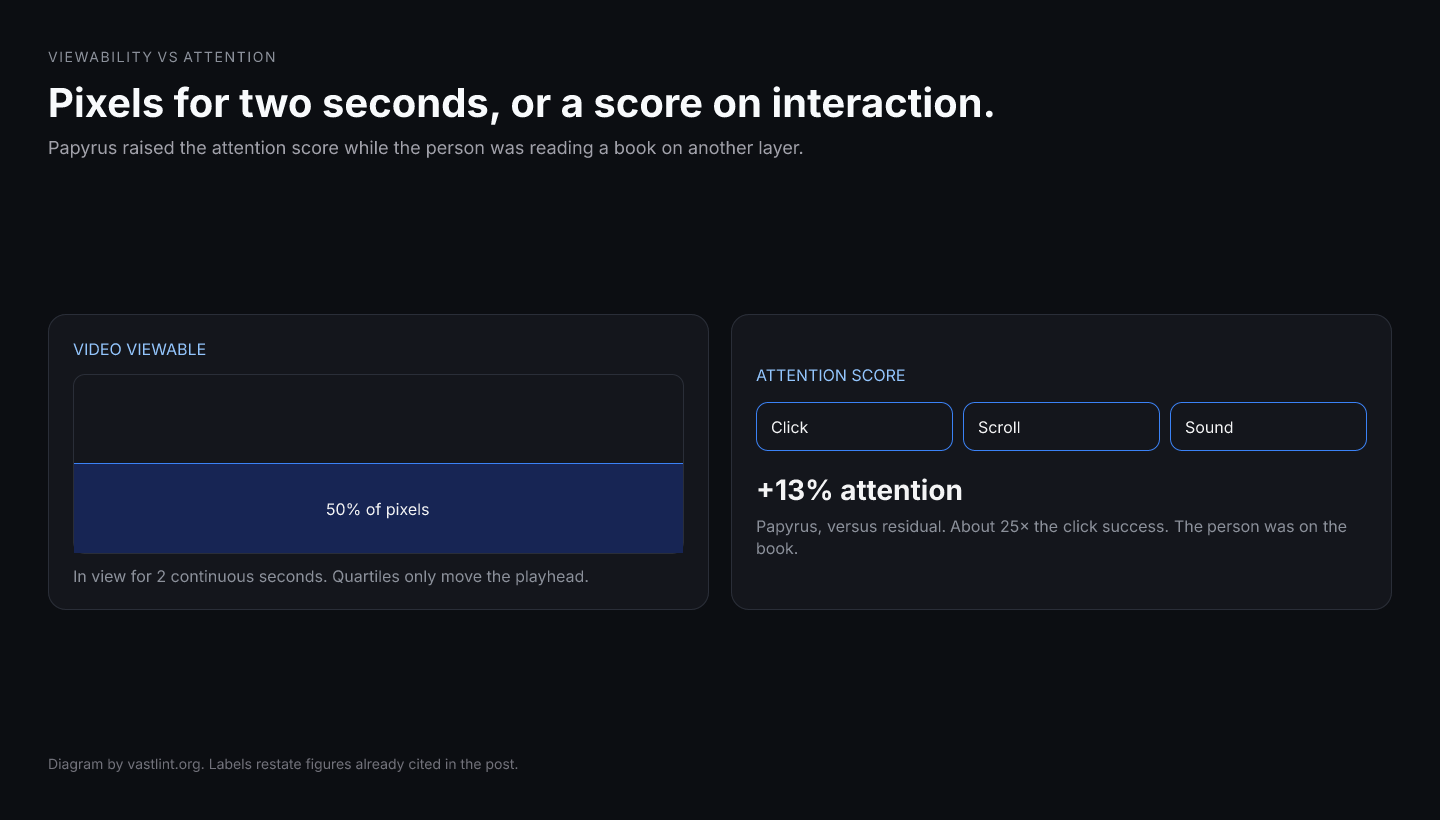
Viewability vs attention is the metric shortlist that sits under the vendor shortlists. Buyers say they want ads that were seen, then optimize the number that is easier to move. The two numbers are built differently. A viewable video impression, as the MRC states it and as trafficking teams already use it, means at least 50 percent of the pixels were in view for at least two continuous seconds. An attention score is a vendor model on top of duration, audibility, and interaction events. One is a threshold on the surface. The other is a score on behavior.
IAS Threat Lab's Papyrus note is the clean demonstration that the score can rise while the person is elsewhere. In that August 6, 2026 analysis, Papyrus traffic had about 13 percent higher attention scores than non-Papyrus traffic, nearly 25 times the click success rate, and roughly 4 times the eCPM. The mechanism was hidden webviews behind a novel-reading app. The user was reading. The metrics were being generated on pages the user did not see. Attention and clicks moved. The surface the person was watching was the book.
A campaign optimized on the score will bid up inventory that produces the inputs to the score. If those inputs can be synthesized, the score is not a stricter viewability. It is a different instrument, and it can point the other way. Remove the vendor names and a pixel-and-time threshold still does not equal a model of interaction.
What viewability measures
The video threshold is geometric and temporal. Half the pixels, two continuous seconds, on the surface where the ad is rendered. Display uses a shorter time threshold for the same pixel idea. The point for video tags is the video rule: quartiles are not a substitute. A midpoint fires because the playhead crossed half of Duration. It does not record that half the pixels were in view. A tag can complete on a panel the viewer is not facing, or in a player that is not the visible surface, and still emit a full quartile set.
VAST 4 puts a separate container, ViewableImpression, next to Impression for the viewability endpoints. That container is how the document declares where a viewability vendor should be called. If the URL is empty, or the node was dropped by a wrapper, the quartile trackers can still succeed. The join between "the ad played" and "the ad met the pixel threshold" never happens. The report then has completion and no viewability, or viewability from a different node than the one the buyer thinks is on the creative.
Viewability is also silent about intent. An impression can meet the pixel threshold because the ad was on screen while the person read something else in the same app, or because a TV was on in an empty room. The MRC threshold does not claim attention. It claims a minimum of pixels and time. Teams that treat "viewable" as "watched" have already left the definition.
What attention measures
Attention products take signals viewability does not require: time beyond the two-second floor, sound on, scroll, clicks, hover, sometimes eye-tracking panels used to train a model that is then applied to impressions without an eye tracker. The output is a score or an index. Two vendors can score the same impression differently because the models weight sound and interaction differently. There is no MRC threshold that says an attention score of a given number means the same thing in two methodologies.
Papyrus shows the failure mode when interaction is unbound from the surface. Click modules passed taps from the reading UI into hidden webviews. Scroll modules moved pages the user was not looking at. IAS reported the attention score up about 13 percent and the click success rate up nearly 25 times against non-Papyrus traffic, with eCPM roughly 4 times higher. The score did what it was built to do. It treated interaction as evidence of value. The interaction was not the reader's.
That is why a rising attention score with flat viewability and flat completion is a specific alarm. Viewability staying flat means the pixel threshold did not suddenly get easier to meet. Completion staying flat means the playhead did not suddenly get further. Interaction moving alone means the inputs that feed the attention model moved. Papyrus is one way to produce that pattern. It is not the only way. The pattern is the thing to split in reporting, whichever firm computes the score.
Why optimizing the score can bid up the wrong inventory
Bidders that use attention as a quality feature will pay more when the score is higher. If invalid traffic can outscore clean traffic, the feature points at the invalid supply. IAS's comparison was Papyrus versus non-Papyrus inside its own observation, not a census of all mobile. The direction still matters. A quality feature that ranks the fraudulent cluster above the residual will move money toward the cluster until something else in the system disagrees.
Viewability does not automatically disagree. A hidden webview can meet a pixel threshold inside its own document while the user looks at another layer. A stitched CTV stream can meet a completion count from the stitcher's beacons while the set is off. The pixel rule and the playhead rule each have a gap. Attention, because it rewards interaction, has a gap that lines up with click fraud and scroll fraud specifically. Using it as a tie-breaker on top of viewability imports that gap into the bid.
The practical split is in the columns, not in a blended "quality" field. Viewable rate, completion, attention, click rate. When the last two rise and the first two do not, the report is describing interaction inflation. When viewable rate rises and attention does not, the report is describing pixels in view without the interaction the model wanted. Both are real. Averaging them into one score hides which one moved.
Get VAST spec updates, platform guides, and release notes in your inbox.
What to do with the shortlist
Quote the definition with the number. A viewability rate should say which threshold, video or display, and which vendor's implementation of it. An attention rate should say which model, and whether interaction events are required to come from the same surface as the creative. A number without that sentence is how Papyrus reads as performance.
On the tag, confirm ViewableImpression and AdVerifications refer to the player that has the media, not to a sibling container. Quartile URLs are not a stand-in. If a wrapper keeps Impression and drops ViewableImpression, you will have delivery and you will not have the pixel join.
vastlint does not compute viewability and does not compute attention. It checks whether the nodes those measurements depend on are present and consistent in VAST 2.0–4.4. A missing ViewableImpression URL is a broken join. It is not, by itself, proof the clicks were synthetic. The structural check comes before the question of whether the interaction was real.
Signals worth keeping in separate columns
- Viewable rate against the pixel-and-time threshold, video or display stated.
- Completion and quartiles, which track the playhead, not pixels in view.
- Attention score, with the model named.
- Click rate on the same line item.
- Whether interaction beacons are bound to the surface that was actually on screen.
A pixel threshold and an interaction score can move in opposite directions, and the score is the one a hidden click is built to win.
Validate viewability nodes before you trust the score
Run VAST 2.0–4.4 tags against specification-derived rules so ViewableImpression and verification companions are present. Nothing is stored.
Open the VAST validatorSources
The pixel-and-time thresholds for display and video viewable impressions.
IAS Threat Lab, August 6, 2026. Attention, click, and eCPM gaps on a hidden-webview scheme.
Why quartile beacons do not satisfy the viewability join.
The Papyrus mechanism, and why engagement can outrank clean traffic.