Is direct CTV free of fraud is the question buyers ask when they move budget out of the open auction. People also type programmatic versus direct ad fraud, private marketplace IVT, and whether a programmatic guaranteed deal is clean. The public figures do not contain a direct-market rate. They contain two named campaigns, an open-auction quarter, and a protected cell.
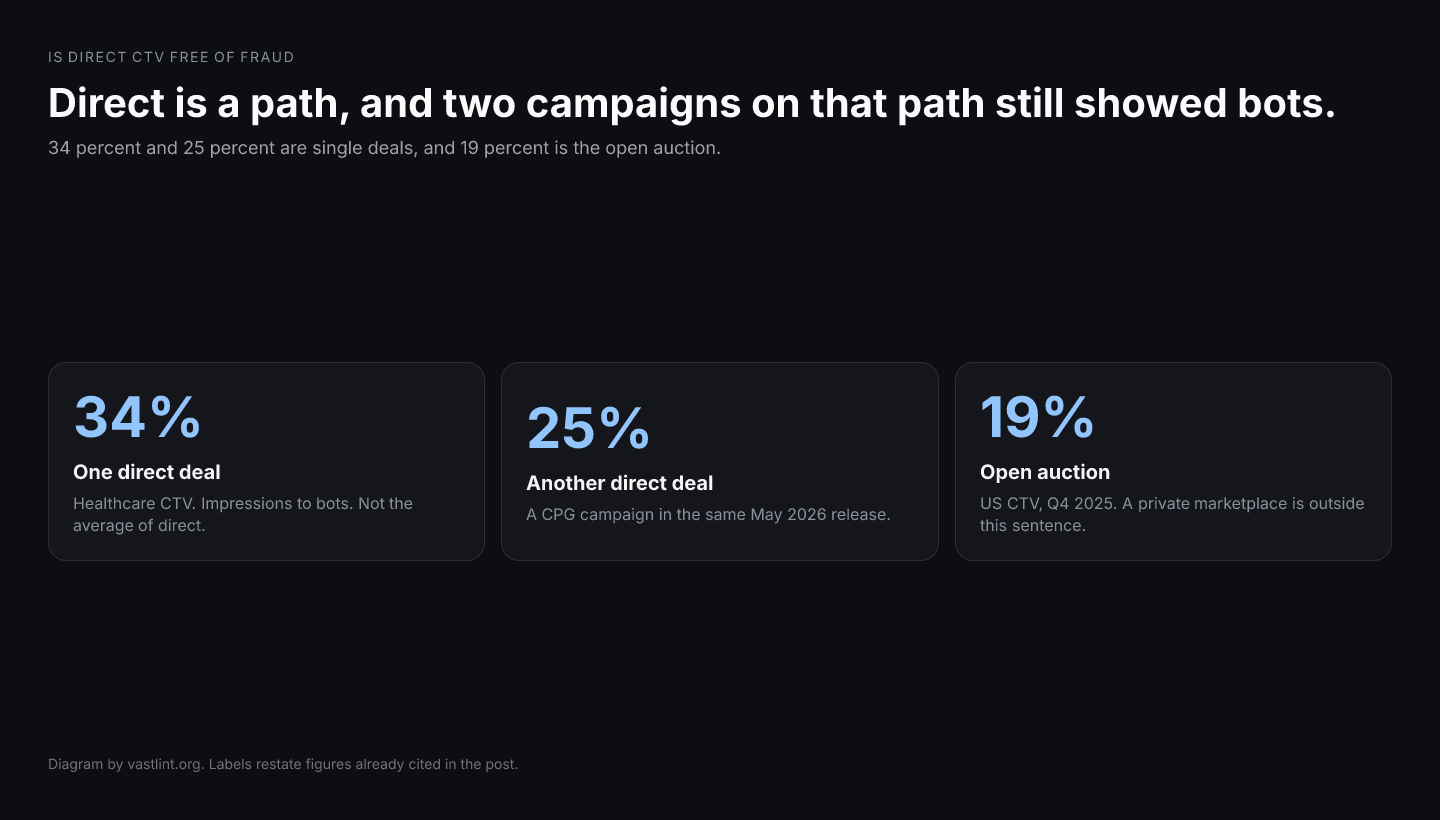
On May 7, 2026, DoubleVerify said bot activity showed up in multiple direct CTV buys, including 34 percent of impressions in one consumer healthcare campaign and 25 percent in a major CPG campaign. The same release put fraud under 1 percent on DV-protected CTV campaigns and nearly 9 percent where controls were not applied. On March 9, 2026, Pixalate put US CTV invalid traffic at 19 percent inside a set of more than 103 billion impressions that are predominantly buy-side open auction. A private marketplace or a programmatic guaranteed buy sits outside the population that 19 percent describes, which is not the same thing as sitting at zero.
vastlint does not know whether a tag was sold direct. It checks VAST 2.0–4.4 structure. A direct deal can still arrive as a wrapper that drops the verification node, and then the path is direct while the measurement is missing.
What the two direct deals are
They are examples inside a release, not a sample designed to estimate all direct CTV. DoubleVerify said bot activity showed up in multiple direct buys, and then named two. Thirty-four and twenty-five are shares of impressions on those campaigns. They are not the average of direct, not the median, and not a ceiling. A third direct campaign can be quieter. Using 34 percent as the direct IVT rate repeats the mistake of using 19 percent as every CTV rate: the denominator in the sentence got dropped.
The protected under-1-percent cell is also not the direct market. It is campaigns where DV controls were on, whatever the deal path. A direct buy with those controls off is closer to the unprotected test, or to one of the named deals, and the release does not say the two healthcare and CPG examples were the unprotected cell. They are additional rows. Leaving them in the 9 percent cell, or in the 19 percent cell, hides the fact that the path was direct.
What open auction, PMP, and direct each fail to prove
Open auction, in Pixalate's March 9 wording, is the predominant source of the benchmark. Programmatic, as buyers use the word, also includes private marketplaces and programmatic guaranteed. Those paths are not automatically inside the 19 percent, and they are not automatically outside fraud. The direct examples are the evidence that a one-to-one buy can still send a quarter or a third of its impressions to bots in a case the vendor chose to name.
Programmatic versus direct is a path comparison only when both sides are impression shares of stated populations. A scheme count, 140 percent more CTV schemes in the first quarter of 2026 than in the first quarter of 2025, does not say schemes prefer the open auction. Schemes can show up in a direct IO. The healthcare and CPG rows are that appearance, on a campaign scale.
If your buy is mostly deals, the planning number is not 19 percent, and it is not zero. It is whatever your own log shows after you label the path, plus the warning that a single direct campaign in this release reached 34 percent. If your buy is mostly open auction with a control already on, your remainder is a third number, closer to a protected rate than to either headline.
Path sentences that are not a direct-market rate
- DoubleVerify, one direct healthcare CTV campaign, May 7, 2026: 34 percent of impressions to bots.
- DoubleVerify, one direct CPG CTV campaign, same release: 25 percent of impressions to bots.
- Those two rows are examples. They are not the average of direct CTV.
- DoubleVerify, controls on: fraud under 1 percent. That cell is the control, not the deal path.
- Pixalate, Q4 2025 US CTV, predominantly open auction: 19 percent. A private marketplace is outside that sentence, which is not a rate of zero.
- A direct tag can still omit AdVerifications. The path and the measurement node are different facts.
Direct is a way the impression was bought, and the two campaigns in the May 2026 release are evidence that the path alone did not keep bots out.
Check the tag on the direct deal the same way
Run VAST 2.0–4.4 tags against specification-derived rules so verification nodes are present whether the IO was direct or the auction was open. Nothing is stored.
Sources
DoubleVerify, May 7, 2026. The two direct-deal examples and the protected and unprotected rates.
March 9, 2026. US CTV at 19 percent in a predominantly open-auction set.
Why none of these percents is the normal, including the direct examples.