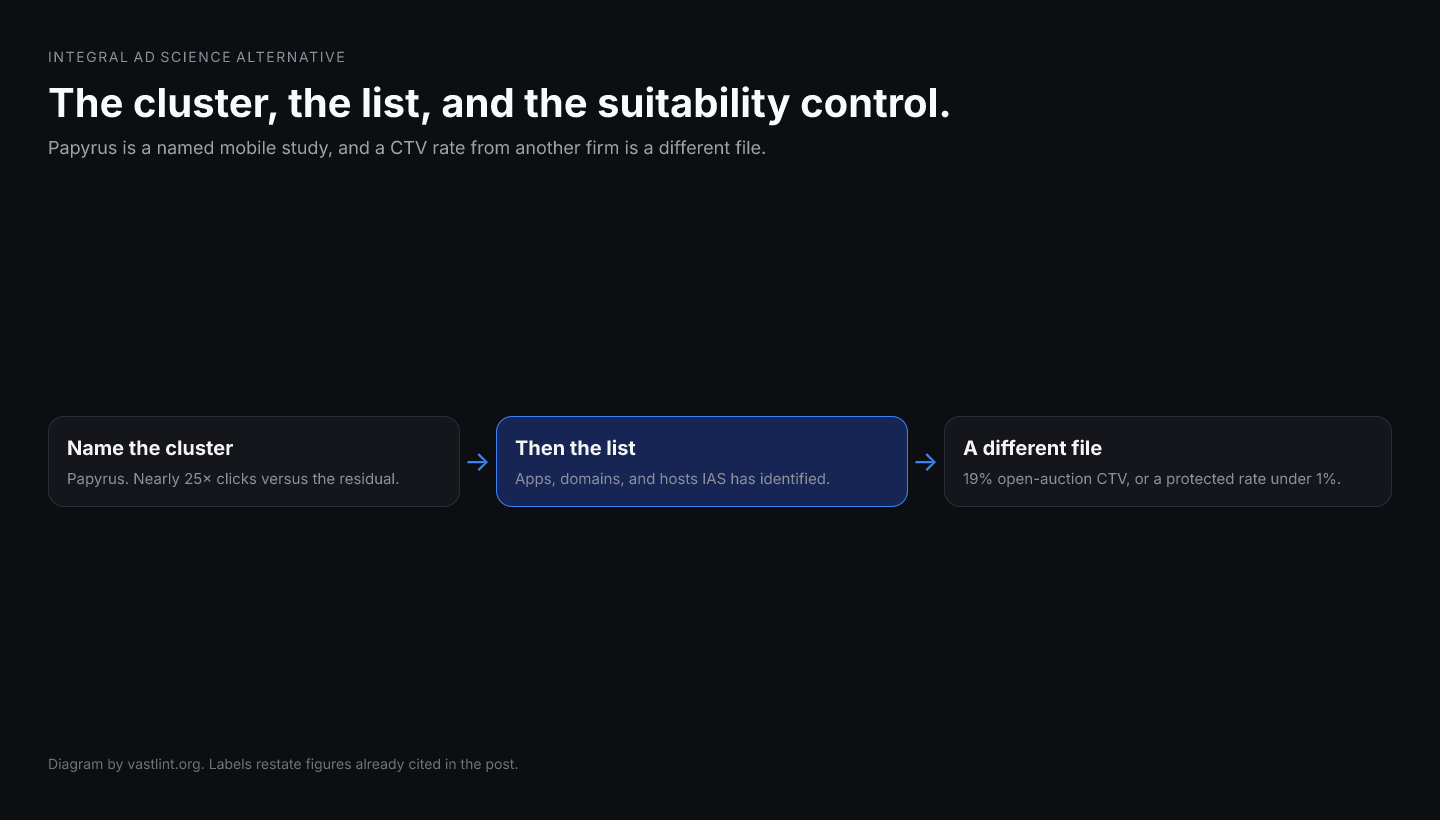
Integral Ad Science alternative is the same search as IAS alternative, and it is the search people type when they also type Pixalate vs Integral Ad Science. The company name in the query is a contract. The public documents attached to that name are more specific. On August 6, 2026, IAS Threat Lab described Papyrus, a mobile scheme in novel-reading apps: hidden webviews, taps passed through as clicks, scrolls on remote instruction. Against other traffic IAS had already separated, that cluster showed nearly 25 times the click success rate, roughly 4 times the eCPM, and about 13 percent higher attention. IAS says clients on IVT avoidance are then filtered against the associated apps, domains, and hostnames.
That is a study of a scheme, and a list built after the scheme had a name. It is not a quarterly share of US CTV, which is Pixalate's March 9, 2026 figure of 19 percent inside a predominantly open-auction set. It is not DoubleVerify's May 7, 2026 figure of fraud under 1 percent on campaigns with DV controls on. An alternative that swaps those rates in for Papyrus has changed the question from a named cluster to a different log.
vastlint is not an Integral Ad Science alternative. It is independent of IAS, DoubleVerify, Pixalate, and HUMAN. It checks VAST 2.0–4.4 structure, including whether verification nodes survived the wrapper. It does not reproduce a scheme study, and it does not classify invalid traffic.
What the IAS documents actually cover
Papyrus is built for long reading sessions. The visible app is the novel. BootNova, the layer IAS names, takes remote instructions for which URLs load and how hidden webviews interact with those pages. IAS reports more than 800 domains and nearly 8,000 unique host values. The monetization estimate, close to $1 million a month at the peak, applies an eCPM from supply IAS directly observed to a broader impression footprint. The comparison group is whatever IAS left outside the Papyrus bucket. A residual defined that way is not an open-auction census, and it is not an unprotected CTV test.
The avoidance sentence is a second artifact. Once the apps, domains, and hostnames are named, IAS says they are filtered for clients using IVT avoidance. A list with a date on it protects against supply that has been tied to this operation. It does not say what a pre-bid model would have done on the bids before anyone had named the scheme, and it does not publish a CTV fraud rate.
Brand suitability is a third job, on IAS's own verification page: pre-bid filtering and post-bid blocking for content that falls outside brand guidelines, described there as context control rather than as a fraud rate. A buyer whose IAS contract is mostly suitability is not shopping for a replacement for Papyrus. A buyer whose contract is mostly IVT avoidance is not shopping for a contextual segment. The alternative search hides that split.
What can stand in for which job
If the job is a post-identification list of apps and domains, another firm's list is a real candidate, and the candidate has to be dated. DoubleVerify's May 2026 release is not that list. It is a CTV scheme count, up 140 percent in the first quarter of 2026 versus the first quarter of 2025, plus impression rates split by whether DV controls were on. Using the under-1-percent rate as proof that a replacement would have caught Papyrus compares a protected CTV cell with a mobile cluster that had already been separated.
If the job is a decision on the next bid, HUMAN's MediaGuard is the public artifact that says it returns an IVT prediction on the OpenRTB request before the impression exists. The MRC's April 11, 2025 memorandum says that suggestion goes to DSPs and SSPs, not to advertisers, and that HUMAN does not itself drop the request. IAS's Papyrus list is applied after identification, to supply that has a name. A flag on an unnamed request and a list of a named scheme happen at different times. Both can be worth buying. They do not substitute by default.
If the job is a picture of open-auction CTV, Pixalate's benchmark is the public artifact, and the query Pixalate vs Integral Ad Science is where people paste it against IAS. Nineteen percent of US CTV impressions, 21 percent of global CTV, more than 103 billion impressions, predominantly buy-side open auction. Papyrus does not contain those denominators. A quarterly share will not tell you whether the reading-app cluster was in the set, and the cluster's click multiple will not tell you the open-auction rate.
Moat is still typed as an older alternative to IAS, and it is not available. Oracle ended Moat Analytics on September 30, 2024. A discontinued attention product does not replace a 2026 scheme study, and a 2026 scheme study does not replace a viewability history a buyer remembers from Moat.
Get VAST spec updates, platform guides, and release notes in your inbox.
What to do with the shortlist
Name the IAS surface you pay for before you name the replacement. A cluster study and the list that followed it, a suitability control, a measurement seat on served impressions. Integral Ad Science alternative is a coherent search inside one of those. Across them, it is three procurements.
Keep the comparison queries as comparisons, not as substitutes. IAS vs DoubleVerify lines up the Papyrus lift with a scheme count and a protected rate. IAS vs Pixalate lines up the same lift with the 19 percent open-auction share. IAS vs HUMAN lines up the study with a flag on the bid. Each of those notes is the argument. This note is the map of which argument you are in.
The tag is still downstream. An avoidance list can block an app and never see the wrapper. A request that is allowed can still drop AdVerifications before the impression is measured. vastlint checks that document. It does not decide whether IAS should keep the contract.
IAS artifacts that do not swap one for one
- IAS Papyrus, August 6, 2026: nearly 25 times the clicks, about 4 times the eCPM, and 13 percent higher attention, versus other traffic IAS had separated.
- IAS, same note: more than 800 domains and nearly 8,000 host values, then an avoidance list of the supply it named.
- IAS verification page: pre-bid filtering and post-bid blocking for content outside brand guidelines, which is a suitability job.
- DoubleVerify, May 7, 2026: CTV fraud under 1 percent with controls on, nearly 9 percent with them off, and 140 percent more schemes, which is a count.
- Pixalate, Q4 2025, US CTV, predominantly open auction: 19 percent of impressions.
- HUMAN: an IVT suggestion on the bid. The MRC says the platform decides whether to drop the request.
A named cluster, the list built after it, and a suitability control are three contracts, and a rival's CTV rate replaces none of them by itself.
Check the tag an avoidance list never sees
Run VAST 2.0–4.4 tags against specification-derived rules so verification nodes and impression events are present. Nothing is stored.
Open the VAST validatorSources
IAS Threat Lab, August 6, 2026. The cluster ratios and the avoidance list that followed identification.
IAS's description of pre-bid filtering and post-bid blocking for brand suitability.
The pair behind one common reading of an IAS alternative.
The pair behind Pixalate vs Integral Ad Science.
The mirror of this note, from the other contract.