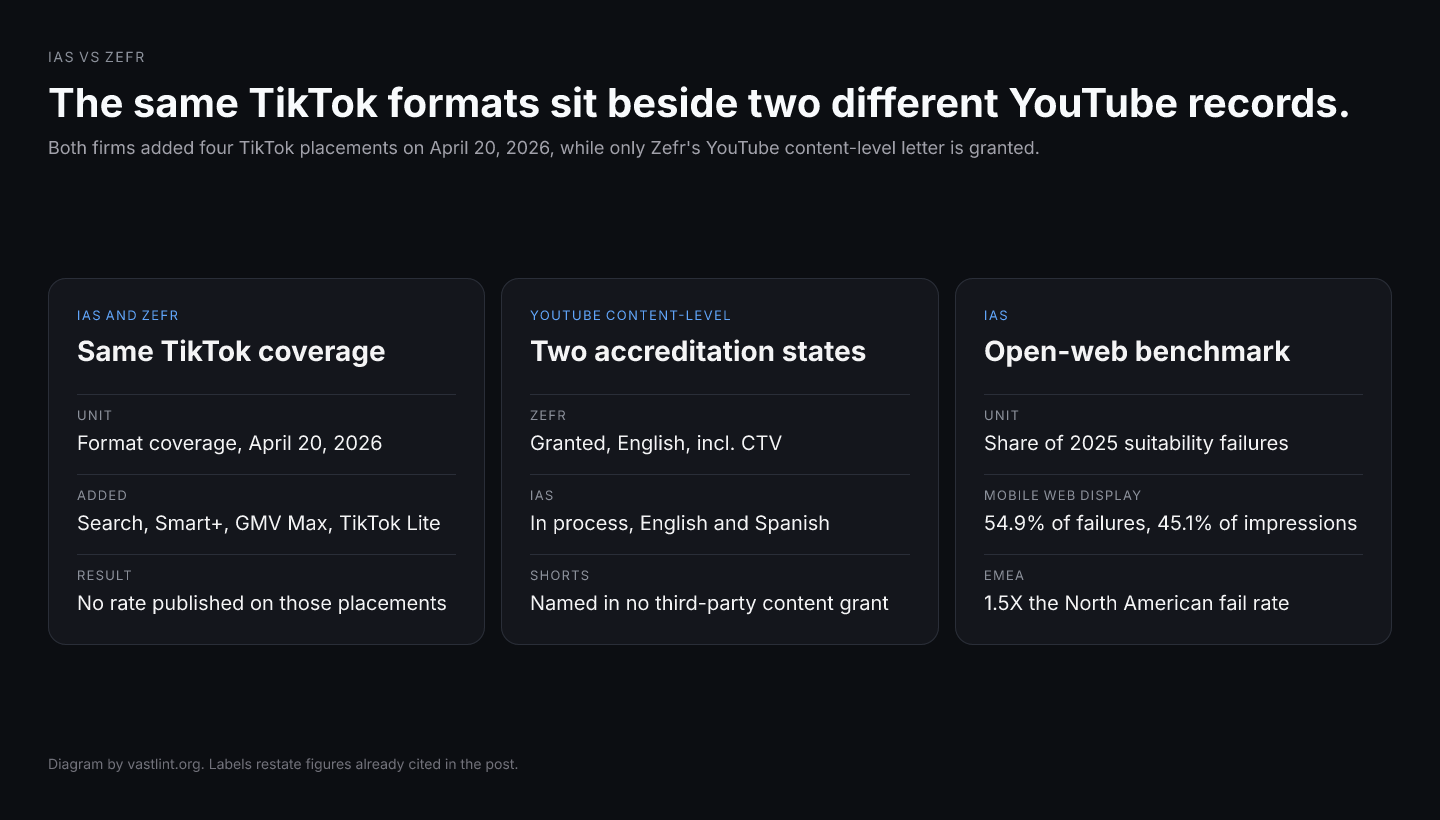
IAS vs Zefr is the comparison a social buyer runs when both names appear on the same platform partner list. On April 20, 2026, the two companies announced measurement for the same four TikTok placements: Search, the upgraded campaign creation experience for Brand and Smart+ traffic objectives, GMV Max in the US, and TikTok Lite in the US. On YouTube the paperwork differs. The Media Rating Council granted Zefr content-level brand safety and suitability accreditation for English-language in-stream YouTube video and music video on January 20, 2026, across desktop, mobile web, mobile in-app, and CTV. The MRC's Digital Platforms chart dated July 9, 2026 lists IAS's content-level brand safety and suitability classification for YouTube content in English and Spanish, on desktop, mobile web, and mobile in-app, as in the accreditation process and not yet accredited. vastlint does not rank IAS against Zefr. It checks whether a VAST 2.0–4.4 tag carries a verification node, which matters on the open web and CTV that IAS also measures and not on the TikTok and YouTube surfaces this pair shares.
The rates attached to each name come from different instruments. IAS's 21st Media Quality Report, released July 9, 2026, covers 2025 open-web display and video on desktop and mobile web. It says mobile web display carried 45.1 percent of impressions and 54.9 percent of brand suitability failures, and it reports suitability fail rates as multiples of a baseline rather than as percentages: EMEA at 1.5X North America, mobile web display at 1.7X desktop display. Zefr's most recent published figures are from a consumer study with OM Media Trials released March 3, 2026: 81 percent of people said at least one type of AI-generated content is inappropriate for brands to appear next to, 41 percent felt more positive about a brand when AI content was clearly labeled, and 32 percent mistook human-created content for AI-generated content.
The comparison is concrete on TikTok because the platform defines the inventory both firms read, and the press releases list the same placements. Off TikTok, the published figures belong to different objects: an open-web impression benchmark, a consumer survey, and two MRC records about the same YouTube category at different stages. None of them orders the other, and the same-day TikTok list does not either, because neither release publishes a result on those placements.
What the IAS figures measure
The Media Quality Report is an open-web benchmark. IAS says it draws on more than 300 billion digital interactions captured each day and that the report covers display and video across desktop and mobile web, with regional, country, and vertical cuts. It defines the suitability fail rate as the share of impressions that fall outside a brand's defined suitability settings, flagged across categories that include Adult, Alcohol, Gambling, Hate Speech, Illegal Downloads, Illegal Drugs, Offensive Language, and Violence, and it shows both brand safety and suitability fail rates as multiples of reference baselines. The global brand safety fail rate fell from 3.7X in January 2025 to 1.0X in December. IVT held at 1.1 percent across 2025. Because the suitability cells are multiples, the report tells a reader that EMEA ran 1.5 times the North American rate and that Retail ran 1.6 times Finance, and it does not print the North American or Finance rate those multiples sit on.
Social is a separate product line with separate releases. IAS describes Total Media Quality as an independent view of brand safety, suitability, viewability, and IVT across more than 15 platforms. Its April 20, 2026 TikTok release says TMQ combines image, audio, and text to classify content with video-level insights, pairs TikTok's first-party pre-bid controls with IAS's post-bid measurement on Search, and excludes Live GMV Max and Shop Tab from the GMV Max integration. On June 11, 2026 IAS extended TMQ brand safety and suitability measurement to YouTube Audio Ads campaigns and described its YouTube coverage as Shorts, long-form video, and audio. On May 18, 2026 it extended Meta Content Block Lists to Threads feed. The social performance figures IAS publishes are case results, such as a 65 percent decrease in brand suitability fail rates two months after one advertiser implemented IAS Social Optimization, cited in a January 7, 2026 post on its 2026 Industry Pulse survey of nearly 300 industry experts.
The accreditation record is itemized. The MRC's accredited-services list shows IAS's core service for tracked ads, rendered impressions, viewability, and SSAI video metrics, with CTV accreditation applying to certified traffic only, plus SIVT detection, property-level ad verification on desktop and mobile web, and pre-bid viewability and IVT avoidance segments. It lists separate integrations: Facebook reporting, where accredited metrics are specific to placements audited for first-party measurement; YouTube via Ads Data Hub, accredited on March 15, 2024 for in-stream and bumper impressions and viewability with GIVT filtration; and a server-to-server Amazon DSP integration accredited in the fourth quarter of 2025. In June 2026 the MRC granted IAS's pre-bid optimization service for viewability segments and IVT avoidance on desktop, mobile web, and mobile in-app. In January 2026 the MRC removed IAS Attention Measurement and IAS In-Game Measurement from in-process status, citing IAS's lack of intent to engage in third-party audit.
The YouTube content-level line is where the record and the product diverge in time. The July 9, 2026 chart shows the IAS cell in the in-process color, scoped to English and Spanish YouTube content on desktop, mobile web, and mobile in-app. The MRC's October 18, 2025 representation policy, with a six-month grace period, says vendors accredited only for property-level ad verification may not position those services as brand safety or as content-level without content-level capabilities for the specific environment, and it asks vendors with true content-level products to submit them for audit. How that policy applies to any named product is the MRC's determination, and this page does not make it. What a buyer can read today is that IAS's YouTube content-level classification is under audit, and Zefr's is accredited.
What the Zefr figures measure
Zefr's January 20, 2026 letter accredits content-level brand safety and suitability content labeling and reporting of Google YouTube English-language in-stream YouTube video and in-stream YouTube music video, within desktop, mobile web, mobile in-app, and CTV. It excludes Shorts, YouTube TV, Google TV, Masthead, Google Video Partner videos, and volumetric data. The MRC's chart calls the line Zefr's independent URL classification. Set next to the IAS cell on the same chart, the two scopes differ in three directions: Zefr's is English only and IAS's in-process scope adds Spanish; Zefr's includes CTV and IAS's in-process cell lists desktop, mobile web, and app; Zefr's is granted and IAS's is not yet.
Zefr's product coverage is wider than its letter in the same way IAS's is. A September 2024 Zefr release said its YouTube brand safety and suitability reporting covers in-stream and Shorts inventory across Video Action, Video Reach, Video View, Performance Max, and Demand Gen, with twelve reporting categories including misinformation. Shorts are outside the January 2026 accredited scope. Zefr's other MRC letter, dated November 6, 2025, accredits Ads Data Hub impressions and viewability for skippable, non-skippable, and bumper in-stream formats with GIVT filtration, the same category IAS has held since March 2024. Both firms therefore measure Shorts in product, neither holds a third-party content-level accreditation that names Shorts, and Google's own content-level controls for Shorts were granted accreditation in a May 28, 2026 letter.
The AI study is a consumer-response instrument. OM Media Trials, a team within Omnicom Media, ran it in the United States and Canada to measure how people react to ads placed next to different kinds of AI-generated content. Zefr reports that satire, humorous youth depictions, and creative expression drove higher ad recall and perceptions of innovation, while spam-like or misleading AI content and authenticity uncertainty were tied to lower favorability, trust, and purchase intent, and that Canadian respondents were more sensitive than US respondents. The page does not publish a sample size. The 81, 41, and 32 percent are shares of respondents. IAS's nearest product, Low-Quality GenAI Avoidance, became generally available on May 29, 2026 as a pre-bid segment and post-bid measure for English-language text on the open web, desktop and mobile web. One classifies pages before purchase, and the other surveys reactions to social video adjacency.
Zefr's position in the platforms is part of how its numbers are produced. Adotat's August 12, 2026 piece reports that Zefr works buy side only and charges brands rather than TikTok, that its data arrives from platforms by API, and that it sends its classifications back so platforms can tune their first-party filters, with Rich Raddon saying it cannot be completely independent. Zefr's April 20, 2026 TikTok release covers brand safety, suitability, viewability, and IVT on the four new placements, available in TikTok Ads Manager for campaigns using Standard or Limited Inventory, with GMV Max excluding LIVE and Shop Tab. TikTok's own brand safety page names DoubleVerify, IAS, and Zefr as post-campaign partners whose rates align to the GARM Brand Safety Floor and Suitability Framework.
Why the same TikTok formats do not put both firms on one scale
A coverage list is not a result. IAS and Zefr both now measure TikTok Search, Smart+, GMV Max in the US, and TikTok Lite in the US, and neither April 20 release reports a suitability rate, a block rate, or a disagreement count on those placements. Each firm applies its own classifier and each advertiser's own suitability profile on top of TikTok's inventory tiers. Two vendors reading the same placement list can return different labels on the same video, and nothing in the public record says how often they do.
The units do not match off TikTok either. IAS's open-web suitability figures are multiples of a baseline and shares of failures by media type. Zefr's 2026 figures are shares of survey respondents. The two YouTube records are accreditation statuses, granted and in process, which describe whether an audit is finished and not how accurate a classifier is. Turning 1.5X EMEA into a YouTube suitability rate, or 81 percent of consumers into a share of unsuitable impressions, changes the object being counted.
The populations do not match. IAS's benchmark population is 2025 open-web impressions it analyzed, on desktop and mobile web, display and video, and it leaves social out of the benchmark tables. Zefr's accredited population is English-language in-stream YouTube video, including on CTV screens. IAS's in-process scope is English and Spanish YouTube content without CTV listed. A Spanish-language YouTube campaign, a Shorts-heavy campaign, and a YouTube campaign watched mostly on television each land in a different cell of that grid.
The dates do not match, and the accreditation map is the part most likely to move. The Zefr letter is from January 20, 2026. The IAS status comes from a chart dated July 9, 2026, and an in-process audit can finish, change scope, or stop between quarterly updates, as IAS's attention and in-game audits did in January 2026. The MQR figures describe calendar 2025. The Zefr survey was released March 3, 2026. A deck that quotes all four in one row is mixing four dates.
Which question each firm's number answers
Cells restate public letters, charts, and releases. Not published means the cited material does not contain it, not that the capability is absent.
| Question a buyer asks | IAS public answer | Zefr public answer |
|---|---|---|
| Is third-party content-level suitability on YouTube accredited? | In process for English and Spanish on desktop, mobile web, and app, per the July 9, 2026 chart | Granted for English in-stream video and music video, including CTV, January 20, 2026 |
| Are YouTube Shorts measured? | Yes in product, per the June 11, 2026 release; no Shorts line in the accreditation record | Yes in product, per the September 2024 release; excluded from the accreditation |
| Which TikTok placements are newly measured? | Search, Smart+, GMV Max (US), TikTok Lite (US), April 20, 2026 | The same four, April 20, 2026 |
| What share of impressions failed suitability? | Open web only, as baseline multiples; mobile web display held 54.9% of failures in 2025 | Not published as a rate in the 2026 releases cited here |
| How is AI-generated content handled? | Low-Quality GenAI Avoidance for English open-web text, generally available May 29, 2026 | Brand-defined AI suitability thresholds, with a consumer study released March 3, 2026 |
| Is open-web verification accredited? | Yes, property-level on desktop and mobile web, plus SSAI video metrics | Not published; releases describe social platforms |
| Is attention measurement accredited? | Removed from MRC in-process status in January 2026 | Not published |
Where IAS rides in the VAST tag and where neither firm needs one
On the surfaces this pair shares, there is no buyer VAST tag to inspect. IAS's accredited YouTube numbers come through Ads Data Hub, its accredited Facebook numbers are tied to placements Meta audited for first-party measurement, and its TikTok measurement is post-bid reporting through the platform. Zefr's YouTube labels attach to videos by URL classification, and its TikTok, Meta, Snap, and Reddit work arrives through platform integrations. On TikTok and YouTube the checkable artifacts are the MRC letter, the chart cell, the exclusions, and the platform's reporting export, and a VAST validator has nothing to read.
On the open web and CTV, IAS measurement reaches the player through the VAST document. In VAST 4.1 and later, AdVerifications sits under InLine or Wrapper and holds a Verification element whose vendor attribute identifies IAS, with a JavaScriptResource declaring apiFramework="omid" or an ExecutableResource, optional VerificationParameters, and a Tracking event="verificationNotExecuted" URL that can return a [REASON] code. VAST 3.0 and 2.0 tags carry the same data inside Extension type="AdVerifications" when they carry it. IAS's accredited SSAI video metrics put the stitched path in scope. In server-side insertion the stitcher decides what verification data reaches the device, and a stitcher that copies Impression and MediaFiles but not AdVerifications leaves an ad that still plays with no Verification element for the player to load. The accredited CTV metrics also apply to certified traffic only, so a missing node and an uncertified app are two separate reasons a CTV impression can go unmeasured.
A buyer with IAS on the CTV leg and Zefr on the YouTube leg has one XML check and one document check. For the CTV leg, fetch the resolved chain with the production timeout and redirect policy, or capture the post-stitch document where the stitcher exposes one, and confirm the IAS Verification entry survived with a non-empty HTTPS resource and verificationNotExecuted tracking. For the YouTube leg, compare the line items against Zefr's exclusions and, if IAS is reporting content-level on YouTube too, note that its letter for that category is still in process. Neither check says whose classifier is more accurate.
What to do with the shortlist
Split the shortlist by surface before comparing vendors. On TikTok, IAS and Zefr now cover the same four new placements, so the useful questions are which suitability profile each will apply, how each reports disagreement with TikTok's inventory tier, and what a trial on the same campaign shows. On YouTube, the useful question is which accreditation status the contract needs: Zefr's English-language content-level letter, or IAS's in-process English and Spanish scope. On the open web and CTV, IAS has an itemized accreditation record and Zefr's public material does not describe that service.
Label every number with its instrument. A baseline multiple from an open-web benchmark, a share of failures by media type, a share of survey respondents, a case-study decrease, and an accreditation status are five different things. Quote the MQR's 54.9 percent as a share of IAS-measured open-web suitability failures, not as a social rate. Quote Zefr's 81 percent as a share of US and Canadian respondents, not as a share of impressions next to AI content. Check the MRC's quarterly updates before renewal, because an in-process cell can turn green, change scope, or be removed.
vastlint is independent of IAS and of Zefr. It checks structural consistency for VAST 2.0–4.4, including whether AdVerifications or the Extension compatibility block is present after the wrapper chain, whether each Verification has a vendor and a resource, and whether tracking URLs are well formed. It only applies to legs that serve a VAST tag the buyer can see, which in this pair means IAS's open-web and CTV measurement. It does not classify content, score suitability or brand safety, read TikTok or YouTube reporting, rank these firms, or know whether a vendor's host is answering.
What to separate before using this comparison
- A shared list of TikTok placements is a coverage statement, and neither April 20, 2026 release reports a result on those placements.
- Zefr's YouTube content-level accreditation is granted for English in-stream video and music video including CTV, while IAS's YouTube content-level classification is in process for English and Spanish without CTV listed.
- IAS's Media Quality Report suitability figures are 2025 open-web baseline multiples and failure shares, and they do not describe TikTok or YouTube.
- Zefr's 81, 41, and 32 percent are shares of consumer respondents in the US and Canada, not shares of impressions.
- Both firms measure YouTube Shorts in product, and no third-party content-level accreditation in the cited records names Shorts.
- IAS Low-Quality GenAI Avoidance covers English open-web text, which is a different surface from Zefr's study of social video adjacency.
- A VAST verification node exists only on the open-web and CTV legs, including after SSAI stitching, so the tag check applies to IAS's measurement there and to neither firm's platform integrations.
Questions buyers ask about IAS and Zefr
- Is IAS MRC accredited for brand safety on YouTube? IAS is accredited for Ads Data Hub impressions and viewability on YouTube, and the MRC chart dated July 9, 2026 lists its content-level YouTube classification for English and Spanish as in the accreditation process.
- Is Zefr MRC accredited outside YouTube? Not in its MRC letters; both cover YouTube, one for content-level labeling of English in-stream video and one for Ads Data Hub viewability.
- Do IAS and Zefr cover the same TikTok placements? Yes for the four added on April 20, 2026: Search, the upgraded Brand and Smart+ flow, GMV Max in the US, and TikTok Lite in the US, with GMV Max excluding Live and Shop Tab in both releases.
- Can IAS's 54.9 percent be compared with a Zefr rate? No; it is IAS's share of 2025 open-web suitability failures that occurred on mobile web display, and Zefr's 2026 releases cited here publish no comparable rate.
- Does IAS have accredited attention measurement? The MRC removed IAS Attention Measurement from in-process status in January 2026, citing IAS's lack of intent to engage in third-party audit.
- What can vastlint check in this pair? On IAS's open-web and CTV legs, whether the resolved or post-stitch VAST 2.0–4.4 tag still carries a Verification entry with a vendor, a resource, and verificationNotExecuted tracking; it cannot check TikTok or YouTube measurement.
Check the verification node on the legs that serve a VAST tag
Run VAST 2.0–4.4 tags, including post-stitch output, against specification-derived rules so AdVerifications and vendor resources are present. Nothing is stored, and the check does not score suitability.
Sources
MRC, January 20, 2026. Content-level scope for English in-stream YouTube video and music video, with exclusions.
MRC, November 6, 2025. Ads Data Hub impressions and viewability for YouTube in-stream and bumper formats.
MRC chart updated July 9, 2026. Zefr's YouTube content-level cell accredited and IAS's English and Spanish cell in process.
MRC list of IAS's accredited metrics, including property-level verification, SSAI video, and the Facebook, YouTube ADH, and Amazon DSP integrations.
MRC, March 15, 2024. IAS processing of Ads Data Hub YouTube impressions and viewability for in-stream and bumper placements.
MRC, April 17, 2026. Zefr's January grant and the removal of IAS Attention and In-Game measurement from in-process status.
MRC, July 13, 2026. June grant of IAS's pre-bid optimization service and continued IAS accreditations.
MRC. Grant of IAS's server-to-server Amazon DSP integration and Zefr's Ads Data Hub reporting.
MRC, October 18, 2025. Property-level versus content-level service lines and the request to submit content-level products for audit.
MRC, May 28, 2026. Google's first-party content-level controls, continued for in-stream and granted for Shorts.
IAS, July 9, 2026. Mobile web display share of impressions and suitability failures, viewability, and data scale.
Full IAS report. Definitions, baseline multiples by region and vertical, IVT, and the open-web scope.
IAS, April 20, 2026. Four TikTok placements, video-level insights, and the GMV Max exclusions.
Zefr, April 20, 2026. The same four TikTok placements, inventory tiers, and GMV Max exclusions.
IAS, June 11, 2026. TMQ on YouTube across Shorts, long-form video, and audio.
IAS, May 18, 2026. Content Block Lists on Threads and TMQ measurement on Meta.
IAS, January 7, 2026. 2026 Industry Pulse survey of nearly 300 experts and the 65 percent case result.
IAS, May 29, 2026. General availability, segment, and English open-web text coverage.
Zefr and OM Media Trials. US and Canada consumer study with the 81, 41, and 32 percent findings.
Business Wire release dated March 3, 2026.
Zefr, September 2024. YouTube reporting across in-stream and Shorts with twelve categories.
Adotat, August 12, 2026. MRC on metric-level accreditation, IAS and Zefr scopes, and Zefr's platform data relationship.
TikTok's page naming DoubleVerify, IAS, and Zefr as post-campaign brand safety and suitability partners.
Why a suitability fail rate and an invalid-traffic rate are different subtractions.
The envelope check for Verification, vendor, resources, wrapper chains, and SSAI output.
IAS's fraud research against a different kind of published rate.