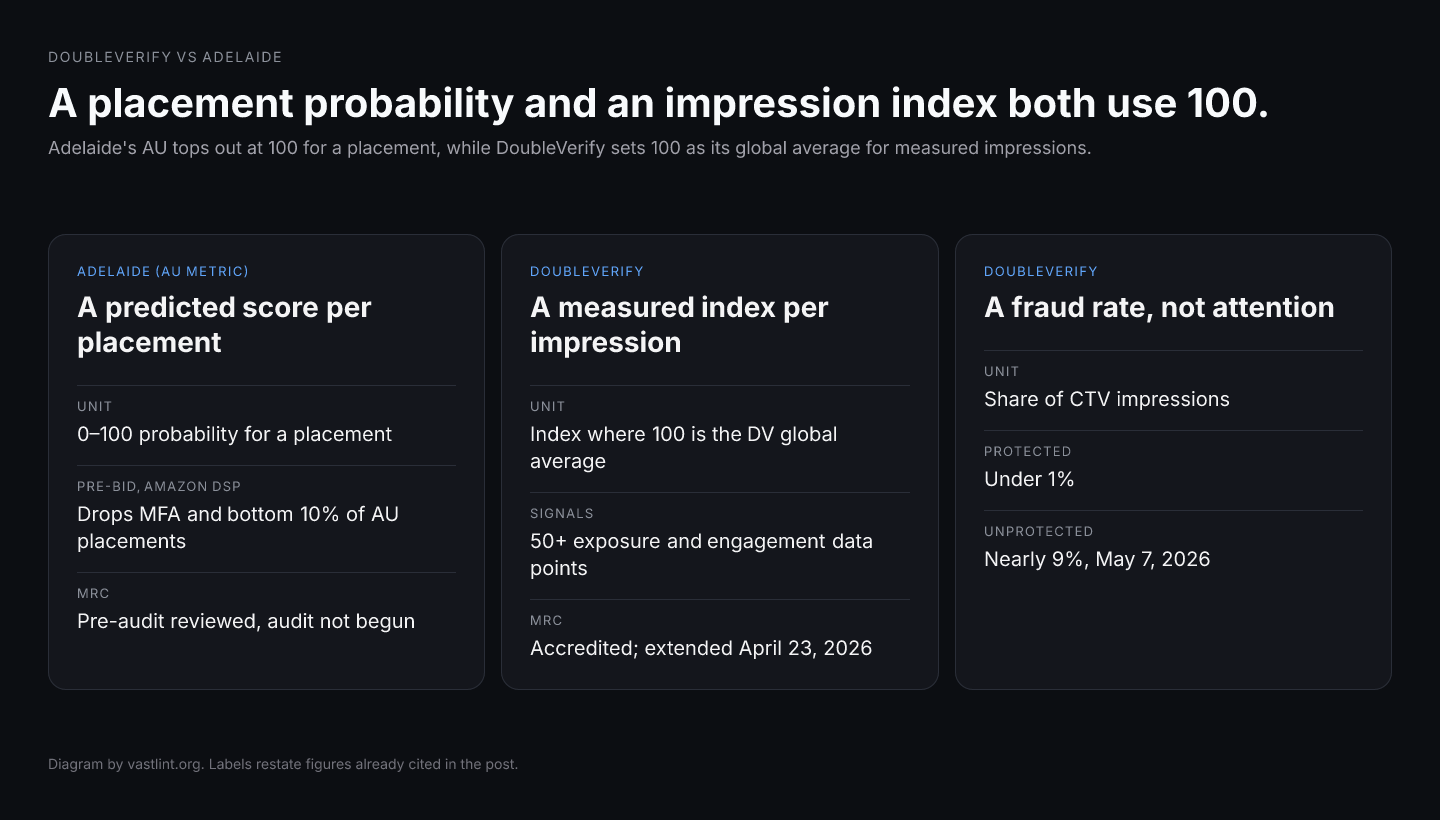
DoubleVerify vs Adelaide is an attention shortlist, and the two names publish a different kind of number. Adelaide describes AU as a 0–100 media quality rating that predicts a placement's ability to capture attention and drive outcomes. On June 10, 2026, Adelaide made AU pre-bid segments available in Amazon DSP, including an AU Quality Floor that excludes made-for-advertising sites and the bottom 10 percent of AU-scored placements. DoubleVerify's attention product, DV Authentic Attention, measures more than 50 exposure and engagement data points on served impressions, and DV's 2025 Global Insights report set the global Attention Index for 2024 at a baseline of 100, with North America 4 percent below it. On April 23, 2026, DoubleVerify said the MRC had extended its Authentic Attention accreditation; the MRC's own listing shows Adelaide's AU as pre-audit reviewed in May 2026 with the audit not begun. vastlint does not rank DoubleVerify against Adelaide. It checks whether a VAST 2.0–4.4 tag still carries the verification node a measurement vendor would have to read, and it does not score attention.
The two 100s are the first trap. An AU of 100 is the top of a probability scale for a placement. A DV Attention Index of 100 is the DV global average, so a placement at 96 is 4 percent below DV's own mean, not 4 points from the top of anything. A shortlist that writes AU 72 next to Attention Index 96 has put a probability beside a ratio to an average and invited the reader to subtract them.
Both companies sell a way to buy more attentive media, and both now reach the bid. The public documents do not settle which to buy. Strip the names off and the claim remains: a predicted score for a placement, built from history and applied before the auction, and an index of signals observed on impressions that already served, are two different instruments, and neither one is a fraud rate.
What the DoubleVerify figures measure
DV Authentic Attention is described on DoubleVerify's product page as more than 50 exposure and engagement data points analyzed in near real time. Exposure covers the ad's presentation: viewable time, share of screen, video presentation, and audibility. Engagement covers user-initiated events while the ad is displayed: eyes-on-screen, touches, screen orientation, video playback, and audio control interactions. The page lists seven indices and says the measurement is accredited by the MRC across desktop and mobile environments, for direct indexed impressions only. The unit is an impression that DV's tag or integration saw.
The Attention Index is a relative number. DV's 2025 Global Insights North America report says the 2024 global Attention Index across all environments and device types was set at a baseline of 100, that APAC was 14 percent above it, EMEA 8 percent above, LATAM 4 percent above, and North America 4 percent below. The report's data notice says the Authentic Attention figures span July 1 to December 31, 2024, and that all data in the report is DV tag-based data from the open web. An index of 96 is a statement about DV-measured impressions in one region relative to DV-measured impressions everywhere, over six months.
Accreditation has a dated scope. DoubleVerify's April 23, 2026 release says the MRC extended Authentic Attention accreditation to cover metrics for authentic non-viewable and authentic modeled video impressions, and quotes MRC CEO George Ivie on the continued accreditation of property-level ad verification and attention. The same release says DV became the first measurement provider accredited for TikTok video viewability reporting, covering impressions, viewable impressions, and SIVT filtration on video ads served to the TikTok mobile app, and that DV first earned MRC accreditation in February 2013. DV also sells Universal Attention Segments, which its product page says are updated daily from Authentic Attention data so buyers can avoid low-attention placements before the bid.
The CTV figures buyers paste into this shortlist are fraud, not attention. DoubleVerify's May 7, 2026 Must-CTV release says fraud rates were under 1 percent on DV-protected CTV campaigns and nearly 9 percent where protection controls were not applied, that DV detected 140 percent more CTV fraud schemes and variants in Q1 2026 than in Q1 2025, and that unprotected fraud can cost about $1.8 million per billion CTV impressions. Its January 6, 2026 Authentic Streaming TV release adds attention indicators and power-state awareness to CTV controls and says DV supports Open Measurement for CTV. Those are impression shares and product scopes, and none of them is an attention score for a CTV placement.
What the Adelaide figures measure
AU is a prediction about a placement. Adelaide's methodology pages describe a model trained on eye-tracking research, historical placement attributes, and historical outcome data, then applied to live placement attributes to produce per-placement ratings. Its data post names eye-tracking from Lumen, Amplified Intelligence, Tobii, TVision, and Viomba, exposure data from log files, Adelaide's own tag and pixels, ad server data, ACR data, and verification data, and outcome data strengthened by the August 2024 acquisition of Rita Data. For CTV, Adelaide says it collects placement characteristics with 1x1 pixels, licensed datasets, DSP logs, and content metadata from partners such as IRIS.TV, then assigns a single normalized score to each placement. The unit is a placement, and the score is a probability, not a measurement of whether a given viewer looked.
The Amazon DSP launch is a pre-bid product built from that history. Adelaide's June 10, 2026 post says the segments are built from historical placement-level AU data, from cumulative, statistically significant AU observations, and cover Display, Online Video, and Streaming TV inventory. AU Media Quality offers High, Average, and Low tiers. AU Quality Floor, exclusive to Amazon DSP, excludes MFA-designated sites and the bottom 10 percent of AU-scored placements; AdExchanger reported that the MFA designation comes from Jounce Media and that AU pre-bid targeting is also available in The Trade Desk, Viant, Yahoo DSP, Adobe Advertising DSP, and Equativ. The 10 percent is a share of scored placements removed from eligibility, not a share of impressions found to be invalid.
The DV360 integration reprices rather than removes. PPC Land reported on July 23, 2026 that Google's Display & Video 360 announcement set a mid-July rollout for AU as a Custom Bidding signal, through an off-the-shelf Maximize Adelaide Attention Unit algorithm or as a multiplier inside advertiser scripts, and that the announcement did not restate which inventory types are covered. On June 16, 2026, Vertical Impression announced it would supply Adelaide with attention data from more than 9,000 elevator screens across North America to calibrate AU's measurement of out-of-home placement quality. Each of these extends where the AU score is applied without changing the unit.
Adelaide's assurance is a different kind from DoubleVerify's. The MRC's services-under-review page lists Adelaide as pre-audit reviewed in May 2026, audit not begun, for AU defined as media placements' potential to deliver an attentive impression across digital display and video, audio, linear TV, cinema, and digital OOH, and the MRC says services listed there are not accredited. Digiday reported on October 29, 2024 that Adelaide had entered the pre-assessment phase. Separately, MediaSense reviewed AU's methodology between February and June 2025; The Media Leader reported that MediaSense did not independently verify the data and documents it received, did not review the source code, and had limited data at the extremes of the AU scale.
Why a placement score and an impression index have no shared scale
The units do not match. AU is a 0–100 probability for a placement. The DV Attention Index is a ratio to DV's global average, where 100 means average. A fraud rate under 1 percent is a share of impressions. A bottom-decile exclusion is a share of scored placements. Those four numbers can sit in one column only if the column header is left blank.
The grain does not match. DoubleVerify's attention metrics come from signals on impressions that served and that DV measured, and the accredited scope is direct indexed impressions on desktop and mobile. AU is assigned to placements, defined by attributes such as app, publisher, show, daypart, pod position, and device for CTV, and the model returns one score for those attributes. Adelaide says Amazon DSP buyers already get impression-level visibility into attention quality after a campaign runs, and its methodology still describes the score as a rating of the placement. Two impressions that share the same placement attributes get the same predicted value. Two impressions on the same placement can get different DV attention readings, because the exposure and engagement signals observed on each one differ.
The time does not match. AU pre-bid segments in Amazon DSP are built from cumulative historical observations and applied before the auction. DV Universal Attention Segments are refreshed daily from measured data, and DV's Attention Index benchmarks cover the second half of 2024. A pre-bid AU exclusion removes supply before any impression exists, so the impressions it removed never reach a post-serve attention measurement.
The standards status does not match either, and the guidelines explain why that matters. The IAB and MRC Attention Measurement Guidelines, final in November 2025, define four approaches (data signals, visual and audio tracking, physiological and neurological observation, and panel or survey methods), serve as the basis for MRC accreditation audits, and say attention is not a standalone measure of ad effectiveness. Adelaide says AU incorporates all four approaches. DoubleVerify's attention metrics are accredited for a named scope; Adelaide's are under review with the audit not begun. That is a difference in audit status, not a finding that either model is wrong.
Which question each firm's number answers
DoubleVerify answers about impressions it measured, and Adelaide answers about placements it predicted.
| Question a buyer asks | DoubleVerify public answer | Adelaide public answer |
|---|---|---|
| What does one attention number describe? | An impression, from 50+ exposure and engagement data points | A placement, as a probability of attention and outcomes |
| What does 100 mean? | The DV global average Attention Index, 2024 baseline | The top of the 0–100 AU scale |
| Is the attention metric MRC-accredited? | Yes, desktop and mobile direct indexed impressions; extended April 23, 2026 | No; pre-audit reviewed May 2026, audit not begun |
| Can I apply it before the bid? | Universal Attention Segments, updated daily | Segments in Amazon DSP, The Trade Desk, Viant, Yahoo DSP, Adobe, Equativ; DV360 Custom Bidding from mid-July 2026 |
| What is the CTV fraud rate? | Under 1% protected, nearly 9% unprotected, May 7, 2026 | Not published; Quality Floor excludes MFA sites and the bottom 10% of AU placements |
| Does it cover out-of-home? | Not in the sources cited | Vertical Impression elevator-screen data, announced June 16, 2026 |
| Does it measure inside TikTok? | Video viewability and SIVT accredited, April 23, 2026 | Not in the sources cited |
Where each one touches the VAST tag
DoubleVerify's post-serve measurement of VAST video needs its script to run. In VAST 4.1 and later, that script belongs in an AdVerifications element as a Verification with a vendor attribute (Google Ad Manager's help uses doubleverify.com-omid as an example vendor key), a JavaScriptResource with apiFramework set to omid, VerificationParameters for the campaign identifiers, and a verificationNotExecuted tracker the player calls when the script cannot run. VAST 3.0 and 2.0 carry the same block in an Extension with type AdVerifications. A wrapper that drops the node, or a CTV player without the OM SDK, leaves the impression countable and its exposure and engagement signals unmeasured.
Adelaide's pre-bid products do not need anything in the VAST document. When Amazon DSP excludes the bottom 10 percent of AU-scored placements, or DV360 multiplies a bid by an AU value, the decision is made on the placement before any ad response exists. Adelaide's post-campaign AU reporting does need exposure data, and Adelaide says that can come from its own tag and pixels, DSP logs, ad server data, or verification data. A pixel in a VAST tag would ride as an Impression or Tracking URL and a script would need a Verification slot; Adelaide's pages cited here do not say which VAST node its CTV pixel uses. A buyer who wants AU reporting from a tag should ask Adelaide where in the document its pixel is expected.
Some of the measurement in this comparison does not touch a buyer's VAST tag at all. DoubleVerify's TikTok accreditation covers direct measurement of video ads served in the TikTok mobile app, reported in DV Pinnacle, and no VAST document from the buyer is involved. Adelaide's out-of-home work with Vertical Impression scores elevator-screen placements. For VAST video on the open web, in apps, and in CTV, the tag is where a buyer can check whether DoubleVerify's node survived the wrapper chain and whether an Adelaide pixel, if one was trafficked, is still present.
What to do with the shortlist
Write the unit beside every attention number before it enters a deck. Placement probability, index against a DV average, pre-bid tier, bottom-decile exclusion, protected impression fraud rate. DoubleVerify versus Adelaide becomes readable once those are separate columns, and even then it compares two methods, not two answers to the same question.
Decide which job the budget line is for. If the job is avoiding low-attention supply before the bid, both firms offer segments, and the comparison is a test on your own campaigns with the same KPI and the same inventory. If the job is an audited attention measurement on impressions that served, the accreditation scopes are the documents to read: DV's covers desktop and mobile direct indexed impressions, and Adelaide's AU is under MRC review with the audit not begun. If the job is fraud, neither attention product is the instrument, and the Must-CTV rates are about DV's IVT controls rather than attention.
vastlint is independent of DoubleVerify and of Adelaide. It checks VAST 2.0–4.4 structure, including whether AdVerifications or the Extension equivalent is present, whether each Verification has a vendor, a resource, and the expected attributes, and whether impression and tracking URLs are well formed. It does not compute AU or a DV Attention Index, it does not classify invalid traffic, and it does not know whether a vendor host is alive.
What to separate before using this comparison
- Adelaide's AU is a 0–100 probability assigned to a placement, so impressions that share the same placement attributes carry the same predicted value.
- DoubleVerify's Attention Index uses 100 as the DV global average, so 96 in North America means 4 percent below DV's 2024 mean rather than a position on a 0–100 scale.
- The AU Quality Floor removes MFA-designated sites and the bottom 10 percent of AU-scored placements from eligibility in Amazon DSP, which is a share of placements and not an invalid-traffic rate.
- DoubleVerify's CTV fraud under 1 percent protected and nearly 9 percent unprotected is an IVT measurement from the May 7, 2026 report and says nothing about attention.
- DV Authentic Attention is MRC-accredited for desktop and mobile direct indexed impressions, while Adelaide's AU is listed by the MRC as pre-audit reviewed with the audit not begun.
- A pre-bid AU decision happens before the VAST tag exists, while a DV attention reading depends on the Verification node surviving the wrapper chain and running in the player.
Questions buyers ask about DoubleVerify and Adelaide
- Is Adelaide AU MRC-accredited? No. The MRC's services-under-review page lists Adelaide as pre-audit reviewed in May 2026 with the audit not begun, and says listed services are not accredited.
- Is DoubleVerify attention MRC-accredited? Yes, for a named scope. DoubleVerify's product page says Authentic Attention is accredited across desktop and mobile for direct indexed impressions, and its April 23, 2026 release says the accreditation was extended to non-viewable and modeled video metrics.
- Can an AU score be compared directly with a DV Attention Index? No. AU is a 0–100 probability for a placement, and the DV Attention Index sets the DV global average at 100, so the two scales have different meanings for the same number.
- Where can I use Adelaide before the bid? AdExchanger reported AU pre-bid targeting in Amazon DSP, The Trade Desk, Viant, Yahoo DSP, Adobe Advertising DSP, and Equativ, and PPC Land reported AU as a DV360 Custom Bidding signal from mid-July 2026.
- Does Adelaide publish a CTV fraud rate like DoubleVerify's? Not in the sources cited. Adelaide's Quality Floor excludes MFA sites and low-AU placements, which is a quality filter rather than an invalid-traffic measurement.
Check whether the verification node survived the wrapper
Run VAST 2.0–4.4 tags against specification-derived rules so AdVerifications, vendor attributes, and impression and tracking URLs are present and consistent. The check does not score attention. Nothing is stored.
Sources
Adelaide. AU Media Quality tiers, the AU Quality Floor excluding MFA sites and the bottom 10 percent of AU-scored placements, and the historical placement-level basis of the segments.
AdExchanger, June 10, 2026. Jounce Media as the MFA source and the other DSPs carrying AU pre-bid targeting.
PPC Land, July 23, 2026. The Maximize Adelaide Attention Unit algorithm, the multiplier path, and the unstated inventory scope.
Adelaide. AU as a 0–100 media quality rating and the training and inference steps.
Adelaide. CTV placement signals, 1x1 pixels and DSP logs as collection methods, and one normalized score per placement.
Adelaide. Eye-tracking partners, exposure data sources including Adelaide's tag and pixels, and the Rita Data acquisition.
Vertical Impression, June 16, 2026. More than 9,000 elevator screens and the OOH calibration role.
MRC listing of Adelaide AU as pre-audit reviewed in May 2026, audit not begun, with its channel scope.
MRC statement that services listed as under review are not accredited.
Digiday, October 29, 2024. The pre-assessment phase and the MRC's note on DoubleVerify's signal-based attention accreditation.
The Media Leader, July 2, 2025. The MediaSense review and its stated limits.
DoubleVerify. More than 50 exposure and engagement data points, Universal Attention Segments, and the desktop and mobile accreditation scope.
DoubleVerify. The 2024 Attention Index baseline of 100, the regional indices, and the July to December 2024 data window.
DoubleVerify, April 23, 2026. The extended Authentic Attention accreditation, TikTok scope, and language accreditations.
DoubleVerify, May 7, 2026. Protected and unprotected CTV fraud rates, the scheme count, and the cost per billion impressions.
DoubleVerify, January 6, 2026. Attention indicators and power-state awareness in CTV controls, and OM SDK support for CTV.
IAB, November 11, 2025. The four approaches, the basis for MRC accreditation audits, and attention as a complementary signal.
Vendor key examples including doubleverify.com-omid, and URL parameters matching VAST 4.1 VerificationParameters.
The metric distinction underneath this vendor pair.
Where the DoubleVerify node belongs in each VAST version, and how wrappers lose it.
The same before-and-after split, applied to invalid traffic instead of attention.