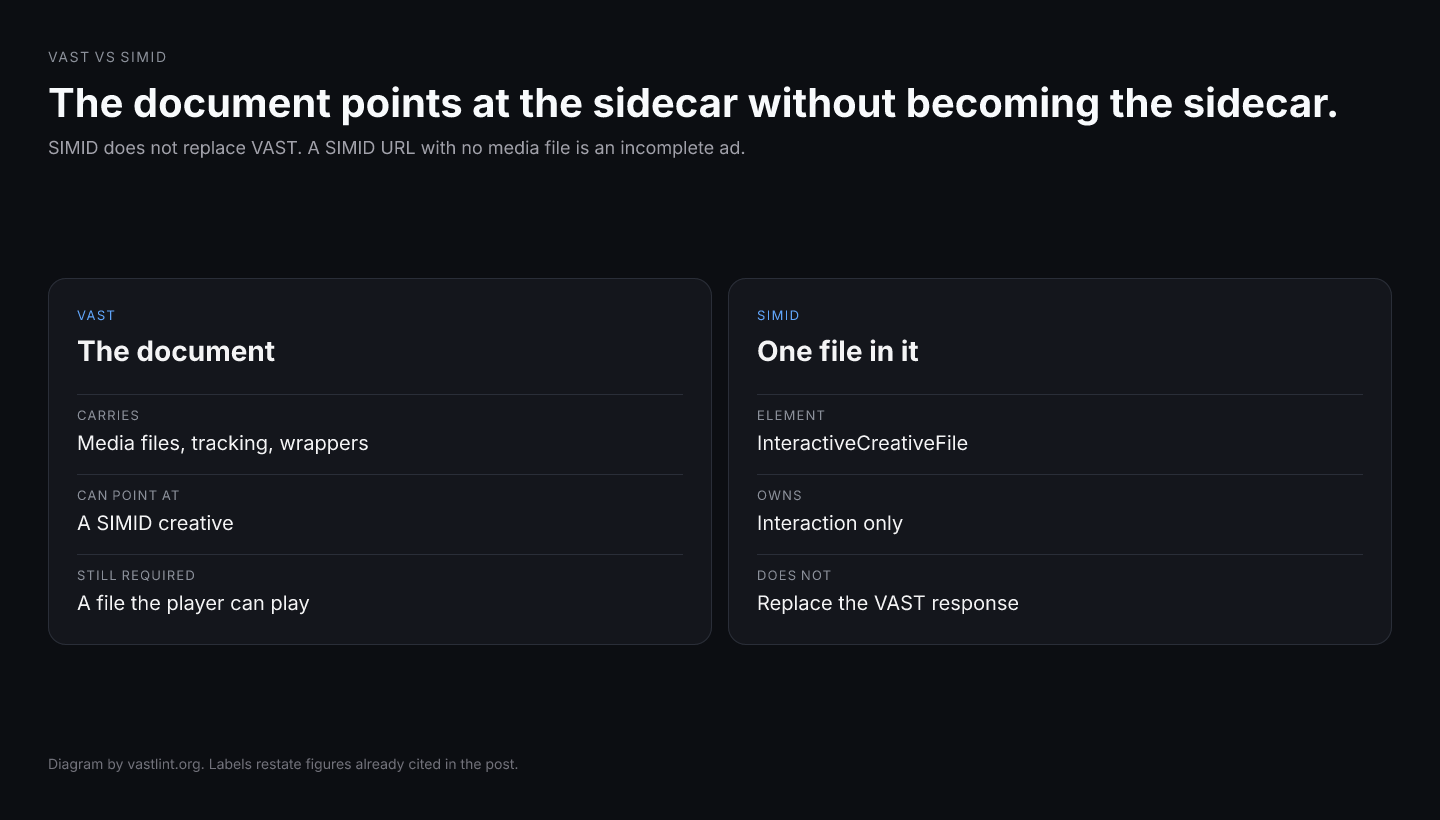
VAST vs SIMID is the same category error as VAST vs VPAID, aimed at the replacement. VAST is the document a player or a stitcher requests: media files, trackers, wrappers, icons, verification. SIMID is one interactive resource that document may name. IAB's SIMID page says the interactive layer and the media asset are both delivered by VAST 4.x, separated so the player keeps the stream. SIMID 1.2, described there as of January 3, 2024, is a protocol between that player and a sandboxed creative. It is not a new ad-serving template.
A campaign cannot switch from VAST to SIMID. It can add SIMID to a VAST inline, or it can leave SIMID out. vastlint validates the VAST document, including whether an InteractiveCreativeFile that says SIMID has a type, a secure URL, and a media file beside it. It does not open a SIMID session, and a session that fails in a particular player's message subset can still belong to a document vastlint accepted.
The incomplete form
The failure that looks like a modern tag is a SIMID URL and no media file. The apiFramework is current. The player that skips unknown interactive files, which stitchers do, has no bytes to insert. That is the VPAID failure mode with the deprecated name removed. IAB's reason for the split was to avoid it. The check is the sibling MediaFile, not the presence of the letters SIMID.
Measurement is a third element, still inside VAST. OMID lives in AdVerifications. It is not part of the SIMID file, and it is not an alternative template either. A comparison that offers VAST, SIMID, and OMID as three choices of format has listed a document, a sidecar, and a measurement API.
Version and player limits stay on their own lines
SIMID is a VAST 4.x interactive creative in IAB's description. Older VAST versions in the wild still carry VPAID instead. vastlint reads 2.0 through 4.4 so a wrapper on an old version and an inline on a new one are both visible. Support for SIMID messages is a player fact. Google's IMA HTML5 guide lists what that SDK implements. A document can be ahead of a player, or a player can be ahead of a sloppy document. Those are different defects.
If the question is which template to traffic, the answer is VAST. If the question is whether this VAST response includes a sound interactive layer, look for the media file first and the SIMID file second.
Read the response in that order
- A VAST root and an inline the player will actually fetch.
- A media file selected without JavaScript.
- SIMID only if the creative has an interaction.
- OMID only if a vendor is measuring, outside the SIMID file.
- No assumption that a valid document has executed the sidecar.
The document can point at the sidecar, and the sidecar does not become the document.
Validate the VAST response the SIMID file sits in
Run VAST 2.0–4.4 tags against specification-derived rules. Nothing is stored. vastlint does not execute VPAID, open a SIMID session, run OMID, or certify an MRAID SDK.
Sources
SIMID page, updated January 3, 2024. SIMID 1.2 separates the interactive layer from the media asset. Both are delivered by VAST 4.x. OMID is named for measurement and SIMID for interactivity, as the replacement for VPAID.
VAST standards hub. VPAID is marked deprecated and replaced with SIMID.
SIMID support is documented on its own page, including which messages the HTML5 SDK implements.
The same container question for the deprecated executable.
When the sidecar should be absent.
Element, sandbox, and examples.
The structural checks.