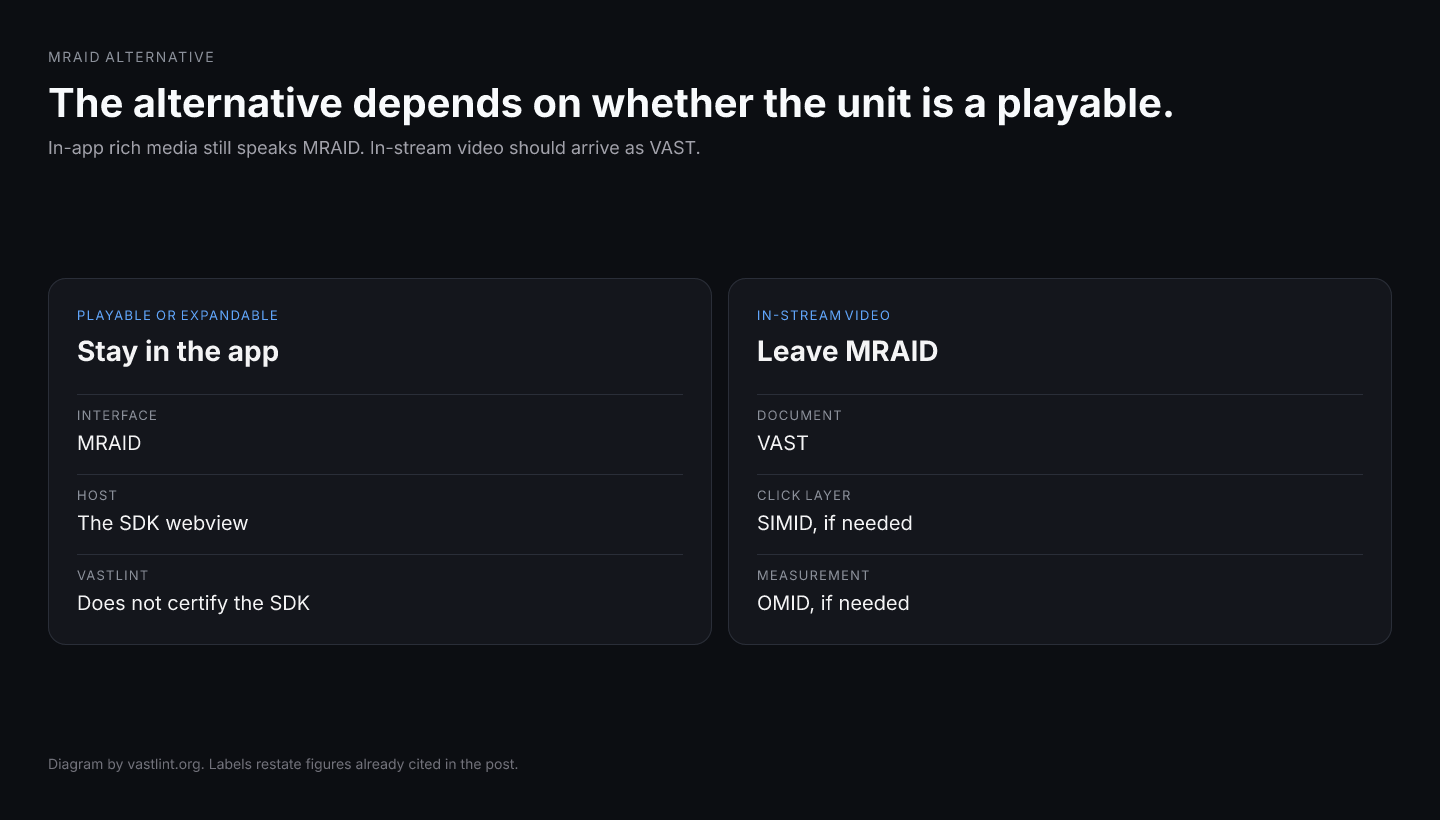
MRAID alternative is an ambiguous search, because MRAID was built so a rich-media creative could run across apps without a new container API per SDK. IAB's MRAID 3.0 note still describes that job: expand, resize, interstitials, viewability and audibility for the creative, a standardized close, and selected VPAID events for in-app video reporting. For an expandable banner or a playable, the alternative to MRAID is often a proprietary SDK call, which is the fragmentation MRAID was written to reduce. vastlint has nothing to certify on that creative. It does not implement the bridge.
The other meaning, and the one this site can actually help with, is a video line that was forced through an in-app HTML unit. In-stream video has a document already: VAST. Interaction on that video is SIMID, beside a media file, not a renamed MRAID creative. Measurement is OMID in AdVerifications. VPAID is the deprecated video executable, not the upgrade path out of MRAID and not the upgrade path into it. vastlint checks that VAST 2.0–4.4 shape. It does not render the playable you decided to keep.
Do not use the borrowed events as a migration map
MRAID 3.0 says selected VPAID events are part of in-app video reporting. That sentence lets a video creative inside the webview emit a familiar quartile. It does not say a VAST player should load MRAID, and it does not say an MRAID container should load VPAID. The hosts stay different. A quartile with a familiar name can still be the creative talking to the SDK, which is a different log from an OMID verification script.
If the SDK vendor offers a private rich-media API as the MRAID alternative, judge it as a container, the way you would judge MRAID: does the placement need expand and a webview, or does it need a media file in a video player? vastlint will not score that private API either.
A practical split for the ticket
Label the unit before you pick a spec. Playable or expandable in-app: MRAID, or the SDK's documented container, and a test harness that actually loads MRAID. In-stream, including in-app video that plays in a player: VAST. Add SIMID only for a real click layer. Add OMID only for a hired verification vendor. Remove VPAID from the default path.
Paste the VAST half into vastlint. Send the MRAID half to whatever preview the SDK expects. One green result does not cover both files. A pass on the VAST document is a VAST check. It is not an MRAID certification.
Answer the search by the unit
- Playable or expandable: MRAID remains the in-app interface to compare other containers against.
- In-stream video: VAST plus a media file.
- A click on that video: SIMID, not MRAID.
- A third-party measurement: OMID, not the creative's viewableChange.
- A VPAID file: legacy, not the bridge between these.
The alternative is a different delivery when the unit is a video ad, and a different container when the unit is a playable.
Validate the VAST half of the campaign
Run VAST 2.0–4.4 tags against specification-derived rules. Nothing is stored. vastlint does not execute VPAID, open a SIMID session, run OMID, or certify an MRAID SDK.
Sources
MRAID is the in-app rich media interface. Version 3.0 adds creative-side viewability and audibility, and selected VPAID events for in-app video reporting.
VAST standards hub. VPAID is marked deprecated and replaced with SIMID.
SIMID page, updated January 3, 2024. SIMID 1.2 separates the interactive layer from the media asset. Both are delivered by VAST 4.x. OMID is named for measurement and SIMID for interactivity, as the replacement for VPAID.
OM SDK page, updated November 4, 2025. Measurement providers collect signals through the OMID API. The current API docs listed there are OMID 1.6.
Why the two files are not backups.
The sidecar versus the webview creative.
What replaces the executable on the video path.