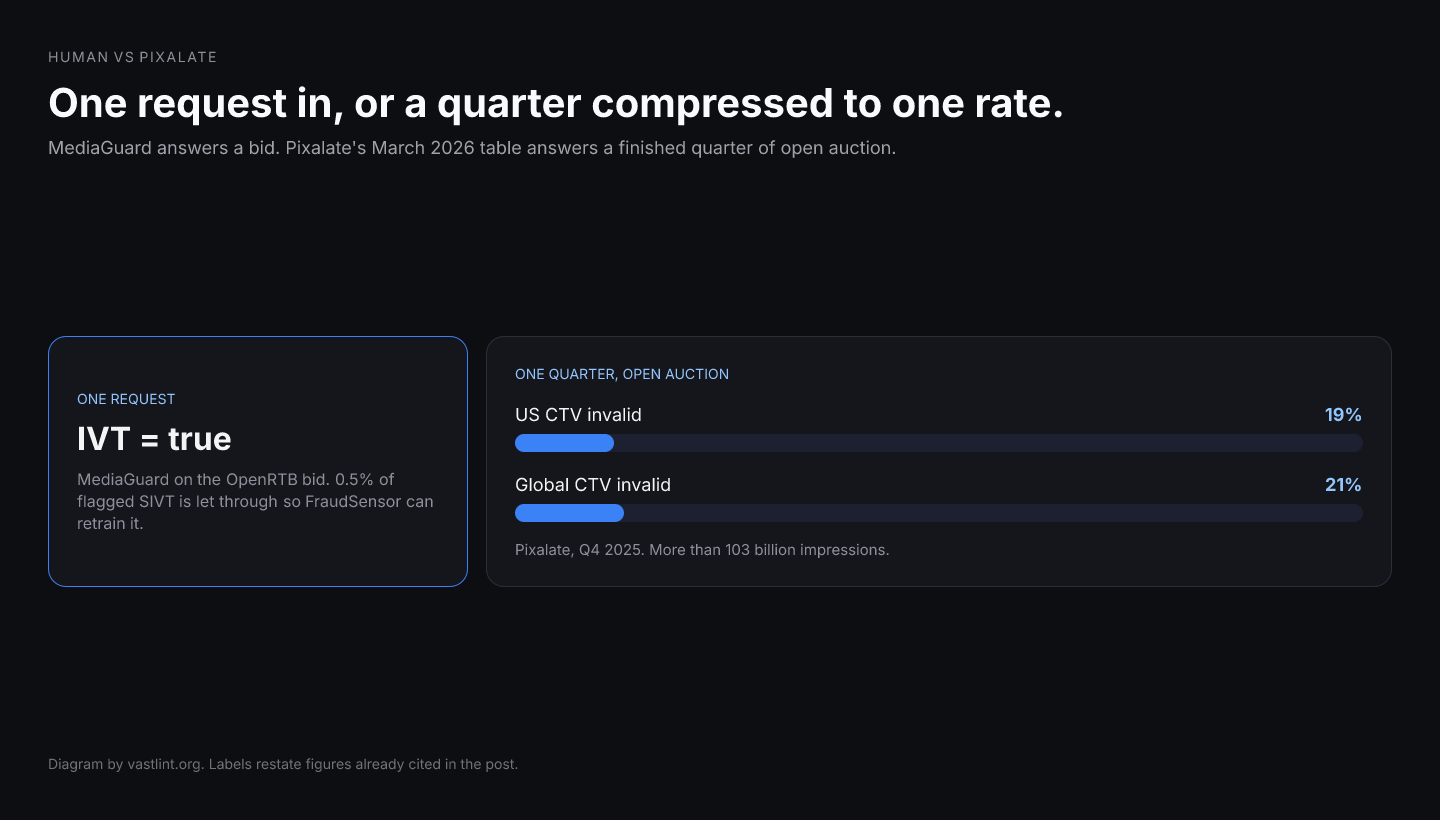
HUMAN vs Pixalate shows up when a buyer wants a fraud vendor and is handed two logos. The documents those logos publish answer different questions. HUMAN's MediaGuard docs describe a real-time prediction on a bid request: send the OpenRTB bid, receive an IVT decision before you bid. Pixalate's March 9, 2026 benchmark says 19 percent of US connected-TV impressions in its Q4 2025 set were invalid traffic, and 21 percent of global CTV, from more than 103 billion programmatic impressions that are predominantly buy-side open auction.
A decision on one request is not a rate for a quarter, and a rate for a quarter is not a decision on the next request. The shortlist becomes a ranking only if someone pretends the 19 percent is HUMAN's block rate, or pretends MediaGuard's flag is a statement about the open-auction census. Neither document says that.
Both companies sell protection against invalid traffic in programmatic, including CTV. Hiring one, the other, or both is a contract. The public numbers do not score the contract. Remove the names and a pre-bid prediction still does not order a quarterly impression share.
What HUMAN publishes about the decision
MediaGuard, in HUMAN's own integration docs, sits between the bid requests a platform receives and the bids it submits. The input is fields from the bid or the full BidRequest. The output is a prediction that the opportunity is or is not invalid, with categories, fast enough that the caller can drop the request. HUMAN describes the model as reputation data, and it says FraudSensor, the post-bid tag, is part of the same integration because post-bid observations retrain the pre-bid model.
The retraining note includes a sampling detail that is easy to misread as a market rate. MediaGuard allows 0.5 percent of traffic it has flagged as sophisticated invalid traffic to pass, so FraudSensor can check the prediction, and 0.05 percent of general invalid traffic for the same loop. That is a deliberate leak in the block, sized by HUMAN, so the post-bid tag still sees some of what the pre-bid model would have stopped. It is not Pixalate's 19 percent, and it is not the share of all bids HUMAN rejects.
Scale claims live in a MediaGuard brochure rather than in that integration note: 20 trillion transactions a week, more than 300 million unique devices a month, and a line that over 85 percent of global programmatic impressions run through MediaGuard. Read those as HUMAN's description of coverage. Coverage is how widely the model is in the path. A firm can see most of the bidstream and still not be publishing the same quarterly IVT table as a firm that benchmarks the impressions it classified.
What Pixalate publishes about the quarter
The March 9, 2026 North America release is a table. US CTV 19 percent, US mobile app 29 percent, US web 25 percent. Canada CTV 16 percent. Global CTV 21 percent, global mobile app 36 percent, global web 23 percent. The base is more than 103 billion global programmatic impressions, predominantly buy-side open auction. The 19 percent is a classification rate on that set, for that quarter, for US CTV.
A March 26, 2026 supply-chain note repeats a 21 percent global CTV invalid share and ties it to open programmatic traffic specifically, on more than 7 billion transactions and $6.9 billion of global open programmatic CTV spend. Device rows in that note run from 14 percent on Amazon Fire TV to 28 percent on Samsung Smart TV. Those rows are still impression shares inside Pixalate's open-programmatic CTV cut. They are not per-bid accept rates from a different company's model.
Pixalate also says it is accredited by the MRC for sophisticated invalid traffic detection and filtration. Accreditation is a statement about a method being audited. It does not convert the 19 percent into HUMAN's IVT flag, and it does not say what fraction of bid requests a pre-bid API would have rejected in the same quarter.
Why the decision and the share stay apart
Time is the first split. MediaGuard is documented to answer before the bid. Pixalate's benchmark is a look back at impressions in a finished quarter. Impressions that were never bought because a pre-bid model said no are absent from a post-bid benchmark. Impressions that were bought and later classified invalid are present. A strict pre-bid model can shrink the post-bid rate without the quarterly benchmark, measured on unfiltered open auction, moving at all.
Grain is the second split. HUMAN's API is one request in, one prediction out. Pixalate's headline is millions of impressions compressed into one percentage. You can aggregate predictions into a rate. HUMAN's docs do not publish that aggregate as a US CTV open-auction IVT percentage for Q4 2025. Pixalate's benchmark does not publish a per-request reason code. The shortlist is borrowing a shape from one firm and a number from the other.
Population is the third. Pixalate names predominantly buy-side open auction. A MediaGuard customer can sit on the supply side, the demand side, or both, and can apply the flag only to some deals. An 85 percent coverage claim, if taken from the brochure, still does not say those impressions are the same 103 billion Pixalate analyzed, or that they were classified with the same rules.
Accreditation does not collapse the split either. Pixalate's release says the firm is MRC-accredited for sophisticated invalid traffic detection and filtration. That is an audit of a method. HUMAN's docs describe a prediction and a post-bid tag that trains it. An audited classification of last quarter's impressions and a live flag on the next bid can both be careful work. Careful work at two different times is still two measurements, and a buyer who picks a vendor because one number was lower has picked a timestamp. If the question is whether to drop this bid, the answer is a flag with a reason code and a threshold the bidder chose. If the question is how invalid open-auction CTV looked last quarter in one firm's log, the answer is 19 percent with the population written beside it. Writing either answer into the other question's blank is how the shortlist manufactures a ranking.
Get VAST spec updates, platform guides, and release notes in your inbox.
What to do with the shortlist
Keep the per-bid decision and the quarterly share in different reports. Use the decision to explain why a request was dropped. Use the quarterly share to explain what a firm saw in open auction after the fact. HUMAN versus Pixalate does not become a single KPI by averaging them.
Ask each firm for the number you actually need. If you need a block rate on your own bidstream, that is a report from the pre-bid integration, with your traffic as the denominator. If you need a market benchmark of open-auction CTV, that is a published table with its population written on it. A brochure coverage statistic answers neither.
After the bid is won, the tag still has to carry measurement. vastlint is independent of HUMAN and of Pixalate. It checks VAST 2.0–4.4 structure, including verification and impression nodes. It does not call a pre-bid API, and it does not reproduce a quarterly IVT table.
Numbers that belong in different columns
- A pre-bid IVT flag on one OpenRTB request.
- A 0.5 percent pass-through of flagged SIVT, used to retrain, not a market rate.
- A coverage claim about how many impressions flow through a model.
- Pixalate Q4 2025 US CTV: 19 percent of a predominantly open-auction set.
- Pixalate device rows: 14 percent on Fire TV and 28 percent on Samsung, same supply-chain cut.
A yes-or-no on the next bid and a percentage of last quarter's open auction are both about invalid traffic, and they are not the same fact.
Validate the tag after the bid is won
Run VAST 2.0–4.4 tags against specification-derived rules so verification and impression events are present and consistent. Nothing is stored.
Open the VAST validatorSources
Pre-bid prediction on the OpenRTB bid, with FraudSensor required alongside it.
Pass-through of 0.5 percent of flagged SIVT and 0.05 percent of GIVT for rescanning.
US CTV at 19 percent and the 103 billion impression base.
The same Pixalate benchmark set beside a protected-campaign rate instead of a pre-bid flag.