IAS vs HUMAN is a shortlist that pairs two companies buyers call when they want invalid traffic kept out of a campaign. The public artifacts are not the same artifact. IAS Threat Lab's Papyrus note, published August 6, 2026, measures a named mobile scheme against other traffic in IAS observation: nearly 25 times the click success rate, roughly 4 times the eCPM, about 13 percent higher attention. HUMAN's MediaGuard documentation describes a different object: a prediction, made from the OpenRTB bid, of whether that opportunity is likely invalid, returned in time to decide whether to bid.
One sentence is about a cluster that has already been found, scored on engagement and price. The other is about a request that has not become an impression yet. A buyer who treats Papyrus's click multiple as HUMAN's block rate, or treats a MediaGuard IVT flag as a statement about attention, has changed the hop and the unit in one move.
Both firms will take a fee to reduce invalid traffic. The research and the integration docs do not say they are reducing the same thing at the same moment. Remove the names and a post-identification cluster study still does not rank a pre-bid decision on a bid request.
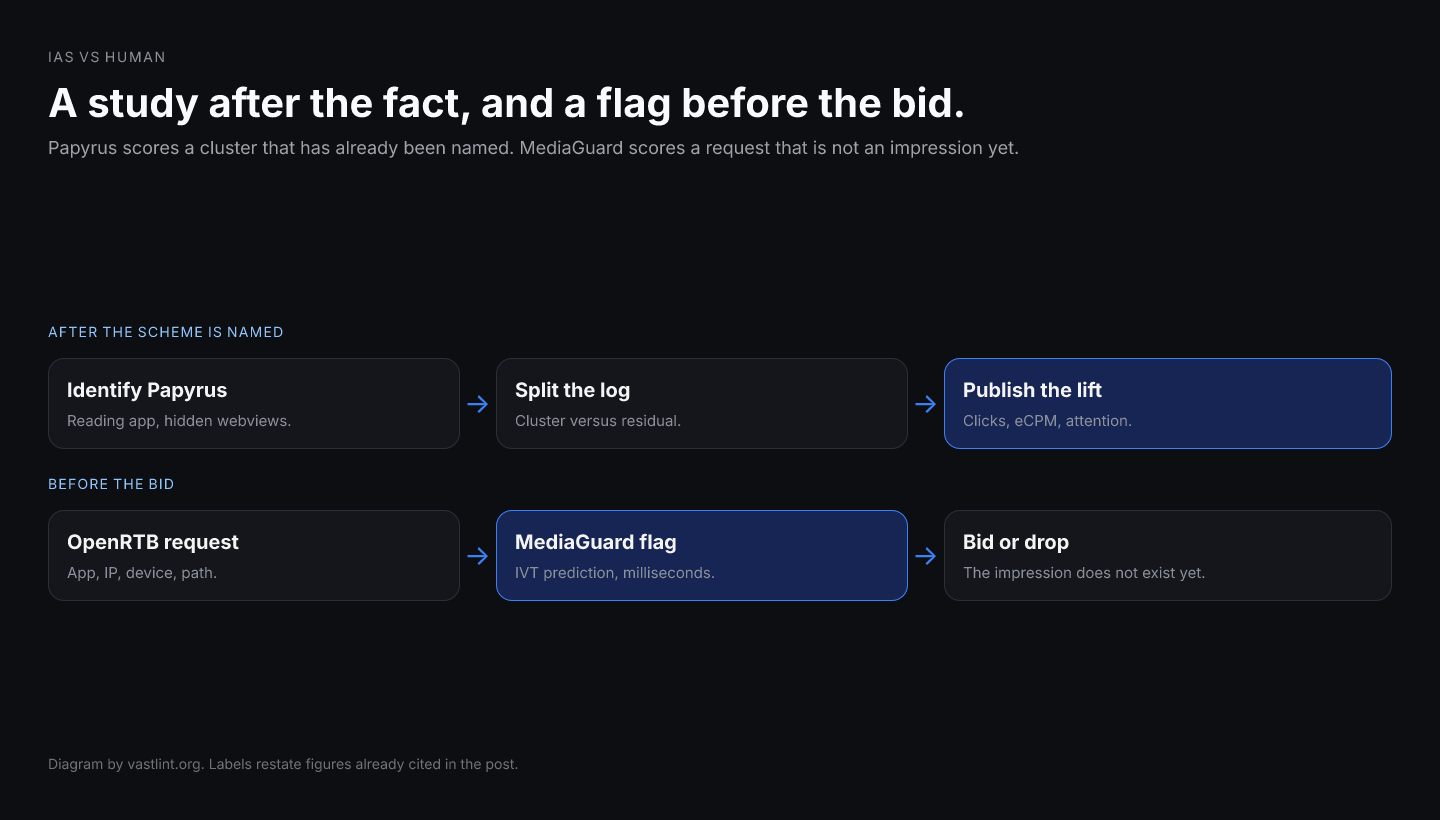
What the IAS figure measures
Papyrus is a mobile operation in novel-reading apps. The user sees the book. Hidden webviews, orchestrated by the layer IAS calls BootNova, load other sites, take taps from the reading interface as clicks, and scroll on instruction from remote configuration. IAS reports more than 800 domains and nearly 8,000 unique host values. The ratios compare Papyrus-associated supply with non-Papyrus traffic after IAS has made that split.
The monetization estimate, close to $1 million a month at the peak, applies an eCPM from Papyrus supply IAS directly observed to a broader impression footprint. IAS says clients using IVT avoidance are filtered against the associated apps, domains, and hostnames. That filter is a list built after the scheme was identified. It is not a prediction attached to an arbitrary OpenRTB bid that has never been tied to this cluster.
The unit is a lift. Clicks, price, and an attention score moved for this named set relative to the residual. A lift on a cluster does not say what fraction of bid requests in a CTV auction HUMAN or IAS would have flagged before the bid. The Papyrus note does not publish that fraction.
What the HUMAN figure measures
HUMAN's MediaGuard docs describe the integration as sitting between bid requests received and bids made. The caller sends fields from the bid, or the OpenRTB BidRequest itself. MediaGuard returns a prediction of whether the opportunity is invalid, including an IVT flag the buyer can use to drop the request. The docs call it a predictive model based on reputation data, and they say the decision is meant to arrive in milliseconds, before the bid.
FraudSensor is the other half, and the docs say it is required alongside MediaGuard. FraudSensor is the post-bid tag. Its observations train the pre-bid model. HUMAN's closing-the-loop note says MediaGuard lets 0.5 percent of traffic it has flagged as sophisticated invalid traffic through, so FraudSensor can rescan it, and lets 0.05 percent of general invalid traffic through for the same reason. Those percentages are a sampling valve on the pre-bid block, not a market IVT rate.
A MediaGuard brochure states a different kind of number: 20 trillion transactions a week, more than 300 million unique devices a month, and a claim that over 85 percent of global programmatic impressions run through MediaGuard. Those are coverage and scale claims in HUMAN's own marketing. They are not a share of impressions classified invalid, and they are not a click multiple on a named scheme. Coverage of the bidstream is how often the model is asked. It is not how often the model says no.
Why a scheme study and a bid decision do not rank each other
The moment differs. Papyrus ratios are computed after the scheme is known and the log is split. MediaGuard's flag is computed before the impression, from what the bid request contains. A scheme that hides in the creative, in a webview behind a reading app, may not be visible in the bid fields MediaGuard is documented to consume. A bid that MediaGuard flags may never become the impression a post-bid study would have scored.
The unit differs. IAS published a ratio of click success, a ratio of eCPM, and a percent difference in an attention score. HUMAN's integration publishes a boolean-style IVT decision and category codes on a request. You cannot average a 25-times click rate with an IVT flag. You can ask both questions about one campaign. They remain two questions.
The training loop is not the study. FraudSensor teaching MediaGuard means post-bid labels update a pre-bid model. That is a product architecture. Papyrus is a published case about one operation's engagement metrics. An architecture that learns from post-bid tags does not, by itself, reproduce a named-scheme ratio, and a named-scheme ratio does not, by itself, say what the pre-bid model would have done on the bids that funded the scheme.
Scale does not close the gap. A brochure claim that most programmatic impressions pass through MediaGuard says the model is widely asked. Papyrus says one cluster, once identified, looked more valuable than the residual on clicks and price. Wide coverage of bids and a deep study of one scheme are both useful to a buyer, and they answer a different meeting. The shortlist is the habit of holding them up as substitutes. A buyer can run both. The pre-bid model can refuse requests that match a reputation already learned, and a Papyrus-style study can explain a cluster that got through because the bid fields looked like ordinary phones. Using one document to answer the other question is how a mobile click multiple becomes a pretend block rate, or a millisecond flag becomes a pretend attention score.
Get VAST spec updates, platform guides, and release notes in your inbox.
What to do with the shortlist
Ask which hop the number came from. A pre-bid flag is a decision not to buy. A post-bid label is a decision about an impression that already served. A named-scheme study is a description of a cluster after someone identified it. IAS versus HUMAN is legible once those three are in different columns.
If the risk you care about is hidden interaction on mobile, Papyrus is evidence that engagement metrics can be driven from a surface the user is not watching. If the risk you care about is bidding on requests that already look invalid, MediaGuard is documented as a check on the request. A campaign can need both, and neither publication substitutes for the other.
The VAST tag is downstream of the bid. A request MediaGuard allowed can still carry a wrapper that drops verification, and a request it blocked never produces a tag to lint. vastlint is independent of IAS and of HUMAN. It checks the tag that remains, for VAST 2.0–4.4 structure. It does not predict IVT on the bid, and it does not reproduce a scheme study.
Hops that the shortlist collapses
- Pre-bid: a prediction on the OpenRTB request, before an impression exists.
- Post-bid tag: a label on a served ad, which HUMAN says also trains the pre-bid model.
- Named scheme: a cluster scored after identification, on clicks, price, and attention.
- Coverage: how many bids a model sees, which is not how many it rejects.
- The tag: whether verification survived the wrapper after the bid was won.
A decision on the bid request and a study of a scheme found later are two moments, and a shortlist that averages them has lost both.
Validate the tag that survives the bid
Run VAST 2.0–4.4 tags against specification-derived rules so verification companions and impression events are present. Nothing is stored.
Open the VAST validatorSources
IAS Threat Lab, August 6, 2026. The cluster ratios and the scope of the scheme.
HUMAN's description of pre-bid prediction on the OpenRTB bid, paired with FraudSensor.
The 0.5 percent SIVT and 0.05 percent GIVT pass-through used to retrain the pre-bid model.
The same Papyrus figures set beside a quarterly impression share instead of a pre-bid decision.