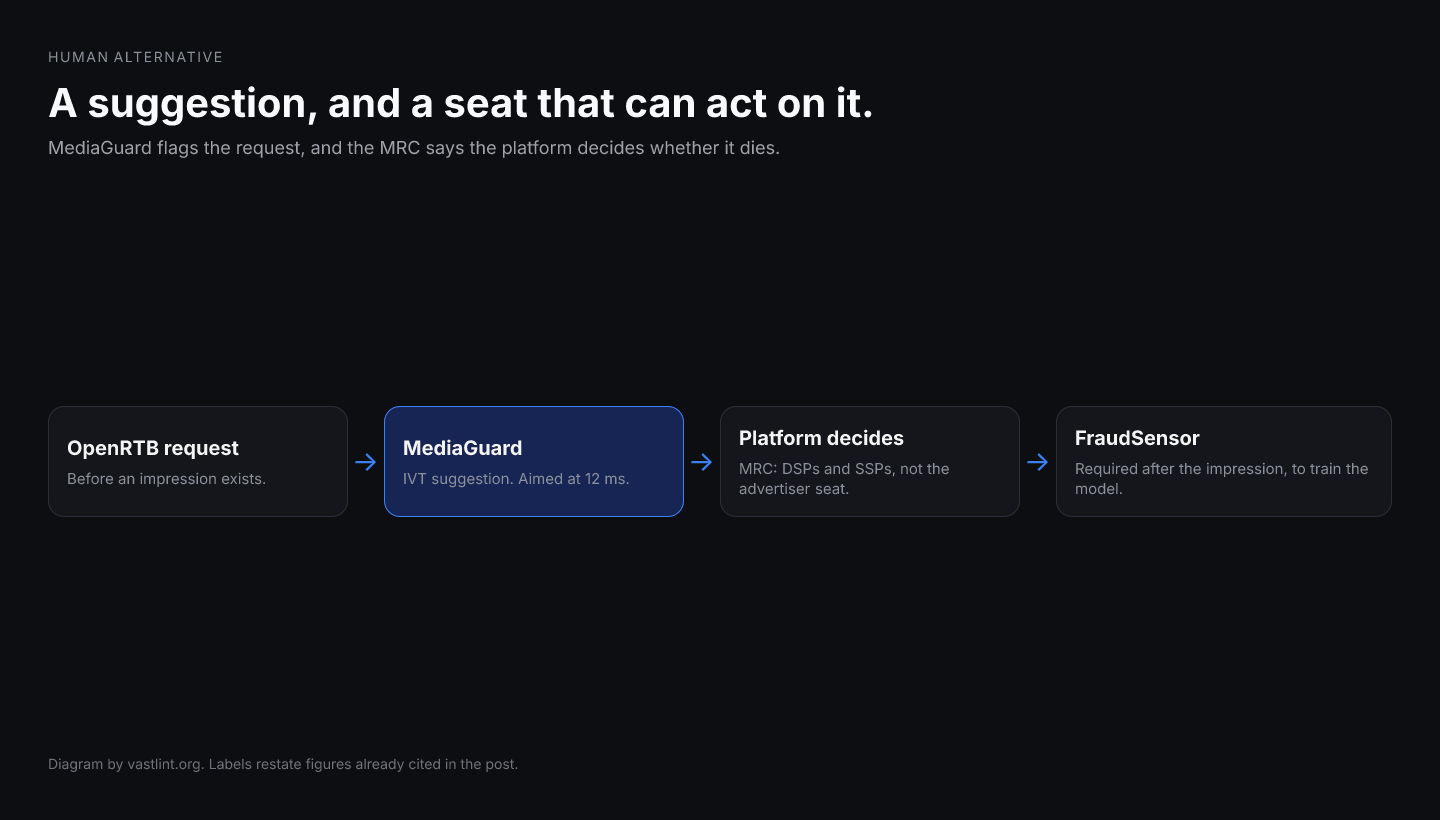
HUMAN alternative, which is also the search for a HUMAN Security alternative and a MediaGuard alternative, wants another way to keep invalid traffic out before the bid. The public object is narrow. MediaGuard, in HUMAN's docs, predicts from the OpenRTB bid whether the opportunity is likely invalid, and it returns that prediction in time to decide whether to bid. FraudSensor, the post-bid tag, is required beside it. The information from the tag trains the pre-bid model, and HUMAN says you must include FraudSensor in the integration.
The MRC's April 11, 2025 memorandum places that prediction in a seat. Suggestions go to DSPs and SSPs, not to advertisers or agencies. HUMAN does not directly filter the request, prevent serving, or enable the block. The platform decides. A replacement that shows up only in an advertiser dashboard has not replaced the integration the memorandum describes, even if the dashboard prints a fraud rate.
vastlint is not a HUMAN alternative. It does not see the bid request and it does not return an IVT flag. It checks the VAST document that exists after a bid is won, for version 2.0–4.4 structure. A request the platform dropped never becomes a tag. A request it allowed can still lose its verification node on the way to the player.
What you would actually be replacing
The integration sits between requests received and bids made. The caller sends selected fields, or the whole BidRequest. MediaGuard returns a prediction and categories. HUMAN's best-practice note says those predictions should not be exposed back to the site or device that sent the request, because the point of the flag is lost if the traffic can test against it. That operational constraint is part of the product. A replacement that writes the decision into a pixel the device can see is a different design.
The pass-through is part of the design too. MediaGuard lets 0.5 percent of traffic flagged as sophisticated invalid traffic through, and 0.05 percent of general invalid traffic, so FraudSensor can rescan and the model can be updated. Those percentages are a valve on the block, not a market IVT rate. An alternative that blocks 100 percent of what it flags has removed the training loop HUMAN documents. That may be what a buyer wants. It is not a like-for-like MediaGuard install.
Scale claims do not specify the alternative. A brochure figure of 20 trillion transactions a week, and of more than 85 percent of programmatic impressions running through MediaGuard, says how widely the model is asked. It does not say how often the answer is no. Coverage is not a block rate, and it is not something another firm inherits by winning the logo.
What can stand in the same hop
DoubleVerify is the name that shares the pre-bid shortlist. The MRC memorandum says DV supplies segments and IVT classifications to DSPs, SSPs, and also to advertisers through DSPs, by API or flat file, and that DV does not itself filter the request. Post-serve blocking exists only where the client configured it. The seat is wider than HUMAN's, on that account, because advertisers are in the distribution. The May 7, 2026 CTV rates, under 1 percent with controls on and nearly 9 percent with them off, are not the segment. They are a later measurement of campaigns. Buying DV to obtain those rates does not, by itself, put a millisecond flag on the next OpenRTB request.
Pixalate's pre-bid product is lists, at user, publisher, and network level, and Pixalate says designations on those lists are opinions rather than guarantees. A list and a per-request model can both run before the bid. They fail differently. A list misses what has not been listed. A request model misses what is not in the fields it is documented to consume. Neither is Pixalate's 19 percent US CTV share, which is a quarterly classification of impressions that were available to classify.
IAS's public pre-buy artifact in the Papyrus note is a list after identification: apps, domains, and hostnames filtered once the scheme has a name. That protects against a cluster someone has already described. It is not a prediction on an arbitrary bid that has never been tied to the cluster. IAS's verification page also describes suitability controls, which are a content decision, not an IVT flag.
HUMAN's own package page uses the word filtration and says bid-request analysis is built to return in 12 milliseconds or less. Hold that next to the MRC sentence. The package describes the signal's speed. The memorandum says the platform is who acts. An alternative should be scored on both: how fast the suggestion is, and whether your seat is one the suggestion is even sold to.
Get VAST spec updates, platform guides, and release notes in your inbox.
What to do with the shortlist
Replace the hop you have. If traders at the advertiser query a segment, HUMAN's distribution, as the MRC describes it, was never that seat, and DoubleVerify's was. If the SSP drops requests from an API before the bid, the replacement has to be an API the SSP will call, with the same rule about not leaking the decision to the device.
Keep FraudSensor's job in the plan. The pre-bid model is documented as dependent on the post-bid tag. Dropping the tag to save a pixel, and keeping only the pre-bid call, removes the loop HUMAN says the prediction is trained on. The VAST verification node is where that post-bid tag has to live if the creative is video.
Do not grade the replacement by Pixalate's 19 percent or by DV's under 1 percent. Those are impression shares on named populations. MediaGuard's public number, where it has one, is a valve and a latency budget and a coverage claim. vastlint will not grade it either. It will tell you whether the tag that survived the bid still has a place for the post-bid check.
What a MediaGuard alternative has to match or deliberately drop
- A prediction on one OpenRTB request, before an impression exists.
- A required post-bid tag, FraudSensor, which HUMAN says trains that prediction.
- A sampling valve: 0.5 percent of flagged sophisticated traffic and 0.05 percent of general invalid traffic let through for a rescan.
- MRC, April 11, 2025: suggestions to DSPs and SSPs, not to advertisers. HUMAN does not itself drop the request.
- DoubleVerify's under-1-percent CTV rate is a protected campaign, not this prediction.
- Pixalate's 19 percent is an open-auction impression share, not this prediction.
The thing being replaced is a suggestion in a platform seat, and a campaign rate from another firm is evidence about a later hop.
Check the tag the post-bid half would have to read
Run VAST 2.0–4.4 tags against specification-derived rules so verification nodes are present for the impression that was allowed to serve. Nothing is stored.
Open the VAST validatorSources
Pre-bid prediction on the OpenRTB bid, and the requirement to include FraudSensor.
The pass-through used to rescan flagged traffic and retrain the model.
Who receives HUMAN's suggestion, and who decides to filter.
The pair this alternative search usually flattens.
The hop split, independent of which logo holds the contract.