Connected TV is no longer an experiment channel. U.S. digital video advertising is projected to reach $81.9 billion in 2026, up 11% year over year, and CTV alone is projected at approximately $29.3 billion. Buyers still want television attention with digital accountability, but the operating question has shifted: not whether CTV can attract spend, but whether delivery, measurement, and creative can run repeatably at that scale.
At IAB Tech Lab's August 2026 Ad Ops Workshop for Advanced TV, supply-chain leaders walked the full path from inventory definition through creative approval, live delivery, and outcome measurement. The through-line was a harder readiness test than most trafficking teams run today. A VAST tag can comply with the specification and still fail in its intended environment. Workshop attendees formalized what that means in practice.
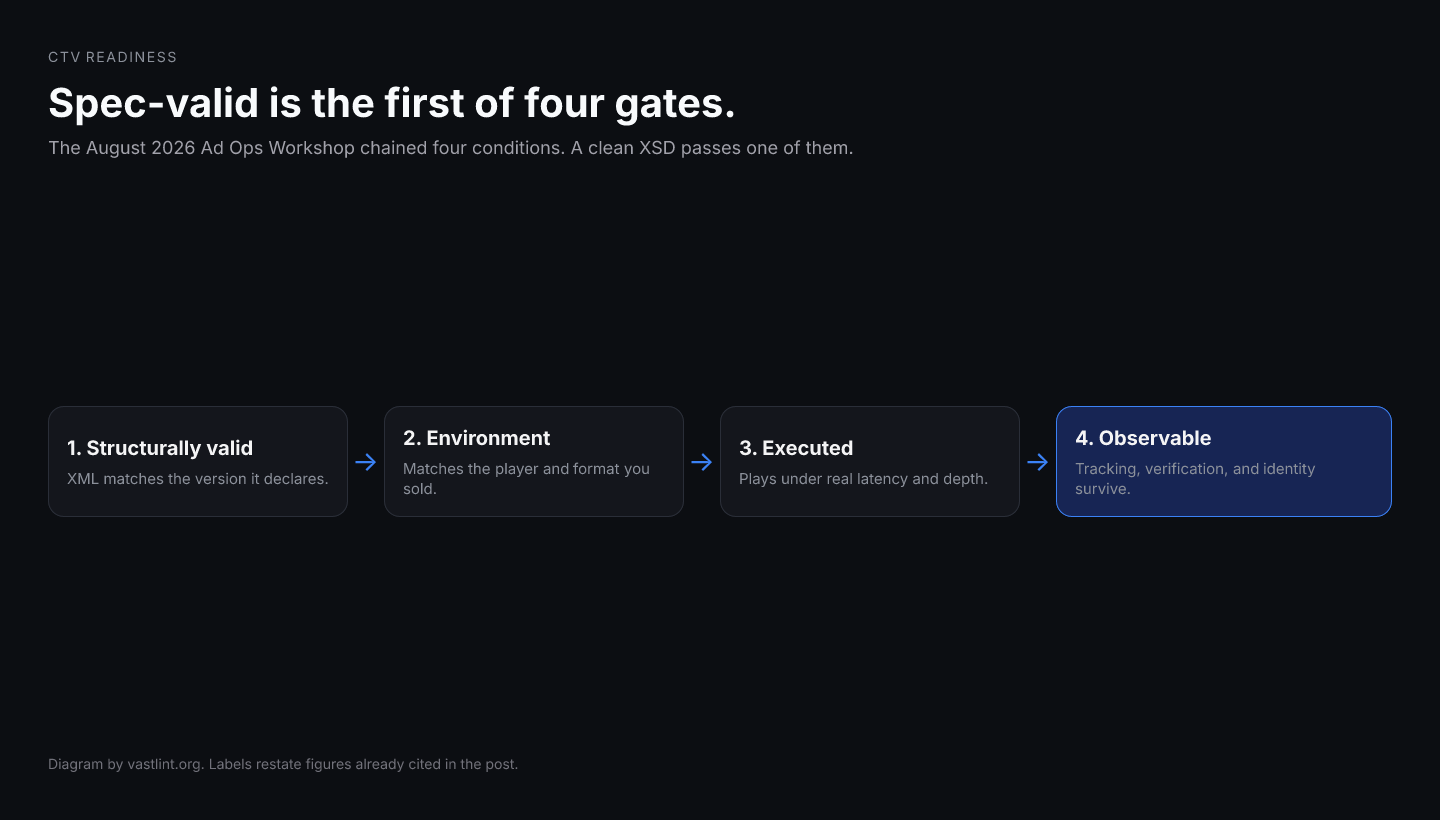
What "ready" actually measures
The workshop did not treat validation as a single XSD pass. For ad ops, readiness is four conditions chained together: structurally valid, environment-compatible, successfully executed, and observable.
Structurally valid is the part most teams already know: XML that matches the declared VAST version, required children present, HTTPS where the spec expects it. Environment-compatible means the creative matches the player, device class, and format path you sold. Pause and overlay inventory in the CTV Ad Portfolio travels on VAST NonLinear Ads tied to OpenRTB video objects; menu and home-screen inventory uses the Native API with video creative embedded as VAST inside the native payload. A tag that parses on a laptop but declares the wrong linearity or omits a NonLinear fallback an unaware player can render fails here even when the schema is clean.
Successfully executed is playback under real latency and wrapper depth, not a curl from a desk. Observable is whether tracking, verification, and identity survive that path so reconciliation and frequency controls work downstream. Validation should begin during creative intake and partner QA, the workshop argued, not after a delivery failure or makegood.
Portfolio formats are moving from pilots to roadmaps
The session opened on finalized CTV Ad Portfolio signaling for Pause, Screensaver, Overlay, Squeezeback, In-Scene, and Menu or Home Screen ads. Many formats already existed as publisher products; the new work makes them recognizable and transactable across buyers, sellers, and platforms.
Audience polling at the workshop was small and directional, not a broad industry benchmark, but the pattern was clear. Of attendees who responded, 58% said their organizations already support at least one portfolio format. Another 33% planned to add support to their roadmap or begin evaluating technical requirements. No respondents expected to monitor adoption without acting.
When asked which format they were most likely to support first, 54% selected Pause Ads, followed by Menu or Home Screen Ads at 15%. That ordering matters for VAST QA because pause inventory now carries duration, MediaFiles, optional SIMID interactivity, and quartile tracking on hardware that has never rendered a portfolio extension. Silent failure is common: an extension a player does not recognize is not a parse error and may not fire an Error ping if no native NonLinear fallback was included.
Creative approval is moving off the bidstream
Standardizing inventory does not help if creative is still awaiting approval when a campaign should start. The Ad Management API offers a non-bidstream path to submit creative to an exchange before it enters the auction, returning structured approval status and actionable rejection reasons instead of a stalled delivery ticket.
When asked what would accelerate adoption, publisher-level approval support led at 27%. More participating counterparties and consistent rejection reasons each received 18%, reinforcing that adoption depends on network participation as much as feature availability.
On validation tooling, 36% of respondents were most likely to add structured VAST checks to creative intake or pre-launch QA. Another 27% selected automated workflow integration, and 27% planned to evaluate before changing their workflow. No one chose to continue with existing tools unchanged. The implied workflow is upstream: catch environment mismatch and broken media before the tag enters a live pod or SSAI stitch.
Live events reorder the sequence
- 93% of buyers in IAB's 2026 spend research consider live content more valuable than other digital video, yet one-third still question whether the premium produces sufficient return.
- Live delivery compresses forecasting, traffic planning, creative preparation, decisioning, and infrastructure scaling into a short window: overtime, audience spikes, or unscheduled breaks create supply without time for manual intervention.
- When asked which Live Event Ad Playbook capability they would implement first, 46% chose structured event and inventory forecasting, 38% selected standardized live-inventory signals, and creative readiness and approval checks followed at 15%.
- The suggested sequence: establish a shared view of what is scheduled, identify live inventory consistently, then coordinate the systems that deliver it. Creative QA comes after the inventory story is trustworthy.
Get VAST spec updates, platform guides, and release notes in your inbox.
Agents need bounded readiness, not a permanent flag
A separate workshop thread on creative readiness for agentic workflows drew a boundary around automation. A creative may be policy-approved but incompatible with a destination. It may be technically valid but not cached for a live event. Readiness therefore needs evidence, scope, authority, version, and expiration, not a single permanent approved bit.
Half of respondents supported allowing an agent to apply technical fixes with human approval. Another 21% would allow approved classes of fixes automatically, and 21% preferred agents to recommend corrections. No one supported allowing an agent to modify creative content within a defined policy. The room was more comfortable automating preparation than creative decision-making.
For VAST teams, that maps cleanly onto linting and structural fixes (HTTPS normalization, missing Duration, wrapper depth) versus changing the creative narrative. Machine-readable policies, bounded permissions, actionable errors, and audit trails expand automation without surrendering control.
Identity and outcomes still wait on coordination
Mature operations also require connecting what ran with what happened afterward. On ECAPI, the Events and Conversion API framework for server-to-server marketing events, 45% of workshop respondents selected access to advertiser event data as the biggest barrier, not technical integration.
On UniversalAdID and the Ad Creative ID Framework, buyer or advertiser demand and better frequency and separation controls each led at 33%, with publisher or marketplace requirements at 17%. Creative identity has to solve visible business problems before trafficking will enforce it in every tag.
Publishing a specification is not the finish line. A standard creates value when it becomes part of real products and workflows, and when partners can rely on one another to interpret it consistently.
A pre-launch checklist aligned to the four gates
- Structurally valid: run spec checks on the declared VAST version, portfolio extensions, and HTTPS across media, tracking, and verification URLs.
- Environment-compatible: confirm NonLinear versus Linear expectations, portfolio format path, and a native NonLinear fallback where extensions may be ignored.
- Successfully executed: resolve the full wrapper chain under CTV latency budgets; validate final MediaFiles and mezzanine on the device classes in the line item.
- Observable: verify AdVerifications, tracking events, and UniversalAdId survive SSAI or wrapper hops so measurement and frequency controls match the buy.
- For live inventory: confirm forecasting and liveness signals are in place before you traffic the creative package.
Run the structural gate at intake
Paste portfolio or live-event VAST at creative intake before it enters trafficking. Fix structural and environment mismatches while rejection is cheap, not after a makegood.
Validate VAST XMLSources
Aug 2026 workshop recap: four-part readiness bar, portfolio adoption polls, Ad Management API, live-event LEAP priorities, agentic readiness boundaries.
$81.9B U.S. digital video and ~$29.3B CTV projections; live content value versus ROI skepticism cited in the workshop post.
NonLinear VAST versus Native-with-embedded-VAST delivery paths for the six portfolio formats.