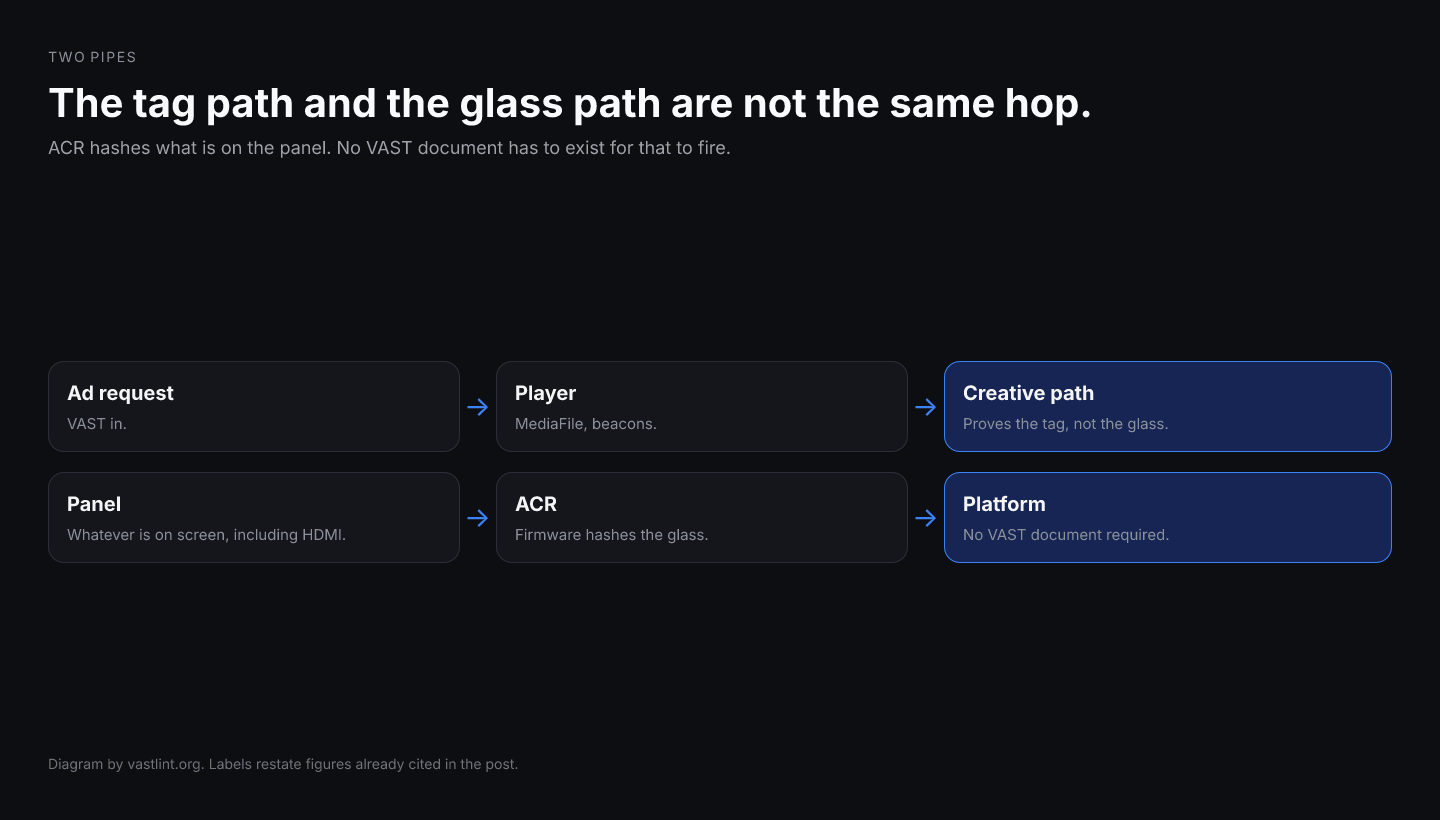
Connected TV QA is built around the tag. Resolve the wrappers, confirm a MediaFile, watch impression and quartile beacons. That workflow measures the creative path. It does not measure the operating system. Automatic content recognition sits in the TV firmware, hashes what is on the panel, and sends that fingerprint to a platform endpoint. No VAST document has to exist for that hop to fire.
An IMC 2024 living-room audit ran that check on Samsung and LG sets in the UK and the US, two platforms the authors cite at about 23 percent and 18 percent market share. They compared linear antenna TV, the manufacturer's FAST app, third-party OTT apps, HDMI from a laptop or console, screen casting, and an idle homepage. The result that matters to anyone shipping video ads is not a fraud score. It is that the loudest ACR traffic was linear TV and HDMI, including when the set was a dumb external display.
What the metric actually measures
The audit is black-box network traffic between the TV and known ACR domains. It does not decrypt payloads. It does not prove which programme was identified. It does prove when the ACR client was talking. Highest volume was linear and HDMI. Other scenarios were much quieter; peaks dropped by up to 12 times, which the authors read as the client often not sending fingerprints. Third-party OTT apps such as Netflix and YouTube did not produce the ACR traffic that linear and HDMI did.
LG's documentation says the client captures frames every 10 milliseconds. Observed network traffic was about every 15 seconds, which they treat as batching. Samsung talked to several of its own ACR hosts; LG talked to a single Alphonso domain that rotates a numeric label. UK hosts used EU in the name. US hosts used US, and those IPs geolocated in the United States.
This is second-party measurement by the platform, not a tracker inside the creative. It is also not the hidden-webview IVT pattern, where a concealed browser forges attention metrics. ACR is the TV looking at its own framebuffer. A valid VAST impression and an ACR match can describe different objects: the ad that played, versus whatever was on the glass, including a game or a laptop window.
Linear TV and HDMI produced the most ACR traffic. A clean VAST tag never sees that hop.
HDMI, FAST, and the two countries
HDMI is the case buyers forget. A console or a laptop on the HDMI input still generated ACR in the audit. The user is not in a publisher app. There is no SSAI stitcher and no VAST wrapper. The panel is still a Samsung or LG, and the firmware still samples the screen. If your brand-safety or incremental-reach story assumes measurement only happens when an ad tag plays, HDMI passthrough is outside that story and still inside the platform's graph.
FAST is not one behavior. In the UK, manufacturer FAST apps (Samsung TV+, LG Channels) sat with the quieter scenarios. In the US, those same apps produced ACR traffic comparable to linear. The paper's working explanation is different content agreements, not a different TV. Login status did not matter in either country: logged-in and logged-out traces looked the same. Turning off viewing information services stopped all traffic to the ACR domains they had identified. No new ACR hosts appeared after that opt-out.
HbbTV overlays on broadcast are a cousin, not this mechanism. They are still not a VAST tag. Do not fold them into ACR, and do not fold ACR into a pixel-fraud post.
Get VAST spec updates, platform guides, and release notes in your inbox.
Two pipes, one living room
The creative pipe is VAST, VMAP, SSAI, OMID, impression and quartile URLs. vastlint reads that pipe. The platform pipe is ACR: framebuffer, fingerprint, vendor endpoint, audience segment on the TV OS ad system. Buyers who reconcile complete rates against Samsung or LG ACR audiences as if they were the same impression will argue with both vendors and still be looking at two clocks.
Pod and stitch failures hide in the creative pipe. HDMI and linear ACR hide in the platform pipe. A tag that 403s on Fire TV never reaches a quartile; ACR can still have hashed the programme that ran in that hour. A tag that plays cleanly on a phone app in the same open CTV line item never touches the Samsung ACR client in the living room. Open programmatic CTV already splits spend across TV OS and mobile. ACR is an extra split on the TV OS half: tagged playback versus screen hashing.
What to do
- Treat platform ACR as a measurement surface with its own opt-out, geography, and input path. Do not file it under VAST QA.
- When the buy includes Samsung or LG large screens, assume HDMI and linear can be hashed even if your tag never loaded.
- Do not copy a UK FAST assumption onto a US FAST line item. The audit saw ACR on US manufacturer FAST at linear-like volume.
- Account login is not the ACR switch in this audit. Viewing information services off was.
- Split reporting: tag-based completes versus platform ACR audiences. If they move together, that is a coincidence until proven.
- Still validate the trafficked VAST. A broken MediaFile is a different loss. The linter catching it does not census ACR.
The tag still has to play
Paste production tags into the validator before they hit the stitcher or the exchange. vastlint checks structural consistency, MediaFile and mezzanine presence, HTTPS, wrapper depth, and spec-derived rules from VAST 2.0 through 4.4. It does not detect ACR, fraud, bots, or whether a TV hashed the programme. Independent of Samsung, LG, and of the IMC paper. A green tag means the creative document is consistent. It does not mean the living room was unmeasured.
Validate the creative pipe
Run VAST tags through specification-derived rules so MediaFile, tracker, and wrapper consistency are visible. ACR on HDMI is a different hop; it will not appear in this paste.
Open the VAST validatorSources
Anselmi, Vekaria, D'Souza, Callejo, Mandalari, Shafiq. IMC 2024. Black-box ACR traffic on Samsung and LG in the UK and US: linear and HDMI peaks, 12 times quieter other scenarios, 10 ms capture versus 15 s batching on LG, opt-out stops ACR domains, login does not, US FAST unlike UK.
Published proceedings version of the same measurement.
Authors' reproduction package for the ACR traffic experiments.